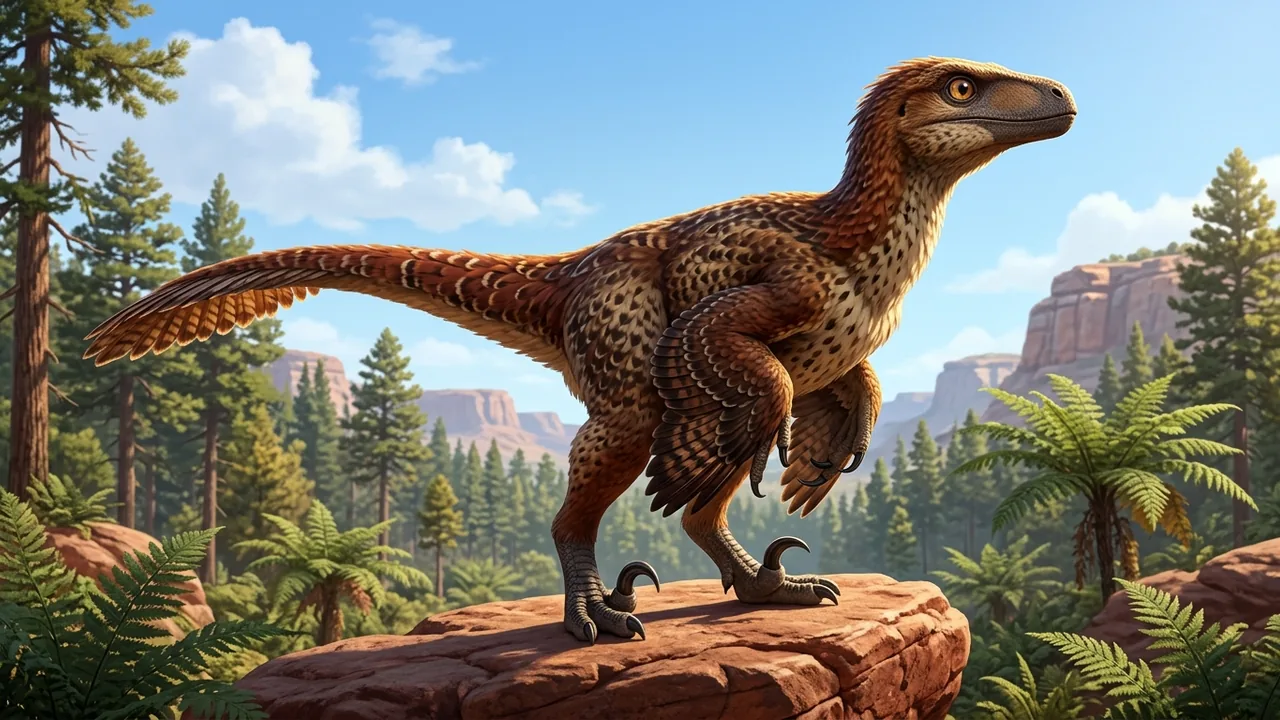
Meet the Legend: Apex Giant of Dromaeosauridae
Within Paraves—the feathered maniraptoran clade uniting birds, troodontids, and dromaeosaurids—most non-avian predators retained modest body masses between one and forty kilograms. In Early Cretaceous western North America, however, the dromaeosaurine lineage underwent dramatic gigantism, culminating in Utahraptor ostrommaysi: the largest and most heavily muscled known to science.
Measuring 6 to 7 meters (20 to 23 feet) in length and weighing roughly 450 to 500 kilograms (1,000 to 1,100 pounds), a mature Utahraptor equaled an adult male polar bear in body mass—outweighing Late Cretaceous Velociraptor mongoliensis nearly thirtyfold! Formally named in 1993 by James Kirkland, Robert Gaston, and Donald Burge, its species epithet honors Yale paleontologist John Ostrom and museum patron Chris Mays.
Comparative osteology across juvenile and adult skeletons reveals a strikingly stocky, robust bauplan distinct from gracile Asian relatives. Deep premaxillae, robust cervical vertebrae, broad scapulocoracoids, and thick-walled hindlimb elements turned this giant raptor into an athletic heavyweight.
Phylogenetic bracketing across feathered paravians—from Microraptor and Zhenyuanlong to quill-knobbed Velociraptor—confirms Utahraptor wore extensive pennaceous plumage, including broad forelimb wings (remiges) and a stiffened rectricial tail fan.
Combining half-ton muscularity with keen binocular vision and avian-grade balance, Utahraptor reigned as North America's premier Early Cretaceous predator long before giant tyrannosaurids existed.
Recovered from lower Cedar Mountain and dated by crystal analysis, its skeleton demonstrates that dromaeosaurids achieved apex-predator body mass right near the dawn of the Cretaceous Period, reshaping how scientists understand paravian evolution across northern continents during the sixty-million-year span before Tyrannosaurus rex appeared.
Lost World Habitat: Cedar Mountain Stratigraphy
Utahraptor fossils derive exclusively from the Yellow Cat Member at the base of eastern Utah's famed Cedar Mountain Formation, exposed across colorful badlands north of Moab and Arches National Park. Detailed of these mottled purple-and-green calcic paleosols, lacustrine limestones, and fluvial channel sandstones reconstructs a seasonally semi-arid continental basin bordered to the west by the rising Sevier Orogenic Belt.
For decades, biostratigraphers estimated the Yellow Cat Member at roughly 125 million years old (Barremian). High-precision uranium-lead (U-Pb) dating of detrital and volcanic-ash zircon crystals recently pushed that age back to approximately 135 to 132 million years ago (Valanginian–Hauterivian)—filling a crucial Early Cretaceous fossil gap following the Late Jurassic Morrison extinctions!
Gallery forests of conifers, cycadophytes, ginkgoes, and tree ferns lined perennial rivers and spring-fed wetlands across this basin, supporting a vibrant vertebrate community.
Brachiosaurid and titanosauriform sauropods (Cedarosaurus, Mierasaurus) browsed upper canopies, basal iguanodontians (Hippodraco, Iguanacolossus) cropped mid-story shrubs, and polacanthine ankylosaurs (Gastonia burgei) grazed floodplain ferns alongside small coelurosaurs, goniopholidid crocodyliforms, and early mammals.
Across this mosaic of dry caliche uplands and lush riparian corridors, vegetated stream margins offered prime ambush cover for a half-ton .
Because epicontinental seaways had not yet split North America into isolated western and eastern landmasses, Early Cretaceous dinosaur faunas dispersed broadly across floodplains stretching from Utah toward Atlantic coastal basins—leaving correlated fossil clues across an entire continent while warm greenhouse climates sustained year-round conifer productivity along fertile mountain-fed drainage basins throughout early Mesozoic North America.
What's on the Prehistoric Menu? Heavyweight Ambush
Occupying the apex predatory guild of the lower Yellow Cat paleoecosystem, Utahraptor targeted medium-to-large herbivorous dinosaurs—especially subadult sauropods and multi-hundred-kilogram iguanodontians like Hippodraco and Iguanacolossus. Tackling quarry equal to or exceeding its own half-ton mass selected for profound biomechanical departures from cursorial pursuit raptors.
Whereas small dromaeosaurids feature elongate metatarsals and slender tibiae tuned for high-velocity sprints, Utahraptor evolved stout, thick-shafted femora, robust tibiae, and shortened, powerfully braced tarsometatarsal levers. Cross-sectional bone mechanics demonstrate high resistance to bending and torsional loads, prioritizing explosive short-range acceleration and immense grappling force over marathon top speed.
Under the 'raptor prey restraint' (RPR) biomechanical model developed from comparative paravian-accipitrid anatomy, Utahraptor launched surprise ambushes from riparian cover, pinning quarry beneath its 500-kilogram mass while driving recurved pedal unguals deep for unyielding purchase.
Simultaneously, rhythmic flapping of its feathered forelimbs and adjustments of its stiffened tail fan maintained center-of-mass equilibrium atop struggling herbivores.
Unlike slender-snouted Velociraptor, Utahraptor also possessed a tall, laterally deep maxilla and premaxilla armed with ziphodont serrated teeth—allowing powerful cranial slicing bites once forelimbs and talons secured control.
Forensic of bite-scored herbivore bones within Yellow Cat confirms that Utahraptor focused on muscular, unarmored iguanodontians while avoiding heavily fortified shields whenever safer prey remained available. By combining broad-shouldered forelimb reach, high ankle leverage, and coordinated wing-and-tail stabilization, this half-ton predator turned streamside thickets into precision Early Cretaceous hunting grounds where sudden burst power and athletic balance outperformed long-distance pursuit across open plains.
Superpowers & Anatomy: Pedal Claws & Caudal Rods
The defining anatomical hallmark of every reached breathtaking scale on Utahraptor's second pedal digit: a strongly recurved, laterally compressed bony ungual core that stretched roughly 24 centimeters (9.5 inches) along its outer keratinous sheath! Ginglymoid (pulley-grooved) phalangeal joints allowed Digit II to hyper-extend dorsally clear of abrasive substrates while Digits III and IV bore locomotory weight.
Digital stress modeling of paravian sickle claws indicates their oval-to-teardrop cross-sections resisted vertical pulling and puncturing loads far better than long slashing cuts. Powered by short, high-leverage metatarsal tendons and massive caudofemoralis leg retractors, those twin 24-centimeter talons functioned like oversized eagle crampons that locked securely into thick hides.
Equally specialized was its axial and sensory integration. Elongated prezygapophyseal and chevron rods encased the distal tail vertebrae in a semi-rigid bundle that pivoted purely at the tail base, acting as a dynamic inertial stabilizer during tight turns and aerial pounces.
Meanwhile, large orbits angled forward for stereoscopic depth perception, paired with an expanded cerebellar flocculus inferred from paravian braincases that coordinated rapid eye, neck, and wing reflexes.
Three long manual digits bearing deeply grooved, hook-like claws completed an integrated grasping apparatus unmatched among Early Cretaceous coelurosaurs.
Unlike armored neighbors encased in heavy dermal plates, Utahraptor kept its integument light and aerodynamic—relying on dense pennaceous plumage for display, thermal regulation, and rapid mid-leap stabilization across broken canyon terrain—demonstrating that feathers remained vital biomechanical tools even in half-ton terrestrial hunters navigating uneven sandstone and floodplain trails.
Flight vs. Fight Arena: Coevolution with Gastonia
Nowhere are evolutionary Flight-versus-Fight arms races clearer than in the shared Yellow Cat quarries where Utahraptor teeth lie mingled directly beside the armor of Gastonia burgei! While sympatric iguanodontians relied on herd vigilance, thumb spikes, and rapid bipedal flight to evade ambushes, five-meter, one-ton polacanthid ankylosaur Gastonia committed completely to passive-active Team Fight fortification.
Virtually every dorsal exposure of Gastonia carried dense dermal armor: interlocking cervical half-rings shielded its neck, paired rows of tall, grooved dorsolateral shoulder spikes discouraged flank leaps, and a continuous fused pelvic shield of co-ossified osteoderm rosettes armored its hips!
Even its low-slung tail carried horizontally projecting, sharp-edged triangular osteoderm plates capable of scissoring against tendons or ankles if swung sideways across floodplain mud.
For an obligate bipedal predator like Utahraptor—whose hunting livelihood depended completely on uninjured hindlimbs and intact pedal talons—attacking a braced, ground-hugging adult Gastonia carried severe biomechanical peril.
Consequently, coevolution produced a balanced ecological standoff: formidable osteoderm shields protected adult Gastonia on Team Fight, nudging intelligent, keen-eyed Utahraptor packs to target less armored herbivores or isolated juveniles caught away from herd protection.
Few fossil pairings anywhere in Mesozoic illustrate antagonistic coevolution better than this giant hunter and its heavily spiked ankylosaurian neighbor sharing Early Cretaceous Utah. Over millions of years, natural selection honed stealth, intelligence, and high-leverage talons on one side while thickening dermal bone plates and defensive spikes on the other until predator stealth and herbivore armor stood in dynamic ecological balance.
Fossil Detective Secrets: Taphonomy of the Megablock
When Kirkland, Gaston, and Burge unveiled Utahraptor in June 1993 from fragments excavated near Dalton Wells and Gaston Quarry, paleontologists marveled at its giant claw yet lacked articulated skeletons to map its exact proportions. That gap closed spectacularly after geology student Matt Stikes discovered concentrated bone weathering out of a cliff at Stikes Quarry on Utah's Doelling's Bowl mesa in 2001.
Recognizing an extraordinary fossil concentration, Jim Kirkland's Utah Geological Survey team engineered steel-reinforced plaster jackets and custom sleds to haul a single nine-ton sandstone megablock intact to museum laboratories. Over thousands of hours of microscopic preparation led by Scott Madsen, forensic revealed how this remarkable concentration formed!
Rather than a normal river sandbar, the host rock was a fluidized sandstone diapir—an ancient upwelling spring of water-saturated quicksand set inside Yellow Cat and dated via zircons to ~135 million years ago. Herbivorous iguanodonts became mired in the deceptive ooze first, broadcasting distress cues across the floodplain.
Drawn toward seemingly easy quarry, at least one large adult Utahraptor, multiple subadults, and tiny one-meter juveniles stepped onto the unstable crust and sank together!
Preserving fragile skulls, articulated necks, and a complete ontogenetic growth series within a single taphonomic snapshot, the Utahraptor Megablock offers compelling evidence that Earth's largest feathered raptors gathered—and perhaps hunted—as cooperative social groups.
As micro-CT imaging and fine preparation of the Stikes Quarry fossils advance through the 2020s, every newly exposed bone adds crisp anatomical detail to North America's polar-bear-sized super-raptor.