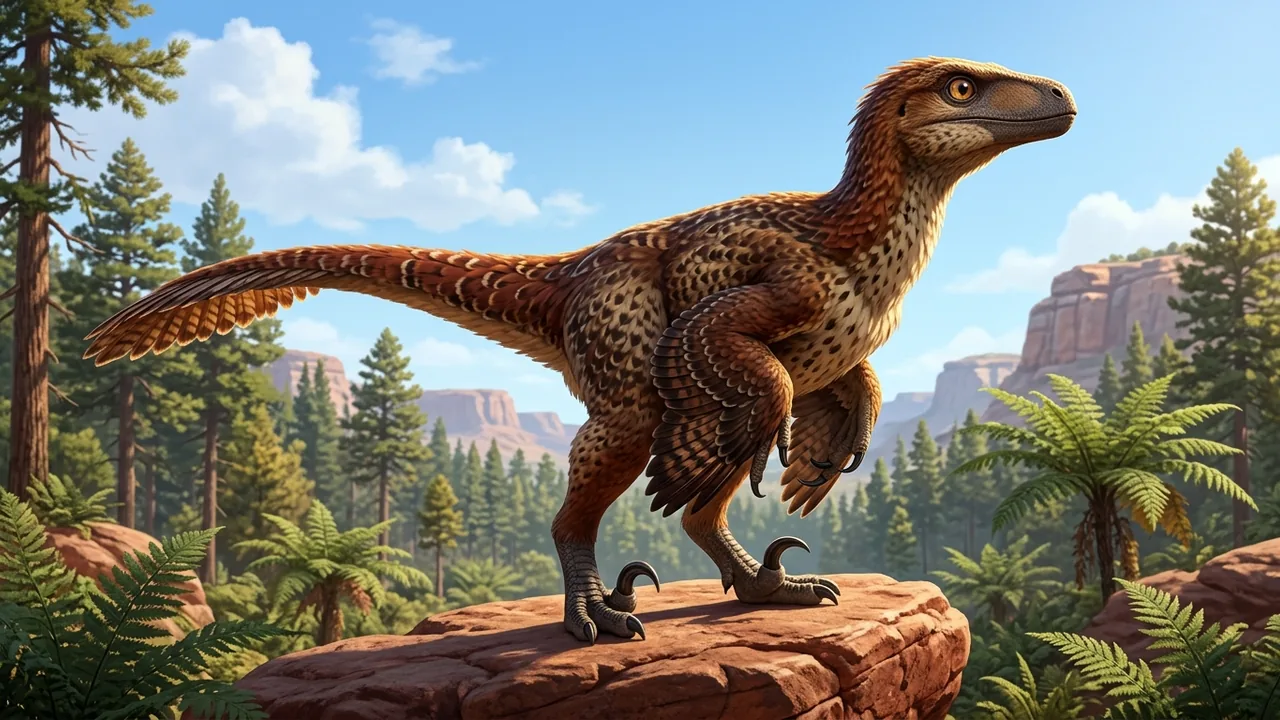
Meet the Legend: Heavyweight of the Dromaeosaurs
Most members of the feathered family were lightweight, agile hunters weighing between five and eighty pounds. Then 135 million years ago in Early Cretaceous North America, evolution scaled the raptor blueprint up to colossal proportions—creating Utahraptor ostrommaysi!
Stretching 20 to 23 feet (6 to 7 meters) from snout to tail fan and tipping the scales at roughly 1,000 to 1,100 pounds, an adult Utahraptor matched a big male polar bear or grizzly bear in mass. Even more surprising than its length was its brawny, broad-chested build.
Where Asian cousin Velociraptor had a slender snout and delicate limbs, Utahraptor possessed a deep, boxy skull, thick neck muscles, and powerhouse hind legs wrapped in dense hawk-like plumage.
Long pennaceous wing feathers lined its muscular forearms while a stiffened tail fan balanced every stride—uniting avian grace with half-ton athletic power.
Studying its robust limb reveals a specialized big-game hunter built not like a fragile sprinter, but like a feathered grizzly bear engineered to rule Early Cretaceous floodplains with unmatched strength, balance, and keen hawk-like senses across western North America's sunlit conifer river valleys.
Lost World Habitat: Energy Across Utah's Floodplains
During the Early Cretaceous Period, western North America looked vastly different from Utah's modern red-rock canyonlands. Rising mountain chains to the west shed winding rivers across broad, seasonal floodplains dotted with shallow lakes, gallery conifer forests, tree ferns, horsetails, and tough cycad groves.
In this sun-warmed basin, solar energy flowed upward through a rich multi-tiered web. Conifers, seed ferns, and early flowering shrubs served as primary producers, supporting abundant primary consumers ranging from freshwater turtles and lungfish to multi-ton herbivores.
Thumb-spiked iguanodonts such as Hippodraco and Iguanacolossus browsed mid-level branches, long-necked brachiosaurid sauropods like Cedarosaurus harvested high conifer crowns, and heavily armored Gastonia cropped low ferns.
At the top of that trophic pyramid stood Utahraptor! Operating sixty million years before giant bone-crushing tyrannosaurs evolved in North America, this giant filled the ecosystem's apex predator niche across wooded river corridors.
Seasonal floods periodically swept rich silt across valley floors, fertilizing fresh plant growth while concentrating thirsty herbivore herds around shady watering holes where patient ambush hunters waited silently behind dense groves of evergreens and tree ferns until large grazers stepped into open clearings.
What's on the Prehistoric Menu? Grappler Physics
How did a thousand-pound predator capture herbivores weighing as much as a small car? Limb hold the answer! When paleontologists measured cross-sections of Utahraptor thigh and shin bones, they noticed its lower legs were shorter and much thicker than those of marathon-running ostrich dinosaurs.
In physics, shorter, thicker limb levers trade extreme top-end sprint speed for tremendous muscular and impact strength! Rather than chasing prey for miles across open plains, Utahraptor excelled at explosive 25-mile-per-hour ambush bursts from streamside conifer cover.
Once within leaping range, Utahraptor used a strategy paleobiologists call 'raptor prey restraint'—the exact technique modern hawks and eagles use today! Driving its full half-ton body weight onto quarry, it anchored deep grip with its enlarged foot claws and three-fingered grasping hands while beating feathered wings for stability.
Deep, robust jaws lined with ziphodont—blade-like and finely —teeth then delivered powerful slicing bites, transferring vital energy up the Early Cretaceous food web.
Even its front premaxillary snout teeth carried crisp serrated edges, giving Utahraptor extra gripping strength whenever multi-hundred-pound herbivores twisted to break free along slippery floodplain trails.
Superpowers & Anatomy: Sickle Talons & Tail Rudders
Utahraptor's most famous anatomical weapon was the oversized, strongly curved claw on the second toe of each foot. Measuring 9.5 inches (24 centimeters) along its outer keratin curve, this laterally flattened talon rotated through a wide vertical arc thanks to specialized pulley-like ankle and toe joints.
While cruising across gritty floodplain trails on its sturdy third and fourth toes, Utahraptor held Digit II hyper-extended upward so the sharp tip never scraped dull against sandstone gravel. When muscles contracted during a leap, high ankle drove that curved point downward like a climbing crampon for unshakable grip!
Equally impressive was this giant 's aerial balance system. Bundles of stiffened bony tendons wrapped tightly around its tail vertebrae, turning the tail into a dynamic counterbalance rod fringed with steering feathers.
Combined with forward-angled eyes for sharp 3D depth perception and enlarged inner-ear balance loops, Utahraptor maneuvered half a ton of muscle through forest clearings with startling athletic precision.
Every joint from flexible wrists to hinged ankles worked as a coordinated biomechanical system, blending hawk-like balance with heavyweight grappling strength across sunlit Utah river valleys.
Flight vs. Fight Arena: Ambush Power vs. Spiky Shield!
Sharing the Cedar Mountain floodplain meant Utahraptor regularly encountered one of prehistory's prickliest neighbors: Gastonia burgei! Weighing roughly one ton and stretching sixteen feet long, this low-slung ankylosaur evolved side by side with Utahraptor—turning their meetings into a classic Flight-versus-Fight showdown.
Swift iguanodonts relied on keen eyesight and long strides to bolt away on Team Flight before an ambush closed in. Short-legged Gastonia, by contrast, invested every ounce of evolutionary energy into Team Fight armor!
Across Gastonia's neck and shoulders jutted twin rows of curved bony spikes, backed by a solid pelvic shield of fused armor plates and a muscular tail edged with triangular bone blades that scissored sideways with bone-bruising force.
Facing a crouched, one-ton fortress with zero exposed underside, Utahraptor's smart brain weighed risk against reward! Even jaws and nine-inch claws could shatter against solid osteoderm bone—teaching cautious predators to test herd edges for unarmored quarry instead.
This evolutionary tug-of-war kept both species sharp: armor shielded slow grazers in open clearings, while stealth and agility rewarded observant hunters along forested river bends where timing mattered far more than brute force alone.
Fossil Detective Secrets: Inside the Nine-Ton Trap
In October 1991, fossil hunters digging in eastern Utah's Yellow Cat quarry uncovered a massive curved toe claw, skull roofs, and leg bones that stunned paleontologists James Kirkland, Robert Gaston, and Donald Burge. Here was a real-life Early Cretaceous far heavier than Deinonychus!
An even more dramatic discovery followed in 2001 when a geology student spotted bone protruding from a giant sandstone mass high on a Utah mesa. Excavating and winching a single 18,000-pound (nine-ton) block down the mountain, preparators discovered a prehistoric predator trap formed by upwelling quicksand!
Locked inside that swirling sandstone lens lay an entire cross-section of Utahraptor life: a 16-foot adult, at least four subadults, and tiny three-foot juveniles buried right beside trapped iguanodont herbivores.
Studying how limb proportions and skull shifted from sleek youngsters to brawny adults—and why multiple ages entered the mire together—gives modern scientists tantalizing evidence that giant feathered raptors may have coordinated in social family packs!
Ongoing CT scans of those delicate juvenile skulls continue to reveal how agile young hunters matured step by step into half-ton rulers of ancient Utah.