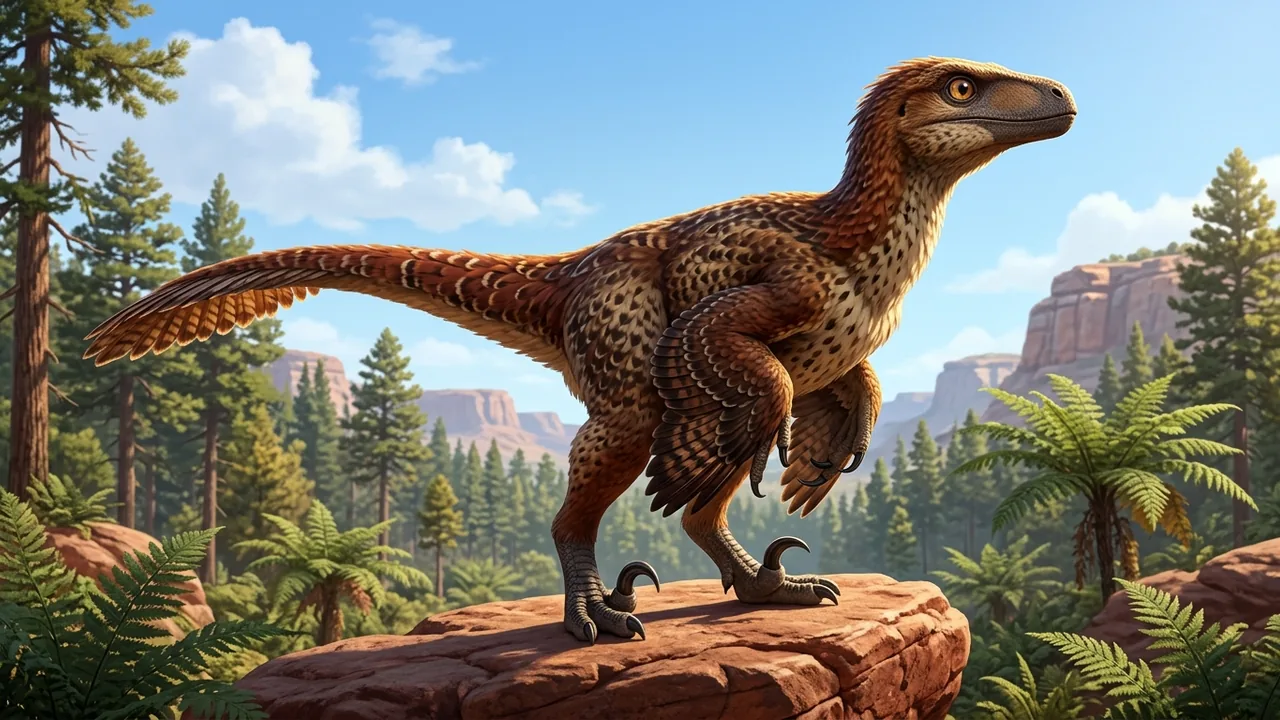
Meet the Legend: Heavyweight Super-Raptor!
Most feathered raptors—like famous Velociraptor—were no heavier than a Thanksgiving turkey or medium dog. Then nature built Utahraptor, the undisputed heavyweight champion of the entire raptor clan! Stretching twenty feet from snout to tail tip, it was as long as a full-size family pickup truck.
Even more amazing was its muscular build: a grown Utahraptor weighed around 1,000 pounds—as heavy as an adult male polar bear! Covered in hawk-like body with winged arms and a fan-tipped tail, this Early Cretaceous ruled western North America.
Lost World Habitat: Ancient Red-Rock Valleys
One hundred and thirty-five million years ago during the Early Cretaceous Period, eastern Utah was not the dry canyon desert hikers visit today. Instead, seasonal rivers wound across wide, sunny floodplains bordered by shady conifer woods, tree ferns, and palmlike cycads.
Herds of thumb-spiked plant-eaters called Hippodraco, young long-necked sauropods, and spiky armored Gastonia grazed along muddy watering holes. Dappled brown-and-russet helped Utahraptor blend right into forest shadows while scouting trails along sunny red-rock streams for its next surprise .
What's on the Prehistoric Menu?
Powering a thousand-pound warm-blooded took plenty of food! Unlike skinny, long-legged dinosaurs built to chase lizards across flat sand, Utahraptor had thick, stocky leg bones packed with muscle—built more like a grizzly bear or football linebacker than a marathon runner.
Waiting patiently behind streamside bushes, Utahraptor exploded out of hiding in a high-speed ! Broad feathered arms flapped for balance while grasping three-fingered hands and deep jaws lined with saw-edged teeth secured medium-sized plant-eaters along muddy riverbanks before smaller scavengers could sneak a single bite.
Superpowers & Anatomy: Giant Sickle Claws
Every raptor carried a special weapon on each foot, and Utahraptor grew the biggest of them all! On its second inner toe sat a curved claw measuring over nine inches long—about the length of a dinner plate! While walking on its third and fourth toes, Utahraptor held that sickle claw raised off the ground.
Keeping the tip lifted protected its sharp point from dulling on rough rocks. Meanwhile, bony rods stiffened its long feathered tail like a tightrope walker's pole, helping this big pivot sharply mid-leap alongside thick wing !
Flight vs. Fight Arena: Testing Living Armor!
As ancient Utah's top hunter, Utahraptor rarely needed to flee, yet one neighbor refused to back down! Sharing the exact same fern meadows was Gastonia—a sixteen-foot, one-ton plant-eater covered in thick bony plates and twin rows of chainsaw-like shoulder spikes!
Too heavy and short-legged to run away, Gastonia planted all four feet on Team Fight whenever Utahraptor circled close. Even with nine-inch claws and muscle, trying to flip a crouching wall of spikes was risky—so smart Utahraptors stayed patient and cautious!
Fossil Detective Secrets: The Quicksand Trap!
Paleontologists first discovered Utahraptor in eastern Utah near Moab in 1991 after uncovering a giant foot claw that shocked everyone with its size! Years later, scientist Jim Kirkland's team found an even bigger treasure: a nine-ton boulder of ancient packed with dinosaur bones!
Locked inside that swirling sand deposit lay an adult Utahraptor, several teenagers, and tiny babies preserved right beside plant-eating prey. Finding so many ages together in one quicksand trap gave detectives exciting clues that giant feathered raptors may have hunted or traveled in family groups!