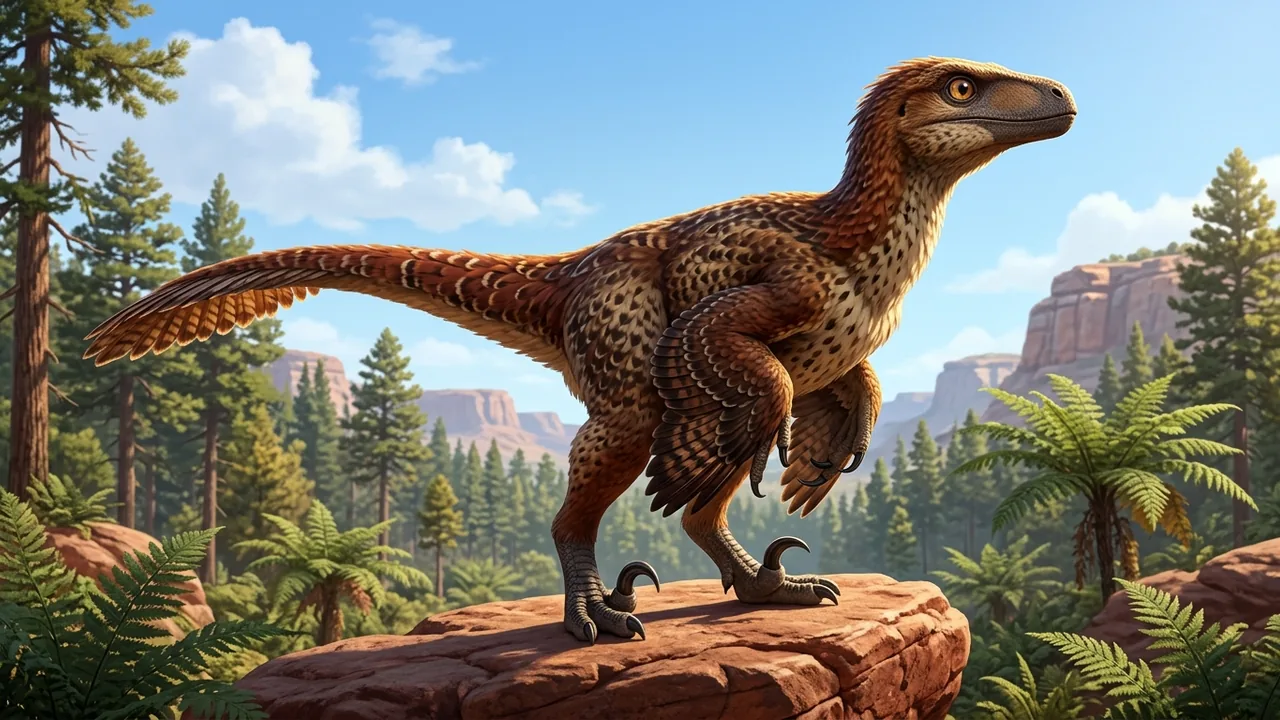
Meet the Legend: Giant of the Raptor Clan
When people hear the word raptor, many imagine sleek hunters the size of wolves—or real-life Velociraptor, which weighed no more than a wild turkey. Then paleontologists in eastern Utah unearthed Utahraptor, a real prehistoric titan that dwarfed every cousin in its family! Stretching twenty to twenty-three feet long and weighing 1,000 pounds, an adult Utahraptor matched a full-grown polar bear in sheer bulk.
Living 135 million years ago during the Early Cretaceous Period, Utahraptor was a warm-blooded, feathered built for strength rather than fragile speed. Broad winged forearms, a stiff feather-fanned tail, and golden hawk-like eyes gave it the look of an eagle crossed with a grizzly bear.
Every inch of its muscular skeleton showcased specialized physical adaptations that crowned Utahraptor the undisputed apex predator of its ancient western landscape!
Lost World Habitat: Early Cretaceous Floodplains
Today, eastern Utah around Moab is famous for dry red sandstone arches and sunny desert canyons. Back in Utahraptor's time 135 million years ago, that region was a semi-arid floodplain crisscrossed by winding rivers, seasonal lakes, and lush streamside conifer forests.
Tree ferns, horsetails, and palmlike cycads carpeted damp riverbanks, feeding herds of plant-eating iguanodonts, long-necked Cedarosaurus sauropods, and heavily armored Gastonia. Over millions of years, river mud and spring sands hardened into colorful rock layers called the Cedar Mountain Formation.
Across the continent right here in Virginia, Early Cretaceous rivers were laying down the Potomac Formation sedimentary clays and sandstones during that same chapter of Earth's history—preserving fossilized conifer cones, dinosaur footprints, and teeth along Virginia's Fall Line for curious young students and museum scientists to study today!
What's on the Prehistoric Menu?
In the Cedar Mountain food chain, green conifers, ferns, and cycads worked as producers converting sunlight into plant energy. Large herbivores such as horse-sized Hippodraco and young sauropods grazed those plants—and top Utahraptor kept herbivore herds in healthy ecological balance!
Unlike slender desert raptors that chased small lizards across open sand, Utahraptor evolved thick thigh and shin bones packed with heavy muscle. Using shady streamside trees for cover, it stalked quietly within striking distance before launching an athletic ambush.
Long grasping hands with three curved claws seized tall prey while deep, sturdy jaws closed with a slicing bite. Each blade-like tooth carried tiny ridges along both front and back edges, helping this half-ton hunter feed efficiently across its floodplain while keeping plant-eating dinosaur herds alert, healthy, and moving across seasonal valleys.
Superpowers & Anatomy: Feathers, Balance & Claws
Utahraptor's signature superpower sat poised on the inner second toe of each foot: a wickedly curved, nine-inch sickle claw! Special hinge joints let Utahraptor walk comfortably on its third and fourth toes while holding that giant second claw raised safely off rough gravel so the keratin tip stayed needle-sharp.
How did a thousand-pound hunter stay balanced while leaping and gripping active prey? Through bird-like feather adaptations! Fossil evidence from across the raptor family confirms dromaeosaurs grew stiff wing feathers along their forearms and a wide fan of feathers on their tails.
Stiffened by thin bony rods along its vertebrae, Utahraptor's tail swung sideways like a rudder during sharp turns, while flapping its feathered arms stabilized its balance—just as modern hawks and eagles flap their wings to stay steady when this agile pounced across forest trails!
Flight vs. Fight Arena: Hunter vs. Spiky Fortress!
In nature's survival arena, strong predators inspire strong herbivore defenses! Sharing Utahraptor's exact Utah was Gastonia burgei—a sixteen-foot, one-ton ankylosaur cousin wrapped from nose to tail in fused bony armor and sharp sideways spikes!
While long-legged ornithopods bolted away on Team Flight, heavy Gastonia stood unshakably on Team Fight. Whenever Utahraptor circled close, Gastonia tucked its short legs underneath its wide belly so no predator could tip it upside down, swinging a spiky tail lined with triangular bony blades.
Even an apex armed with nine-inch claws and teeth respected that prickly shield! Because a leg injury meant a predator could no longer hunt, smart Utahraptors bypassed healthy adult Gastonia fortresses unless teamwork or surprise offered a safe opening across the muddy floodplain where unarmored plant-eaters grazed beside shady streams.
Fossil Detective Secrets: Secrets of the Megablock
In 1991, paleontologists digging in eastern Utah uncovered a nine-inch curved toe claw far bigger than any raptor fossil known at the time—proving giant dromaeosaurs truly walked the Earth! Even bigger news arrived years later when geologist Jim Kirkland's team located an extraordinary nine-ton sandstone block perched high on a Utah ridge.
Geologists discovered the rock had formed as a bubbling spring of wet quicksand! Preserved together inside that single natural trap lay skeletons of at least one full-grown Utahraptor, several medium-sized teenagers, and tiny one-meter hatchlings alongside plant-eating iguanodont bones.
Finding multiple growth stages side by side gave paleontologists a treasure trove of behavioral clues—suggesting Utahraptor may have gathered in cooperative family groups, using social smarts as a powerful survival across ancient North America! Careful lab work on those Utah bones keeps revealing fresh discoveries every year.