Meet the Legend: Paravian Claws vs. Pure Flight
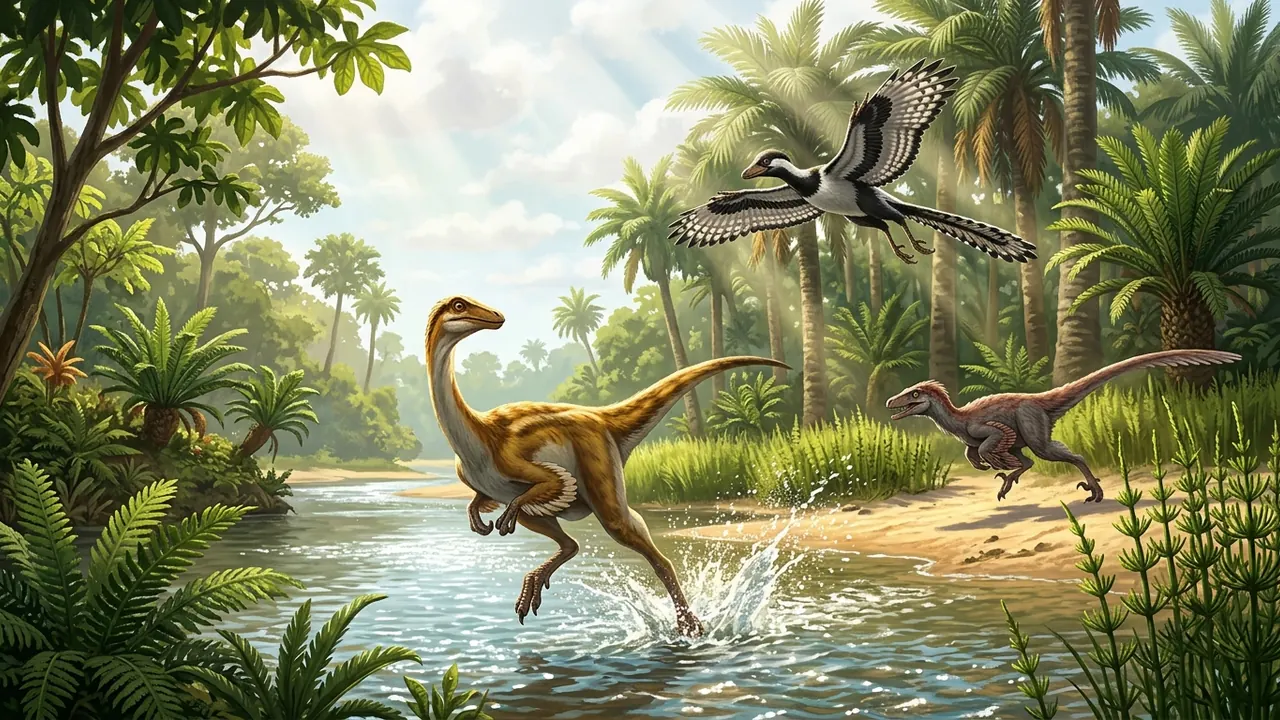
While multi-ton ceratopsians, stegosaurs, and ankylosaurs answered predation by investing heavily in structural bone armor, coelurosaurian theropods explored the opposite pole of biomechanical design: lightweight pneumatic skeletons, plumage, cursorial velocity, and true aerial locomotion. Across Jurassic and Cretaceous ecosystems, these evolutionary innovations staged nature's sharpest test of active pursuit versus high-speed escape.
Representing specialized ambush grappling stood feathered dromaeosaurids—Campanian Velociraptor mongoliensis (roughly fifteen kilograms) from Mongolia's arid and Aptian-Albian Deinonychus antirrhopus (roughly seventy kilograms) from North America's swampy Cloverly Formation.
Both paravian hunters wielded hypertrophied, sickle-shaped unguals on hyperextensible pedal digit II, medially folding semilunate wrists, and elongated caudal prezygapophyseal bone rods that turned their tails into dynamic mid-air counterbalances.
Confronting predation across Mesozoic landscapes were two divergent prey strategies: stocky ground defenders such as ceratopsian Protoceratops and iguanodontian Tenontosaurus that engaged in hazardous close-quarters Team Fight, versus cursorial and volant specialists that perfected Team Flight.
Leading that evasion guild were six-meter Maastrichtian ornithomimid Gallimimus bullatus of Mongolia's Nemegt Basin and raven-sized Tithonian avialan pioneer Archaeopteryx lithographica of Bavaria's !
Comparing their hind-limb and forelimb lever ratios illuminates one of evolutionary biomechanics' deepest trade-offs: optimizing foot bones for powerful talon grappling directly sacrifices maximum overland running speed, opening a decisive survival lane for specialized sprinters and winged gliders across both continents and geologic eras. Tracing how dromaeosaurids, ornithomimids, and early avialans diverged from shared coelurosaurian ancestors reveals why natural selection repeatedly favored feather-light bone walls, elastic ankle tendons, and high-efficiency avian respiratory air sacs across open Mesozoic landscapes.
Lost World Habitat: Eolian Dunes to Lagoons
Detailed stratigraphic context reveals how paleoenvironmental sightlines dictated whether Fight or Flight adaptations prevailed across distinct sedimentary basins. Within Mongolia's Campanian (~75–71 MYA), cross-bedded orange sandstones and structureless sandflows record arid eolian dune seas punctuated by scrubby interdunal oases.
Steep dune slip-faces and desert brush provided tight visual cover allowing nocturnal or crepuscular Velociraptor to stalk within meters of burrowing multituberculate mammals, lizards, and gregarious Protoceratops before launching explosive short-range pounces.
Roughly five million years later in Mongolia's wetter Maastrichtian Nemegt Formation (~70 MYA), meandering river channels, taxodiaceous conifers, and broad alluvial mudflats created expansive, unobstructed corridors where long-necked Gallimimus flocks spotted both stalking dromaeosaurids and cursorial juvenile Tarbosaurus long before ambush distance closed.
In Early Cretaceous Montana and Wyoming (~115–108 MYA), poorly drained Cloverly Formation cypress floodplains juxtaposed dense fern thickets against open oxbow clearings shared by Deinonychus and browsing Tenontosaurus.
Meanwhile, 150 million years ago across Late Jurassic Europe's archipelago, warm hypersaline lagoons encircled low subtropical carbonate islands vegetated by drought-adapted conifers and seed ferns.
Sharing narrow coral beaches with swift terrestrial coelurosaurs like Compsognathus, crow-sized Archaeopteryx exploited vertical arboreal perches and inter-island air corridors to step cleanly out of two-dimensional ground-predator reach—demonstrating how open horizontal flats and vertical forest canopies independently rewarded rapid locomotion! Even Early Mesozoic rift-valley mudstones along eastern North America—including Virginia's Culpeper Basin trackway beds—preserve parallel three-toed cursorial footprints across open lake margins, underscoring that unobstructed sightlines and firm shoreline substrates promoted high-speed theropod evasion across every stage of the Age of Dinosaurs.
What's on the Prehistoric Menu?
Reconstructing Mesozoic trophic interactions requires testing classic artwork assumptions with modern geochemical and biomechanical evidence. For decades after John Ostrom excavated multiple Deinonychus skeletons alongside Tenontosaurus bones in Montana, popular reconstructions depicted dromaeosaurids hunting in cooperative, mammal-like family wolf packs.
In 2020, however, stable carbon and oxygen isotope analyses of juvenile versus adult Deinonychus tooth enamel revealed starkly partitioned diets! Small juveniles foraged independently on small brush or arboreal vertebrates while full-grown adults converged opportunistically on larger Tenontosaurus—closely resembling modern Komodo dragon or crocodilian mobbing rather than mammal-style pack provisioning.
Moreover, paleontologist Denver Fowler's raptor prey restraint biomechanics demonstrated that claws acted like modern hawk talons rather than slashing blades: raptors pinned smaller or similar-sized quarry beneath their body weight, anchoring tight with curved pedal-II unguals while executing rapid stability-flapping strokes with forelimb wings as serrated jaws dispatched prey.
Across the trophic spectrum, four-hundred-pound Gallimimus functioned as a wide-ranging omnivore, cropping horsetails, seeds, insects, crustaceans, and small amphibians with a broad keratinous rhamphotheca while maintaining elevated panoramic surveillance above delta reeds.
In island shrublands, sharp-toothed Archaeopteryx gleaned lacewings, beetles, and small lizards among coastal branches—fueling high endothermic metabolic demand throughout warm Jurassic afternoons while relying on instant wing-assisted launch whenever swift terrestrial predators patrolled nearby coral sands. Fine lamellar ridges preserved inside ornithomimid keratinous beaks also suggest filter-straining of aquatic invertebrates along shallow Nemegt ponds, demonstrating how versatile omnivory let cursorial flocks refuel rapidly in exposed clearings without lingering inside dense, ambush-prone waterside vegetation where dromaeosaurids waited unseen.
Superpowers, Senses & Anatomy
Comparative skeletal lever ratios vividly illustrate why dromaeosaurids could never catch healthy adult ornithomimids in an open footrace! Velociraptor and Deinonychus possessed relatively short, wide tarsometatarsi engineered to maximize mechanical advantage and torsional grip strength for their enlarged second-toe sickle claws—a specialization that capped their cursorial sprint speeds near thirty-five to forty kilometers per hour.
Gallimimus optimized the exact opposite biomechanical equation for overland flight! Extensive cervical and dorsal pneumaticity hollowed its vertebral column via avian-style air sacs, while massive caudofemoralis retractors concentrated heavy muscle mass proximally near the pelvis to minimize distal limb rotational inertia.
Crucially, Gallimimus elongated its tibia well beyond femur length and fused its third foot bone into a spring-like : the proximal shaft pinched wedge-like between metatarsals II and IV to dissipate ground reaction shock cleanly at velocities approaching fifty-five to sixty kilometers per hour (35+ mph)!
Simultaneously, Late Jurassic Archaeopteryx bridged non-avian theropods and crown birds by pairing a boomerang-shaped furcula wishbone, folding semilunate wrist bone, and asymmetrically vaned primary remiges along elongated arms.
Synchrotron X-ray micro-tomography of Archaeopteryx humeri and ulnae in 2018 revealed thin-walled, torsion-resistant bone geometry closely matching modern burst-flying galliform birds like pheasants and roadrunners!
Reinforced at the outer wingtips by rod-shaped melanin melanosomes that stiffened feather keratin against aerodynamic drag and wind abrasion, Archaeopteryx achieved active burst flapping and agile island-to-island gliding across Late Jurassic lagoons. Meanwhile, enlarged cerebellar flocculus lobes revealed inside and avialan braincase CT scans coordinated split-second gaze stabilization—keeping vision locked steady whether pinning prey or banking between branches!
Flight vs. Fight Arena!
Placing Team Fight directly alongside Team Flight clarifies the evolutionary cost-benefit balance of anti-predator defense across dinosaur clades. Short-limbed herbivores like 180-kilogram Protoceratops in dune fields or one-ton Tenontosaurus on floodplains lacked cursorial escape speed, compelling active close-range defense: Protoceratops countered Velociraptor lunges with a deep, high-leverage shearing beak and bony neck frill, while Tenontosaurus swept a massive, tendon-stiffened tail capable of fracturing ribs.
Yet engaging an agile, sickle-clawed predator at zero range always carried severe hazard if sandy footing slipped, darkness favored nocturnal raptor vision, or multiple mobbing hunters attacked simultaneously!
By sharp contrast, Team Flight neutralized dromaeosaurid weaponry long before physical contact ever occurred. Equipped with huge laterally oriented orbits granting near-panoramic 340-degree visual coverage across open deltas, foraging Gallimimus herds detected subtle predator movement dozens of meters outside pouncing range.
Accelerating explosively on spring-loaded levers and executing synchronized flock-wheeling turns counterbalanced by horizontal feathered tails, adult ornithomimids effortlessly outpaced both short-footed dromaeosaurs and subadult tyrannosaurids while expending zero tissue-healing energy!
Even more transformative was Archaeopteryx's conquest of vertical space across islands: a single pheasant-like burst launch from coral sand into conifer crowns rendered every non-volant terrestrial jaw and sickle claw instantaneously obsolete, proving aerodynamic evasion was nature's cleanest survival breakthrough. In evolutionary energetics, avoiding physical combat altogether preserves 100 percent of somatic growth and reproductive fitness, because even a victorious ground defender suffers costly tissue trauma and infection risk—explaining why cursorial limb elongation and feathered aerial escape flourished wherever open sightlines or vertical perches existed.
Fossil Detective Secrets
Two of vertebrate paleontology's most celebrated Lagerstätte discoveries immortalize the stark evolutionary divergence between hazardous ground combat and winged escape! Unearthed in 1971 by a joint Polish-Mongolian expedition in Campanian red sandstones of the at Tugrikeen Shireh, the iconic 'Fighting Dinosaurs' specimen (MPC-D 100/25) preserved an adult Velociraptor and a crouched Protoceratops buried alive together when a rain-saturated sand dune collapsed mid-clash.
Entombed in articulated three-dimensional life posture, Velociraptor's left pedal sickle claw remained thrust directly toward Protoceratops's ventral throat region while the ceratopsian's powerful shearing beak clamped squarely across the raptor's fractured right radius and ulna—unmistakable forensic proof that Team Fight could trap predator and defender alike!
Meanwhile, across fine-grained Tithonian lagoonal muds of Germany's , twelve exquisite Archaeopteryx specimens preserve carbonized plumage, asymmetrical aerodynamic vanes, and microscopic melanosome arrays analyzed via scanning electron microscopy and synchrotron X-ray fluorescence.
Paired with Mongolian ornithomimid trackways recording sustained high-speed gaits and feathered Canadian Ornithomimus fossils preserving filamentous body coats plus adult wing-like forelimb plumes, fossil detectives traced an unbroken evolutionary arc across the Mesozoic.
While non-avian ground fighters vanished sixty-six million years ago at the end-Cretaceous impact horizon, small, toothless, pennaceous masters of Team Flight endured the global winter—radiating into over ten thousand living dinosaur species soaring across Earth's skies from backyard treetops to ocean cliffs today! Laser-stimulated fluorescence imaging of Solnhofen slabs continues to uncover previously invisible soft-tissue wing membranes and foot scales each year, confirming how seamlessly feathered dinosaur anatomy launched vertebrate life's most enduring evolutionary success story.