Meet the Legend: Two Paths Past the Raptor
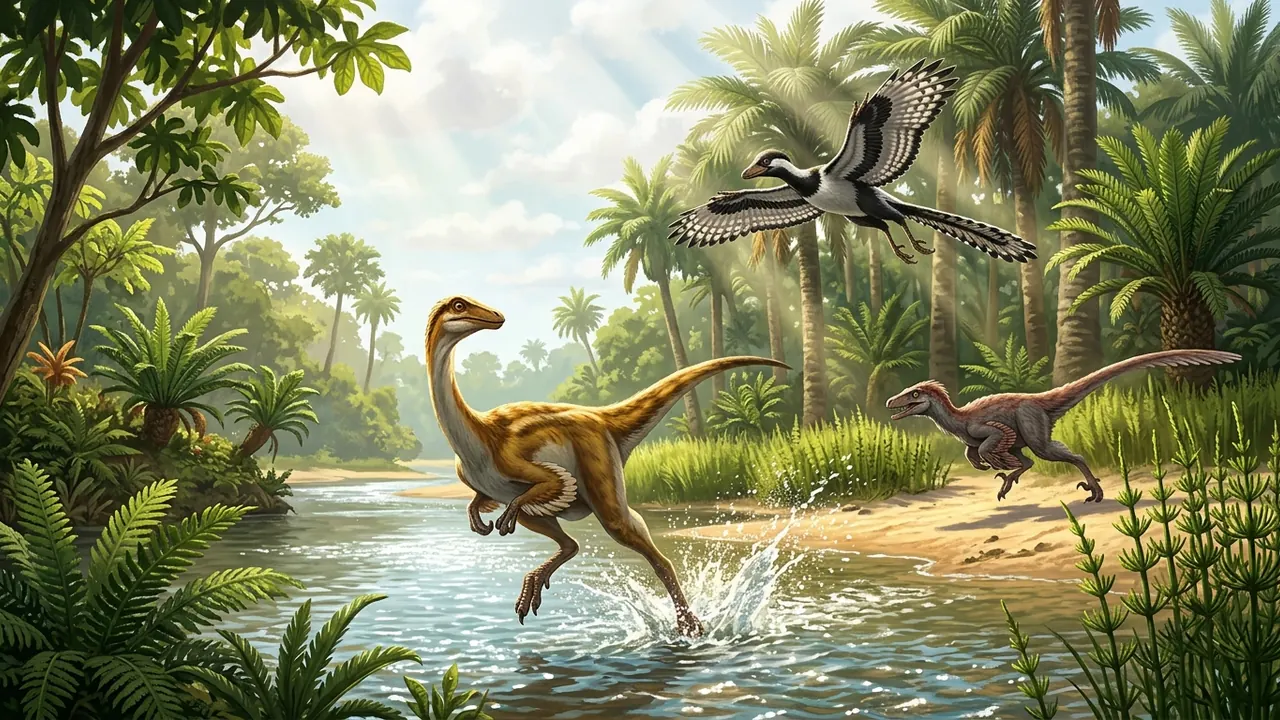
Not every dinosaur answered hungry predators by growing tons of bone armor or swinging spiked tail clubs! Across the Jurassic and Cretaceous Periods, slender feathered theropods turned pure foot speed, agile reflexes, and wings into nature's ultimate evasion toolkit.
On the hunting side stood feathered dromaeosaurs: forty-pound Velociraptor mongoliensis in Late Cretaceous Mongolia and hundred-sixty-pound Deinonychus antirrhopus in Early Cretaceous North America. Both carried enlarged curved claws on their hyperextensible second toes, inward-facing grasping hands, and stiffened counterbalance tails.
Facing dromaeosaur hunters across Mesozoic landscapes were two sharply different survival philosophies. Stocky, short-legged herbivores like sheep-sized Protoceratops and one-ton Tenontosaurus lacked top-end running speed, forcing them to stand firm on Team Fight whenever ambushed.
By contrast, four-hundred-pound Gallimimus bullatus and two-pound Late Jurassic avialan pioneer Archaeopteryx lithographica invested every ounce of skeletal engineering into pure Team Flight!
Comparing raptor strike physics against 35-mile-per-hour overland sprinting and winged treetop launching reveals why escaping an attack cleanly without taking a single scratch often beat winning a bruised ground brawl in ancient ecosystems. Across tens of millions of years, lighter skeletons, springy foot levers, and contoured feathers proved just as effective as horns or clubs.
Lost World Habitat: Arenas Built for Speed
Terrain geometry decides whether ambush predators or fast runners hold the upper hand in nature! Seventy-one million years ago in Mongolia's wind-sculpted Gobi dunes, steep orange sand ridges let Velociraptor creep undetected close to burrowing mammals and nesting Protoceratops before launching short, explosive pounces.
Nearby in Mongolia's wetter Nemegt river basin, braided channels opened onto broad, sun-drenched alluvial flats bordered by dawn redwoods and horsetails. Across those unobstructed plains, towering twenty-foot Gallimimus flocks enjoyed wide peripheral vision that spoiled ambush approaches early—both from agile raptors and long-legged juvenile Tarbosaurus!
Meanwhile, in Early Cretaceous Montana's Cloverly floodplains, swampy cypress groves and fern glades created tighter clearings where groups of Deinonychus confronted browsing Tenontosaurus.
Step back 150 million years to Late Jurassic Bavaria, Germany, and the survival arena became truly three-dimensional! Warm Solnhofen island archipelagos ringed by clear turquoise lagoons grew low shrubby conifers where nimble Compsognathus hunted lizards across white coral beaches.
By leaping from ground scrub onto overhead branches with wings, Archaeopteryx unlocked vertical habitat space that land-bound hunters pacing the sand below simply could never reach! Whether racing across wide Mongolian mudflats or gliding over German lagoons, open sightlines rewarded swift reflexes.
What's on the Prehistoric Menu?
How did feathered dromaeosaurs actually capture meals without breaking their narrow jaws? Modern biomechanics replaced older movie myths with the model! Like modern hawks and eagles, Velociraptor and Deinonychus leaped onto prey up to their own body size, pinning it down with full body weight while driving curved second-toe claws deep for a tight anchor grip.
While pinning struggling quarry on the ground, raptors beat their broad, feathered forelimbs in rapid 'stability flapping' strokes so they stayed centered atop their target while serrated jaws went to work!
Across the food web, swift Team Flight species fueled high-energy warm-blooded metabolisms on remarkably flexible menus. Toothless Gallimimus acted as a versatile omnivore—snapping up insects, frogs, crustaceans, seeds, and tender shoots along riverbanks while constantly scanning horizons from a six-foot-high vantage point.
In Solnhofen's sunny island shrublands, sharp-toothed Archaeopteryx snatched dragonflies, beetles, and tiny lizards.
Because active feathered bodies burn calories rapidly from dawn to dusk, both Gallimimus and Archaeopteryx had to forage out in open clearings for hours every day—relying on split-second alertness and instant acceleration whenever shadows moved across the ferns.
Superpowers, Senses & Anatomy
Look closely at fossil leg proportions and you can read a dinosaur's top speedometer! Velociraptor and Deinonychus possessed relatively short, stout lower-foot bones built for powerful pouncing leverage and high gripping torque—capping their sustained overland running speed around twenty to twenty-five miles per hour.
By contrast, Gallimimus engineered the ultimate dinosaur sprinter's leg! Heavy caudofemoralis muscles bunched high near its hips, keeping the lower limb whip-light like a metronome pendulum, while elongated shin bones and pinched arctometatarsalian bones multiplied stride length and absorbed heavy impact shock across hard sand.
Balanced horizontally by a stiff feathered tail, Gallimimus accelerated smoothly past thirty-five miles per hour! Above the ground, Archaeopteryx pioneered true wing anatomy.
Asymmetrical primary feathers along its long clawed arms and frond-like tail formed cambered lifting surfaces that sliced air cleanly, while hollow pneumatic bones trimmed skeletal weight.
Microscopic electron scans of fossilized pigment capsules inside Archaeopteryx's wing feathers proved its outer plumes gleamed matte black—not merely for island camouflage, but because dense melanin rods structurally toughen feather keratin against high-speed wind shear during rapid treetop launches!
Flight vs. Fight Arena!
Compare what happened in nature when dromaeosaurs confronted Team Fight versus Team Flight! Against stocky, short-limbed Protoceratops in Gobi sand dunes, Velociraptor closed sprint distance easily—yet immediately faced a fierce counterattack from a muscular parrot-like beak capable of snapping small arm bones.
Similarly, when hungry groups of Deinonychus targeted juvenile or solitary Tenontosaurus beside Montana swamps, only worked if they avoided one bone-rattling sweep of the herbivore's heavy tendon-laced tail.
Team Flight rewrote those survival odds completely by refusing close-quarters combat altogether! With large eyes set wide on a lightweight skull providing near-360-degree awareness, a foraging Gallimimus detected stalking predators dozens of yards before pouncing range.
Accelerating past thirty-five miles per hour on springy levers and banking sharply in synchronized flock waves, healthy adult ornithomimids simply outpaced short-footed dromaeosaurs across open deltas!
Even more decisive was Archaeopteryx's vertical escape: bursting upward with rapid pheasant-like wingbeats to glide smoothly between Solnhofen conifers turned three-dimensional airspace into an unbreakable safety barrier no terrestrial theropod claw or jaw could ever cross. By turning wide horizons and overhead branches into instant escape lanes, Team Flight survived ferocious predators without risking a single broken bone.
Fossil Detective Secrets
Extraordinary Lagerstätte fossil beds preserve both chapters of this Flight-versus-Fight story in breathtaking stone detail! In 1971, paleontologists exploring Mongolia's red Djadochta Formation excavated the world-famous 'Fighting Dinosaurs' specimen—an adult Velociraptor and a Protoceratops entombed mid-struggle beneath a rain-collapsed desert sand dune.
Preserved bone-on-bone after seventy-one million years, Velociraptor's grip aimed its raised sickle claw straight toward Protoceratops's throat while the defender's shearing beak clamped tight onto the raptor's fractured right forearm—dramatic proof that ground combat could trap hunter and defender alike!
Meanwhile, over six thousand miles away in Montana rocks, shed Deinonychus teeth beside Tenontosaurus skeletons revealed fierce group feeding, though differing tooth isotopes showed young and adult raptors foraged separately rather than living like mammal wolf packs.
Across the globe in Bavaria's fine-grained Solnhofen Limestone, twelve exquisite Archaeopteryx fossils preserved delicate feather vanes, microscopic pigment structures, and curved wishbones.
Together, these stone masterpieces show why cursorial speed and winged flight triumphed across evolutionary history—surviving even the end-Cretaceous asteroid impact through more than ten thousand living bird species soaring overhead today! Every robin, hawk, and ostrich sprinting or gliding today carries forward the winning physics first tested beside hungry Mesozoic raptors.