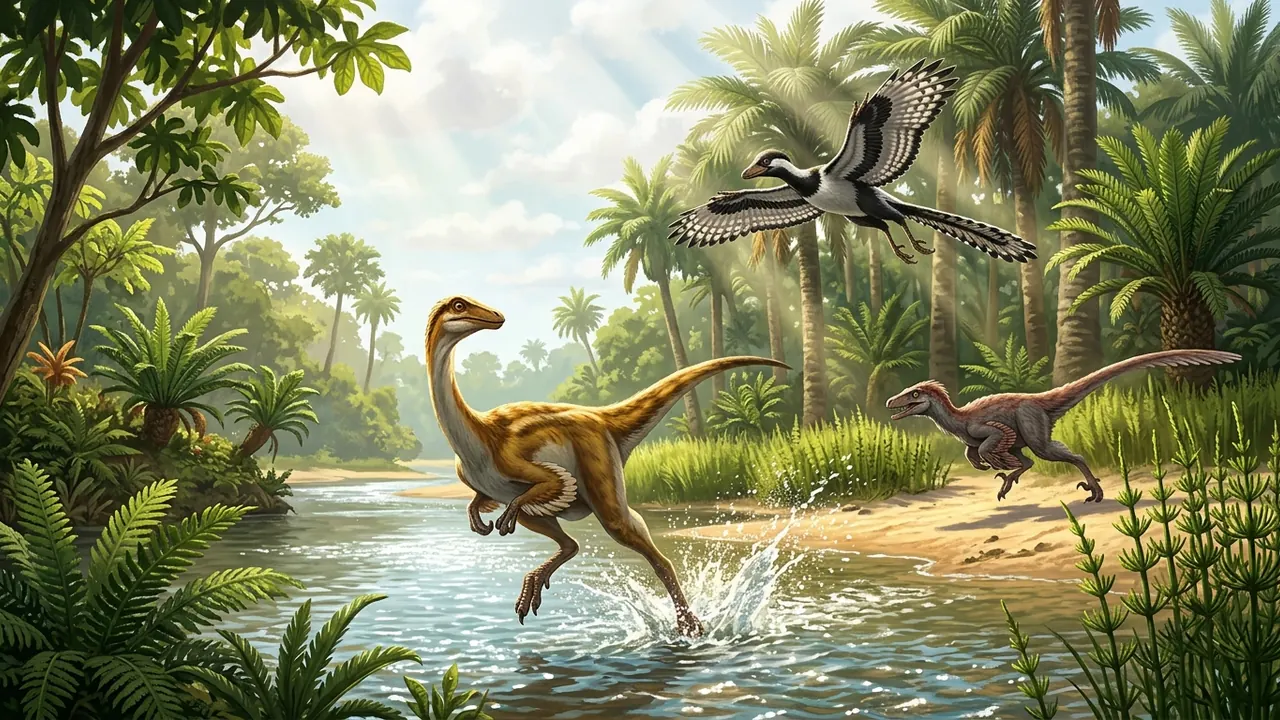
Meet the Legend: Speed & Wings vs. Claws
Across our earlier showdown books, giant multi-ton herbivores stood their ground with horns, armor plates, and tail spikes. Yet millions of smaller, lighter dinosaurs survived fierce predators without carrying a single ounce of heavy bone armor! Welcome to nature's ultimate showcase of Team Flight versus feathered hunters.
Representing the hunters are desert-dwelling Velociraptor mongoliensis of Asia and wolf-sized Deinonychus antirrhopus of North America—warm-blooded, fully feathered raptors built with hooked second-toe claws, grasping hands, and lightning reflexes.
Representing pure Team Flight are twenty-foot ostrich-mimic Gallimimus bullatus and raven-sized Late Jurassic pioneer Archaeopteryx lithographica! By contrasting stocky defenders that fought raptors on the ground against sprinters and winged gliders that escaped them cleanly across open flats and treetops, scientists uncover two brilliant evolutionary survival blueprints that shaped modern birds. Instead of trading heavy blows on muddy ground, speedsters and gliders turned swift motion into unbeatable protection!
Lost World Habitat: Open Runways & Islands
Every survival matches the physical habitat where an animal lives! In Early Cretaceous Montana swamps and Late Cretaceous Mongolian sand dunes, thick brush and rolling sand ridges gave feathered raptors shadowy cover to stalk within leaping distance of unsuspecting prey.
Nearby across Mongolia's lush Nemegt river deltas, wide floodplains opened into flat, sandy stretches where herds of golden-feathered Gallimimus gathered with clear 360-degree sightlines across open ground. Meanwhile, 150 million years ago in Solnhofen, Germany, warm tropical island lagoons dotted with low conifers gave winged Archaeopteryx vertical escape routes up into sunny branches!
Even right here in Virginia's Culpeper Basin, Early Mesozoic stone quarries preserve long trails of three-toed footprints where swift dinosaurs raced across ancient mudflats—showing how open shorelines have favored speedy runners for over two hundred million years.
What's on the Prehistoric Menu?
Food chains explain why alertness never took a break in prehistoric ecosystems! Agile Deinonychus hunted across North American cypress floodplains, often targeting horse-sized herbivore Tenontosaurus, while desert Velociraptor stalked lizards, burrowing mammals, and sheep-sized Protoceratops across breezy Gobi oases.
Unlike pure plant eaters or pure meat hunters, twenty-foot Gallimimus thrived as an opportunistic ! Using a flat, toothless keratin bill, it plucked seeds, tender water plants, insects, and small lizards along muddy riverbars while keeping its keen eyes raised high on a slender S-curved neck to spot danger early.
In Late Jurassic Europe, crow-sized Archaeopteryx snapped up crunchy beetles, dragonflies, and tiny lizards among sunny island shrubs, yet had to watch constantly for swift ground predators like Compsognathus patrolling white coral beaches right below its breezy seaside perch! Staying light, nimble, and alert allowed both omnivores and insect hunters to dine safely beside hungry neighbors.
Superpowers, Senses & Anatomy
Feathers and hollow bones powered both hunters and escapers across the Mesozoic world! Velociraptor and Deinonychus grew true pennaceous feathers along their arms and stiffened tails. Rather than flying across skies, raptors flapped their winged arms for steady balance while pinning prey down with enlarged, curved second-toe claws!
Gallimimus answered with supreme leg engineering built for pure overland speed. Its shin bone and fused foot bones grew significantly longer than its muscular upper thigh, multiplying every running stride while pneumatic air sacs kept its skeleton remarkably light and cool.
Archaeopteryx took feathered one giant leap further into the open air! While retaining three clawed fingers and a bony tail from its raptor cousins, it evolved flight feathers with stiff leading shafts—allowing quick bursts of flapping launch and controlled island gliding.
Flight vs. Fight Arena!
Nature tested both Team Fight and Team Flight against sharp raptor claws! Short-legged Protoceratops could not outrun Velociraptor across loose sand dunes, so it braced firmly on Team Fight with a bony neck frill and a vise-like shearing beak. Likewise, bulky Tenontosaurus swung its long, sinewy tail to fend off Deinonychus ambushes.
Yet Team Fight always carried heavy danger whenever teeth and claws met at close quarters! By contrast, when an alert Gallimimus flock spotted movement with wide-set eyes, the entire group exploded to thirty-five miles per hour across open delta flats—leaving twenty-four-mile-per-hour raptors and giant tyrannosaurs far behind in the dust.
Even more revolutionary was Archaeopteryx's literal Flight! One quick leap and wingbeat carried the dino-bird safely up onto a conifer branch, proving vertical escape beat any ground predator cleanly.
Fossil Detective Secrets
One of paleontology's greatest treasures captures Team Fight frozen directly in stone! Discovered in Mongolia in 1971, the 'Fighting Dinosaurs' fossil preserves an adult Velociraptor and a Protoceratops buried instantaneously by a rain-soaked collapsing sand dune—with the raptor's sickle foot claw raised high and Protoceratops clamping its strong beak tight onto the raptor's arm!
In Montana rocks, shed Deinonychus teeth found beside Tenontosaurus skeletons confirm fierce swamp encounters too. Meanwhile, powerful microscope scans of 150-million-year-old Archaeopteryx feathers from fine German limestone revealed tiny pigment structures called melanosomes that strengthened wing tips against wind wear.
Together, these stone detective clues reveal a grand lesson: while brave ground fighters battled toe-to-toe, bones, speed, and feathers carried bird-line dinosaurs safely through deep time all the way into our sunny modern skies!