Meet the Legend: Raptors vs. Speedsters
Forget bulky movie monsters—real feathered raptors and dinosaur speedsters were sleek, warm-blooded, athletic marvels! Turkey-sized Velociraptor in Asia and wolf-sized Deinonychus in North America belonged to the feathered family, famous for hooked claws and quick reflexes.
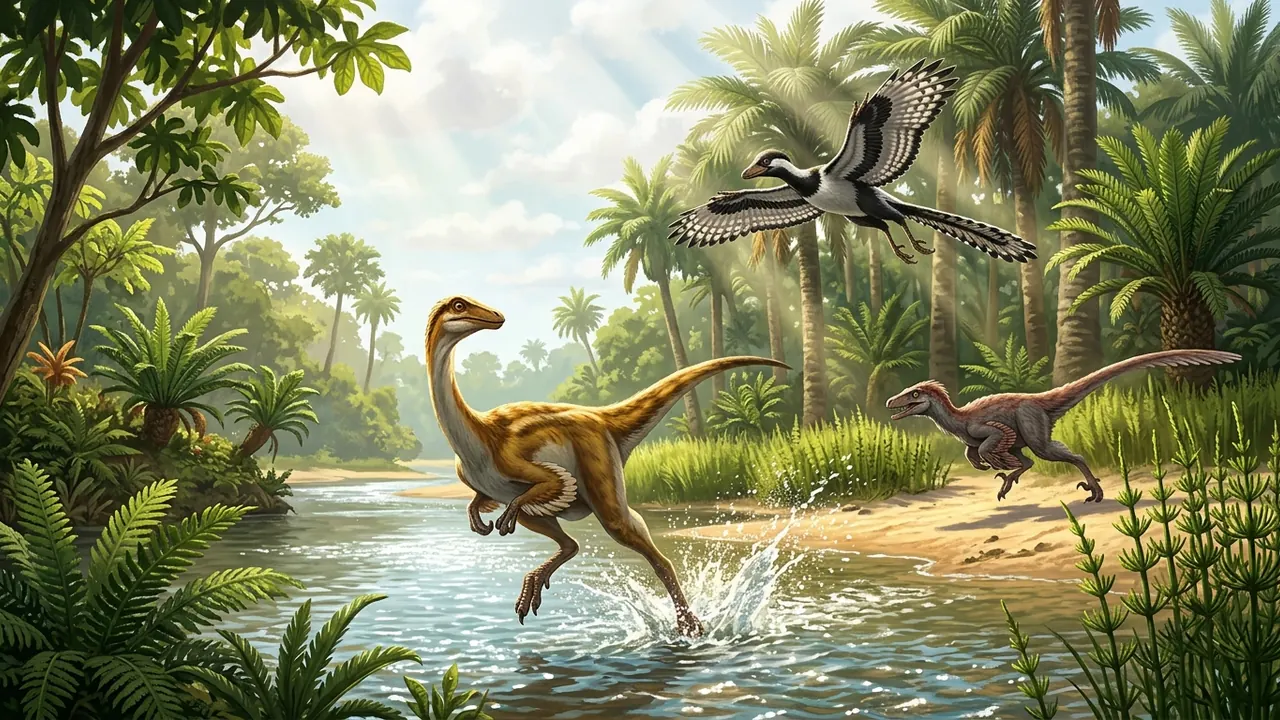
How did lighter neighbors survive without heavy horns or tail clubs? Meet twenty-foot Gallimimus, built on bones like a giant golden ostrich, and raven-sized Archaeopteryx, the earliest winged dino-bird! Instead of trading dangerous blows on the ground, these two pioneers mastered high-speed Team Flight across land and sky!
Lost World Habitat: Open Flats & Lagoons
Different habitats shaped different escape tricks! Seventy million years ago in Mongolia, wide river deltas met dry desert sand dunes. Open mudflats gave long-legged Gallimimus herds plenty of clear, sunny runway to spot crouching predators from far away.
Eighty million years earlier in Late Jurassic Germany, warm turquoise lagoons surrounded tropical coral islands dotted with palm-like shrubs. There, agile little Archaeopteryx hopped through sunny branches high above small beach-running hunters, turning the open sky itself into a brand-new safety zone via winged !
What's on the Prehistoric Menu?
Feathered dromaeosaurs were bold, sharp-eyed meat eaters! In Mongolia's sand dunes, Velociraptor stalked lizards, small furry mammals, and sheep-sized Protoceratops. In North America's Early Cretaceous swamps, agile Deinonychus hunted horse-sized plant eater Tenontosaurus.
Meanwhile, toothless Gallimimus was a fast omnivore that plucked seeds, insects, eggs, and tender green shoots near water, always lifting its tall neck like a watchtower for instant . Tiny Archaeopteryx snapped up crunchy beetles and dragonflies with miniature pointed teeth while keeping one sharp eye on hungry predators below!
Superpowers, Senses & Anatomy
Every dinosaur in this arena carried feather-light engineering! Velociraptor and Deinonychus held a curved second-toe raised off the ground so its tip stayed needle-sharp, using wide arm feathers like flaps to stay balanced when pinning prey.
Team Flight answered with weight-saving magic! Both Gallimimus and Archaeopteryx had strong, bones filled with air pockets just like modern birds. Long lower-leg bones let Gallimimus take giant ground-covering strides, while uneven flight feathers turned Archaeopteryx's clawed arms into real lifting wings for smooth !
Flight vs. Fight Arena!
When raptors pounced, slower plant eaters had to fight! Stocky Protoceratops clamped down hard with its sharp beak, and muscular Tenontosaurus whipped its heavy tail to knock Deinonychus aside. That was classic Team Fight!
Gallimimus and Archaeopteryx chose pure Team Flight instead! Spotting danger with wide side-facing eyes, Gallimimus rocketed past thirty-five miles per hour—faster than any raptor could sustain across open flats! Even better, Archaeopteryx flapped and launched into smooth treetop where ground claws could never follow.
Fossil Detective Secrets
In 1971, Polish and Mongolian fossil detectives uncovered the famous 'Fighting Dinosaurs' skeleton in the Gobi Desert! A collapsing sand dune buried a real Velociraptor with its raised against a Protoceratops biting the raptor's arm—proving Team Fight carried real risks for both sides!
By contrast, fossil trackways of sprinting ostrich-dinosaurs and microscope scans of black-and-white wing feathers on Archaeopteryx show why Team Flight became an evolutionary superpower. Today, over ten thousand living bird species carry that winged dinosaur victory across every sky!