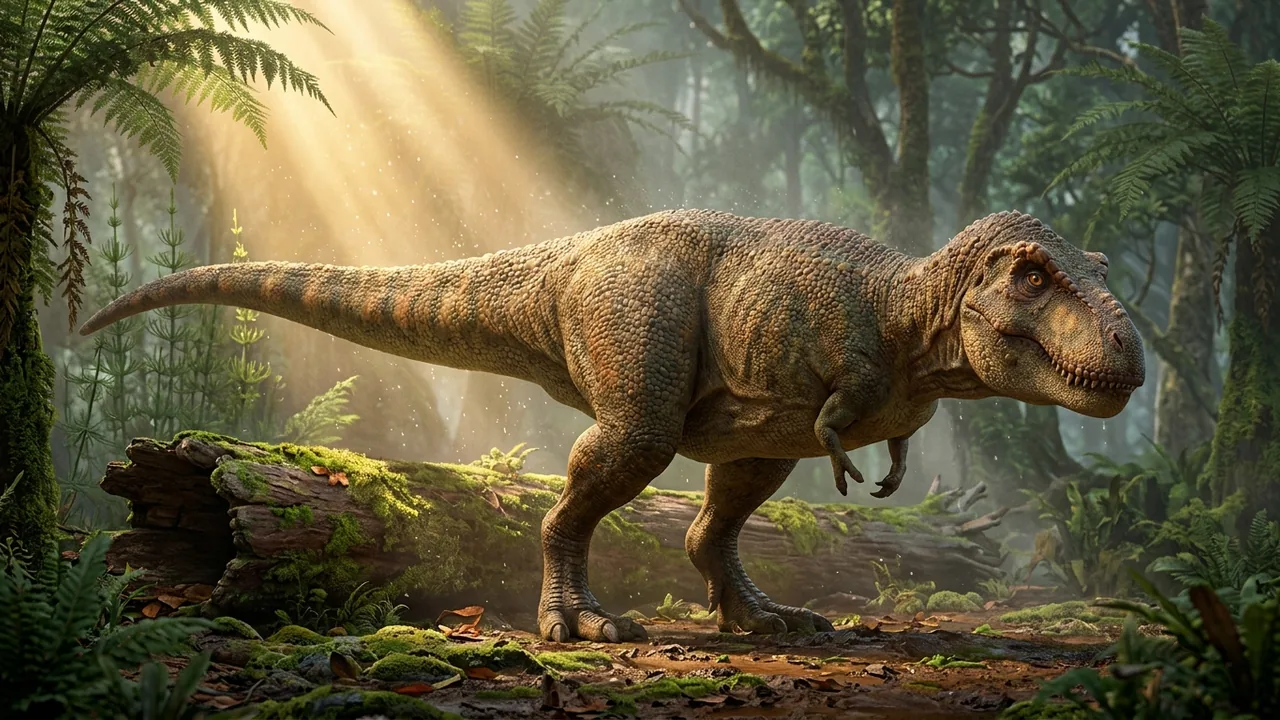
Meet the Legend: Culmination of Tyrannosaur Evolution
When Tyrannosaurus rex strode across western North America during the final two million years of the Cretaceous Period, its family tree had already spent nearly one hundred million years evolving from dog-sized, fleet-footed ancestors. Early Jurassic and Early Cretaceous tyrannosauroids in Asia and North America were slender, three-fingered hunters living quietly in the shadows of giant allosauroids. Only after older mega-predator lineages vanished around ninety million years ago did tyrannosaurids surge to colossal proportions, culminating in a twelve-and-a-half-meter coelurosaurian giant weighing between seven and nine metric tons.
Twenty-first-century paleobiology has overturned virtually every outdated museum posture once assigned to this icon. Complete articulated skeletons confirm a horizontal vertebral column suspended over pillar-like hindlimbs and counterbalanced by massive caudofemoralis tail musculature. Rather than dangling downward like bunny paws, its compact two-fingered hands rotated palms inward toward the midline—an ancestral maniraptoran-grade wrist trait shared across bird-line theropods.
Equally transformative, microscopic comparisons of tooth enamel hydration and jawbone neurovascular foramina indicate that smooth extra-oral scaly lips covered its dentition when the jaws closed, preventing brittle enamel cracking.
Furthermore, cladistic analyses place tyrannosauroids firmly inside Coelurosauria, making Tyrannosaurus rex far more closely related to feathered modern birds than to earlier carnosaurs like Allosaurus! Combined with dramatic anatomical shifts across its from downy hatchling to deep-skulled sovereign, modern and biomechanics reveal an intelligent, keen-sensed apex predator.
Even preserved skin impressions from adult flanks show fine, non-overlapping mosaic scales resembling durable pebbled leather across its muscular torso and tail.
Lost World Habitat: Reading the Hell Creek Formation
Paleontologists reconstruct the vanished homeland of Tyrannosaurus rex through high-resolution across the Hell Creek Formation of Montana and the Dakotas, alongside contemporaneous Lance, Scollard, and Frenchman beds in Wyoming, Alberta, and Saskatchewan. Alternating cross-bedded river sandstones, gray floodplain mudstones, and dark lignite coal seams record a low-lying coastal plain on the island continent of Laramidia, bordered eastward by the retreating Western Interior Seaway.
High-precision argon-argon dating of volcanic sanidine crystals interleaved within those coal seams pins Tyrannosaurus rex between 68.0 and 66.0 million years ago during the Late Maastrichtian stage. Immediately above the highest non-avian dinosaur fossils rests a millimeter-thin clay boundary enriched in extraterrestrial iridium and shocked quartz—the unmistakable geological fingerprint of the Chicxulub asteroid impact.
Prior to that sudden global winter, leaf-margin paleobotany and oxygen isotopes inside freshwater gar scales confirm mild, frost-free subtropical lowlands with lush seasonal rainfall. Towering metasequoia dawn redwoods, ginkgoes, cycads, and diverse flowering angiosperms shaded winding river oxbows.
Beneath those canopies thrived a complex vertebrate community: champsosaurs, trionychid soft-shelled turtles, bowfins, alligatoroids, multituberculate mammals, early marsupials, giant azhdarchid pterosaurs overhead, and vast multi-generational herds of ceratopsian and hadrosaurid megaherbivores that sustained Laramidia's top carnivore.
Periodic flooding along meandering river channels rapidly entombed fallen trees, leaves, shells, and skeletons together, locking an entire ecosystem into stone. Every exposed badland hillside across eastern Montana today represents a vertical timeline of shifting riverbanks, oxbow swamps, and ancient forest soils that preserves paleoclimate shifts across the final millennia before the Cretaceous-Paleogene extinction event.
What's on the Prehistoric Menu? Ontogeny & Food Webs
Modern African savannas partition predatory niches among half a dozen distinct carnivore species, scaling smoothly from jackals and wild dogs up to cheetahs, leopards, hyenas, and lions. Yet Hell Creek reveals a striking ecological anomaly: aside from turkey-to-coyote-sized dromaeosaurs and troodontids, virtually zero medium-sized adult meat-eating dinosaur species shared ecosystems with mature Tyrannosaurus rex!
Bone histology and tyrannosaur solve this ecological puzzle with elegance. Microscopic lines of arrested growth inside limb bones demonstrate that juvenile Tyrannosaurus rex spent their first thirteen years as slender, long-shinned cursorial hunters armed with narrow, blade-like teeth. By pursuing swift ornithopods, pachycephalosaurs, and young hadrosaurs, teenage tyrannosaurs monopolized mid-tier predatory guilds themselves—crowding out rival medium theropod lineages across Laramidia.
Around age fourteen, surviving individuals ignited an extraordinary somatic growth spurt, packing on over two kilograms per day for four years while broadening their temporal jaw chambers and deepening their mandibles.
Mature adults developed deeply rooted, sub-circular teeth engineered for , harvesting multi-ton Triceratops and Edmontosaurus prey while pulverizing solid cortical bone and digesting mineral-rich marrow inside intensely acidic digestive tracts. Whenever seasonal floods delivered drowned carcasses along river bends, oversized olfactory bulbs also guided adults to effortless scavenging windfalls.
Fossilized coprolites packed with etched, rounded fragments of hadrosaur fibulae provide direct chemical proof that bone itself served as a staple energy source. Nitrogen isotope studies further confirm that adult tyrannosaurs occupied the undisputed pinnacle of terrestrial food webs, channeling vast quantities of floodplain primary productivity upward.
Superpowers, Senses & Anatomy: Inside the Endocast
Non-destructive X-ray computed tomography allows researchers to generate a three-dimensional digital of the Tyrannosaurus rex braincase without sawing into irreplaceable museum skulls. These virtual casts expose colossal olfactory bulbs surpassing almost all non-avian theropods, thick optic nerve tracts serving fifty-five degrees of stereoscopic visual overlap, and elongated cochlear loops tuned specifically to low-frequency infrasound footsteps echoing through forested valleys.
Structurally, the one-and-a-half-meter cranium operated as a reinforced biomechanical truss. Fused, rugose nasal bones down the dorsal snout and air-filled paranasal sinuses routed torsional stresses safely around delicate sensory capsules while massive adductor muscles delivered 35,000 to 57,000 Newtons of clamping force.
Concentrated onto stout, D-cross-section maxillary crowns with serrated carinae, tooth-tip pressures exceeded two gigapascals—shattering dense megaherbivore bone during without fracturing the predator's own stiffened secondary palate. Continuous dental replacement ensured any crown chipped against heavy armor was steadily succeeded from beneath.
Postcranially, Tyrannosaurus rex retained a pinched arctometatarsalian foot inherited from fleet coelurosaurian forebears. Bound tightly by interosseous ligaments, the wedge-shaped third metatarsal absorbed ground-reaction shocks and resisted rotational torque whenever an eight-ton adult pivoted sharply across slick floodplain clay, pairing marathon walking efficiency with unmatched close-quarters grappling stability.
Even internal neck vertebrae held hollow pneumatic chambers connected to avian-style air sacs, lightening the front body while supporting ferocious head-shaking leverage. Semicircular ear canals tracked rapid head tilts so its binocular gaze stayed locked onto moving prey even across uneven riverbanks during dimly lit dawn or dusk hunts.
Flight vs. Fight Arena: Coevolutionary Trade-Offs
Natural selection enforces unforgiving mechanical trade-offs between Team Flight velocity and Team Fight fortification. As Tyrannosaurus rex prioritized massive cranial musculature and multi-ton body mass for , mature adults forfeited true aerial running phases; finite-element tibial stress models cap safe adult speeds near twelve to twenty miles per hour, allowing lightweight ornithomimids such as Struthiomimus to escape open pursuits through sheer cursorial velocity.
Unable to outrun light sprinters, adult tyrannosaurs specialized in confronting fortified Team Fight megaherbivores locked into coevolutionary arms races. Coexisting Triceratops horridus countered bone-crushing jaws by replacing the windowed frills of earlier ceratopsians with a thick, solid squamosal-parietal shield, mounted upon a spherical occipital condyle ball joint that whipped three keratin-clad horns toward any flanking lunge.
Even more impervious, low-slung Ankylosaurus magniventris armored its back, neck, and even its eyelids in fused composite osteoderms while wielding a stiffened tail club capable of fracturing tyrannosaur metatarsals upon impact.
Fossil pathology confirms how evenly matched these encounters were: museum collections preserve Triceratops brow horns and squamosals bearing remodeled, healed Tyrannosaurus rex puncture grooves—direct physical proof that alert defenders survived ambushes and forced even the Tyrant Lizard King to calculate risk before every strike.
Ultimately, floodplain survival hinged on terrain, sightlines, and patience: dense dawn-redwood margins favored the stealthy predator, whereas open fern clearings rewarded vigilant defenders. Neither rival held a guaranteed victory, illustrating how reciprocal coevolution sharpened predatory offense and herbivore defense simultaneously across millions of years of Late Cretaceous ecological competition.
Fossil Detective Secrets: From Barnum Brown to Sue
Since American Museum collector Barnum Brown excavated the holotype skeleton from steep Montana sandstone outcrops in 1902, more than fifty partial-to-near-complete Tyrannosaurus rex individuals have entered scientific collections, making it Earth's most thoroughly sampled mega-theropod. Landmark discoveries—most notably Sue Hendrickson's 1990 find of FMNH PR 2081 in South Dakota and Saskatchewan's hyper-robust elder 'Scotty' (RSM P2523.8)—supplied over ninety percent skeletal completeness across multiple growth stages.
Today, interdisciplinary research teams synthesize high-resolution field , volcanic geochronology, finite-element jaw engineering, and digital tomography to reconstruct individual life histories in astonishing detail. Healed tail punctures, fused rib calluses, gout-like toe lesions, and remodeled jawbone infections document grueling real-world encounters across sixty-seven-million-year-old floodplains.
Most remarkably, gentle demineralization of a fractured Montana femur (MOR 1125) uncovered flexible, branching microvascular structures alongside medullary reproductive bone tissue similar to modern egg-laying birds.
Cross-checking western body-fossil quarries against eastern North American sedimentary basins—such as Virginia's Culpeper trackway sandstones and coastal plain marine beds—shows how distinct rock environments preserve complementary chapters of Mesozoic history.
Together, Hell Creek skeletons, bone-filled coprolites, and biomechanical computer models prove non-avian dinosaurs flourished at peak evolutionary sophistication right up to the final day of the Cretaceous Period. Ongoing summer excavations continue uncovering juvenile skulls, scaly skin impressions, and footprint trackways across western badlands, ensuring fresh paleobiological breakthroughs still await future generations of fossil detectives exploring North America's ancient rock record with modern laboratory instruments, geochemical isotope probes, high-resolution laser scanners, and curious scientific minds eager to decode every remaining mystery locked inside Late Cretaceous stone.