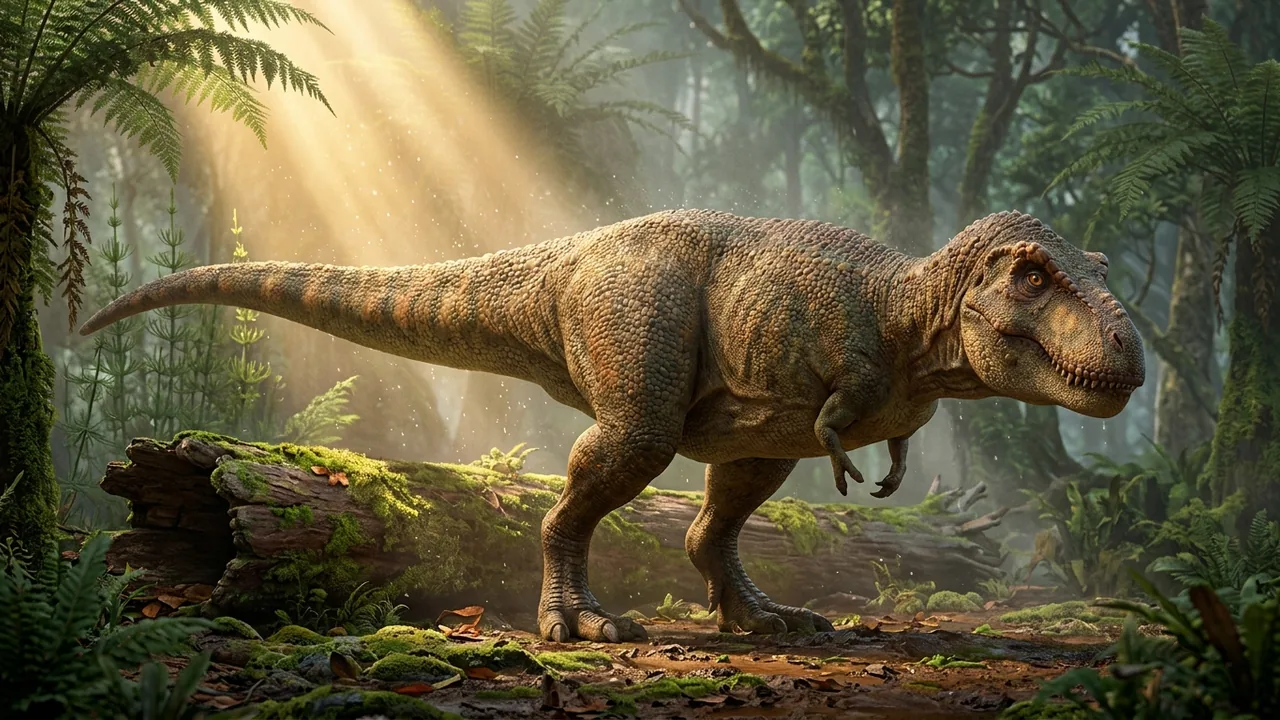
Meet the Legend: Bigger Than a School Bus
Picture a yellow school bus parked outside your school. A full-grown Tyrannosaurus rex stretched just as long—about forty-two feet from nose to tail tip! Standing twelve feet tall at the hips and weighing as much as four pickup trucks, this giant ruled western North America sixty-six million years ago.
Old museum drawings showed it standing upright with its tail dragging on the dirt. Modern fossils tell a much cooler truth! Tyrannosaurus rex balanced its massive body horizontally like a giant seesaw, with inward-facing two-fingered hands and tough scaly lips covering its shiny tooth .
Lost World Habitat: Steamy Coastal Forests
Sixty-seven million years ago, a warm shallow sea split North America right down the middle! Along the western shore, wide muddy rivers wound through misty cypress swamps and towering redwood trees. Warm sunlight filtered softly through the high leafy onto thick green carpets of ferns and flowering shrubs.
Tyrannosaurus rex shared these lush floodplains with three-horned Triceratops, club-tailed Ankylosaurus, and noisy herds of duck-billed Edmontosaurus. Giant turtles and freshwater gars swam in lazy creeks while small feathered dinosaurs darted safely beneath low ginkgo branches whenever the giant walked past.
What's on the Prehistoric Menu?
Feeding an eight-ton took serious hunting skill and patience! Tyrannosaurus rex tracked large plant-eating neighbors, especially duck-billed Edmontosaurus and sturdy Triceratops. It also lifted its gigantic snout into the breeze to sniff out leftover meals across miles of dense riverside forest.
Instead of sprinting like a racehorse, an adult Tyrannosaurus rex relied on fast power-walking and clever surprise under the forest . Thick cushioned pads on the bottoms of its three-toed feet muffled heavy footsteps, letting the hunter creep close before lunging forward in a sudden burst of speed.
Superpowers, Senses & Anatomy
Most meat-eating dinosaurs had eyes on the sides of their heads, but Tyrannosaurus rex had forward-facing vision! Just like a modern eagle or owl, it judged exact distances through tangled tree trunks. Huge scent chambers inside its five-foot skull gave it an extraordinary sense of smell day and night.
Inside its jaws sat about sixty thick teeth coated in super-hard . The biggest teeth grew as large as bananas, with deep roots anchored into heavy jawbones. Those jaws clamped down harder than a garbage truck compactor, crunching solid bone with ease!
Flight vs. Fight Arena!
When Tyrannosaurus rex stepped into a sunny clearing, speedy ostrich-like dinosaurs chose Team Flight and raced away at thirty miles per hour. Heavyweights like Triceratops chose Team Fight instead! Weighing as much as a big elephant, Triceratops swung three yard-long horns and a solid bone neck shield toward danger.
To stay safe from those sharp horns, a hungry avoided charging straight ahead. Tyrannosaurus rex used depth vision and patience to wait in the shadows for a surprise side opening, turning every forest meeting into a careful contest of brains and balance.
Fossil Detective Secrets
Finding a complete Tyrannosaurus rex skeleton takes sharp eyes, shovels, and months of patient teamwork. Museum crews travel to rocky badlands in Montana, South Dakota, and western Canada to stone bones locked inside steep sandstone cliffs. Thick plaster bandages protect heavy jaws and ribs during the ride to science labs.
By comparing dozens of fossils from slender youngsters to giant elders, detectives learned amazing secrets. Tooth wear and leg bone rings show Tyrannosaurus rex gained over four pounds every single day during its teenage growth spurt before reaching full size around age twenty!