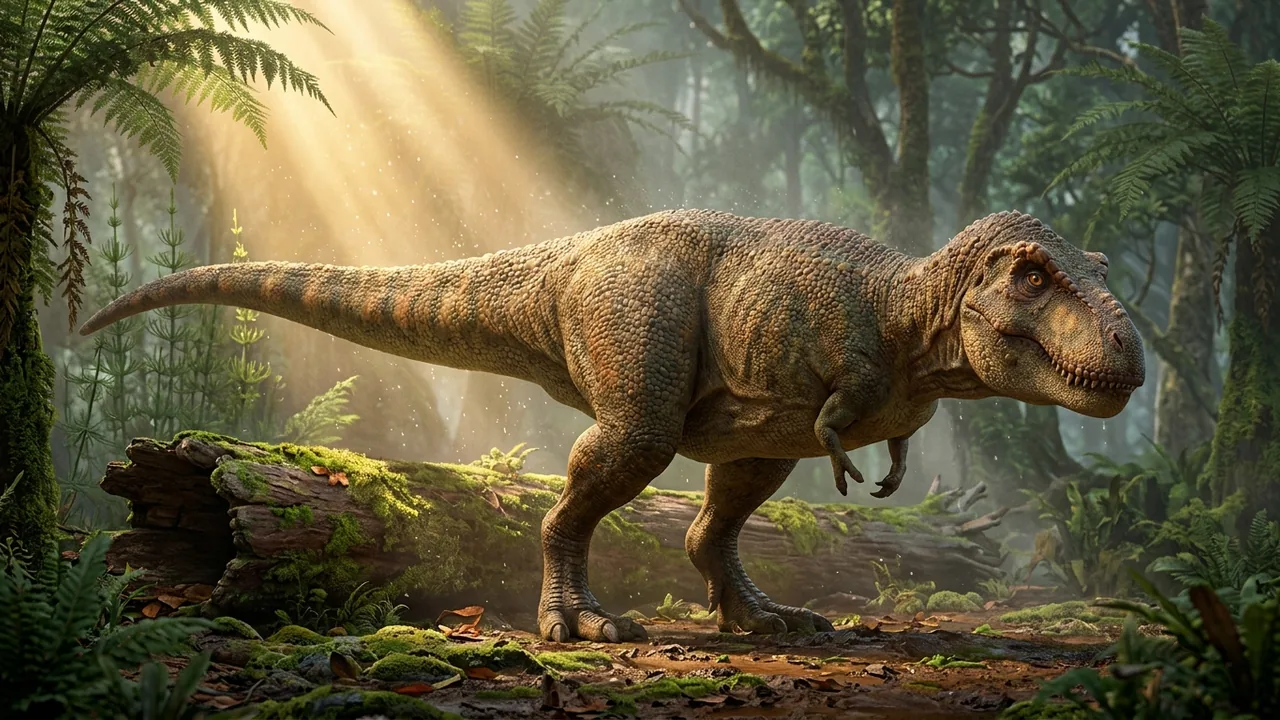
Meet the Legend: Crown of the Food Chain
At forty-two feet long and up to nine tons in weight, Tyrannosaurus rex stood as the undisputed carnivore of Late Cretaceous North America. Its scientific name means 'Tyrant Lizard King,' a title earned through extraordinary physical strength, keen senses, and problem-solving intelligence.
Every inch of its body showed specialized design. Rather than dragging its tail upright like old museum mounts once guessed, Tyrannosaurus rex balanced its horizontal backbone evenly over muscular hips. That heavy tail acted as a counterweight whenever its massive five-foot skull leaned forward during a stride.
Close examination of tiny jawbone grooves also revealed a neat physical : smooth scaly lips covered its sixty thick teeth when its mouth closed. Those protective scales kept tooth surfaces moist and tough, while compact two-fingered hands turned inward like clapping palms to grip close targets.
Lost World Habitat: A Thriving Floodplain Web
Sixty-seven million years ago, lush coastal lowlands bordered a warm inland sea east of the rising Rocky Mountains. In this humid , broad winding rivers spilled nutrient-rich mud across flat valleys where dawn redwoods, palms, tree ferns, and flowering magnolias flourished year-round without harsh winter blizzards.
Warm sunlight and heavy seasonal rains powered a vibrant prehistoric food chain. Dense riverside plants fed huge herds of duck-billed Edmontosaurus, horned Triceratops, and armored Ankylosaurus. Soft-shelled turtles, bowfin fish, and crocodile cousins crowded the warm channels below overhanging cypress roots.
Walking quietly along shaded forest trails, Tyrannosaurus rex occupied the position of this food chain. By hunting large plant-eaters and keeping giant herds moving steadily from meadow to meadow, top predators helped prevent tender riverside forests from being stripped bare, keeping the whole habitat healthy for smaller birds and mammals too.
What's on the Prehistoric Menu?
For decades, paleontologists debated whether Tyrannosaurus rex was an active hunter or strictly a slow . Careful fossil detective work solved the puzzle: just like modern African lions and spotted hyenas, this resourceful giant succeeded brilliantly at both jobs!
Healed bite marks preserved on Edmontosaurus tail vertebrae and Triceratops collar frills prove beyond doubt that Tyrannosaurus rex ambushed living prey—because dead bones can never heal! Waiting silently behind dense redwood trunks was a key behavioral for surprising watchful herbivores near watering holes.
At the same time, oversized scent bulbs inside its braincase worked as a long-range sensory adaptation. Whenever summer floods swept carcasses downstream, Tyrannosaurus rex followed windborne scents across miles of misty swamp to claim effortless scavenger meals, ensuring zero food energy went to waste anywhere in its wide territory.
Superpowers, Senses & Anatomy
Every superpower of Tyrannosaurus rex grew out of remarkable physical for life in wooded floodplains. Its wide rear skull and pinched snout aimed both eyes straight ahead, creating overlapping depth perception sharper than a modern hawk's gaze. Meanwhile, long coiled inner-ear canals detected deep, low-pitched rumbles made by distant herds.
Inside its jaws, thick banana-shaped teeth featured rounded cross-sections and saw-edged ridges that gripped and shattered solid bone without snapping in half. Hollow air pockets inside the skull bones kept its enormous five-foot head light enough for thick neck muscles to swing rapidly.
Down below, three-toed feet hid a pinched middle ankle bone wedged tightly between its neighbors like a built-in shock absorber. Paired with spongy fleshy heel pads, those sturdy legs carried eight tons smoothly across miles of soft mud throughout its .
Flight vs. Fight Arena!
Sharing an with a forty-foot hunter pushed every dinosaur neighbor to sharpen either Team Flight speed or Team Fight armor. Slender ostrich-mimic dinosaurs trusted long legs to outrun danger across open sandbars, while multi-ton Triceratops and club-tailed Ankylosaurus stood firm.
Because a broken shinbone meant an eight-ton hunter could no longer chase dinner, caution guided every single encounter. Against a healthy adult Triceratops, charging straight into three yard-long brow horns and a solid bone neck shield invited serious trouble.
Instead, Tyrannosaurus rex relied on twilight stealth, mottled forest shadow, and quick footwork to test whether a defender was distracted or alone. Meanwhile, Triceratops pivoted rapidly on sturdy front legs to keep its protective horn shield aimed squarely forward until the cautious predator backed away into the shady redwood trees.
Fossil Detective Secrets: Clues in Layered Stone
Dinosaur skeletons become fossils only under rare conditions: river floods must bury bones rapidly under thick sand and silt before scavengers or bacteria break them down. Over millions of years, mineral-rich groundwater turns porous bone spaces stone-hard inside layered rock.
While Tyrannosaurus rex skeletons erode out of western badlands in Montana and South Dakota, students in Virginia can observe how sedimentary layers capture prehistoric life right in their own state! In northern Virginia's Culpeper Basin, ancient quarry sandstones preserve thousands of three-toed meat-eating dinosaur footprints pressed into muddy lake flats earlier in the Age of Dinosaurs.
By comparing western skeleton quarries with eastern footprint beds, paleontologists piece together how carnivores walked, grew from sleek youngsters into heavy adults, and shaped ancient North American habitats across millions of years of Earth's history.