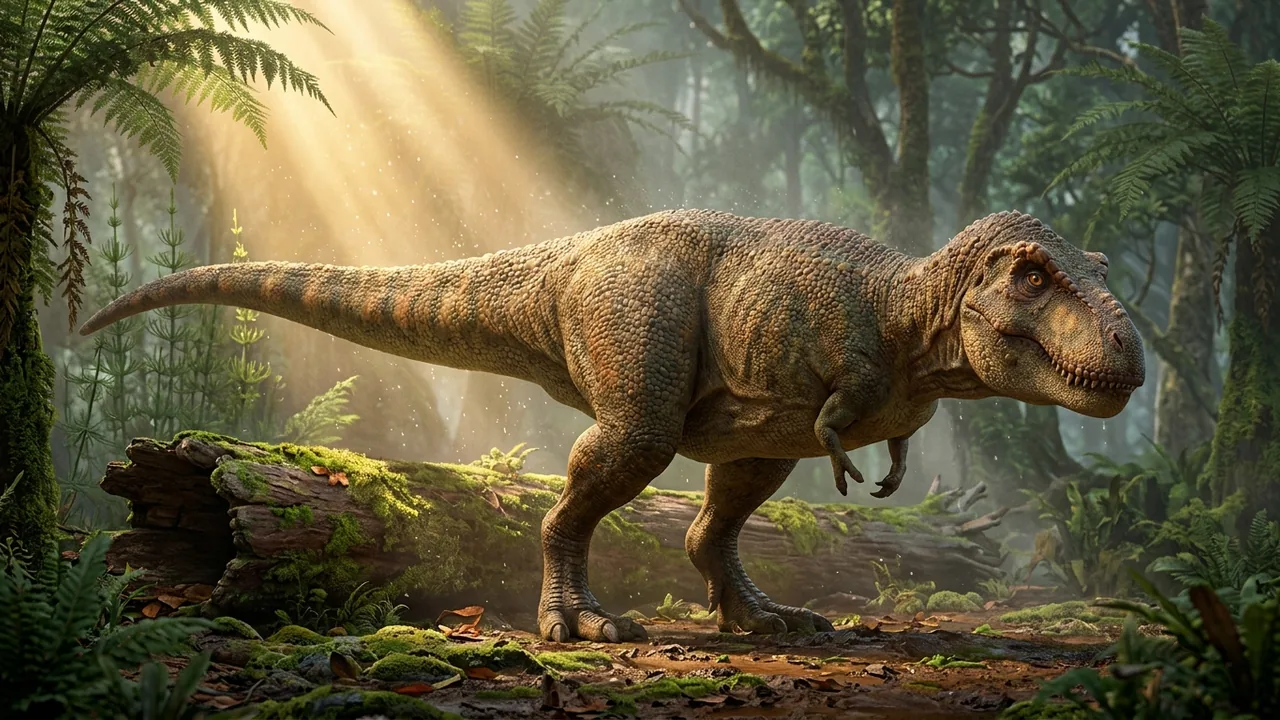
Meet the Legend: Engineering an Eight-Ton Titan
Among all terrestrial predators in Earth's history, none united sheer body mass, sensory precision, and jaw leverage quite like Tyrannosaurus rex. Stretching forty to forty-two feet from snout to tail tip and weighing between seven and nine tons, this Late Cretaceous theropod stood roughly twelve feet tall at the hips.
Modern reveals a finely tuned athletic machine rather than a sluggish, tail-dragging brute. Thick caudofemoralis muscles anchored along the base of its stiff horizontal tail pulled each thigh bone backward with tremendous power, propelling long strides while counterbalancing its massive five-foot-long skull over two pillar-like hind legs.
Along the upper and lower jaws, smooth extra-oral lip scales sealed moisture over sixty thick teeth so their hard enamel stayed resilient instead of drying brittle. Even its famous short arms served a clear mechanical purpose in close-range grappling.
Measuring roughly three feet long—similar to adult human arms—those compact forelimbs bore thick cortical bone walls and scarred bicep ridges. Facing their two-clawed palms inward toward each other rather than downward, they anchored close-range prey while the colossal neck and jaws delivered the decisive clamp across coastal floodplains.
Lost World Habitat: Energy Flow in Western Lowlands
Sixty-seven million years ago, the warm Western Interior Seaway moderated climates across broad coastal floodplains stretching from New Mexico northward into Montana and western Canada. Braided rivers meandered lazily through bald cypress swamps, towering dawn redwoods, ferns, horsetails, and early flowering trees beneath humid, frost-free skies.
Across this lush food web, solar energy captured by dense plant growth supported enormous herds of primary consumers. Duck-billed Edmontosaurus stripped soft conifer needles and leaves, three-horned Triceratops sheared tough low palms, and heavily armored Ankylosaurus cropped floodplain shrubs along muddy oxbow lakes.
In most modern savannas, several mid-sized carnivore species hunt smaller game while giant predators target multi-ton herbivores. Yet Late Cretaceous rock layers in Montana preserve almost no medium-sized adult predator species alongside Tyrannosaurus rex!
Growth studies and explain this fascinating ecological puzzle. Slender, long-legged juvenile Tyrannosaurus rex sprinted after swift smaller ornithopods, occupying the middle tier themselves for over a decade before bulking up into eight-ton apex adults that ruled the top of the food web and recycled energy across the entire river basin.
Meanwhile, crocodiles, champsosaurs, soft-shelled turtles, and decomposers completed the floodplain nutrient cycle below overhanging cypress roots.
What's on the Prehistoric Menu?
Fueling an active eight-ton warm-blooded predator demanded tens of thousands of calories every single week, pushing Tyrannosaurus rex to blend stealthy ambush strikes with wide-ranging scavenging. Inside its skull sat gigantic bulbs—proportionally larger than those of nearly any other meat-eating dinosaur—allowing it to trace windborne scents across miles of misty forest.
When stalking live Edmontosaurus herds or solitary Triceratops, a mature adult could not gallop with both feet airborne without risking catastrophic bone stress in its shins. Instead, computer models show adults reached brisk power-walking speeds of twelve to twenty miles per hour while keeping at least one foot planted firmly on the ground.
That efficient stride conserved stamina across vast river territories until dense redwood shadows allowed an explosive close-range lunge. Once within reach, Tyrannosaurus rex clamped down on neck or hip bones to halt multi-ton quarry in seconds.
Nothing went to waste afterward. Unlike blade-toothed predators that stripped only soft muscle, Tyrannosaurus rex crunched straight through marrow-rich leg bones and ribs, unlocking fat, phosphorus, and calcium reserves hidden deep inside solid skeletons while leaving unmistakable grooved bite traces for future paleontologists.
Superpowers, Senses & Anatomy: 12,800 Pounds of Force
How could Tyrannosaurus rex splinter solid Triceratops hip bones like dry firewood? Digital simulations calculate that bulging jaw muscles packed into wide rear skull openings generated 8,000 to 12,800 pounds of clamping force—roughly 35,000 to 57,000 Newtons! Focused onto thick tooth tips, contact pressures topped an astonishing 300,000 pounds per square inch.
Thin, blade-flat teeth would shatter sideways under such extreme mechanical loads. Instead, Tyrannosaurus rex grew thick, D-shaped crowns reinforced with fluted enamel ridges, deep roots, and microscopic edges that wedged stress cracks straight through solid cortical bone.
Sensory engineering matched that raw jaw power. Because the back of its skull flared wide while its snout narrowed sharply, both softball-sized eyes faced forward with fifty-five degrees of stereoscopic overlap—giving it sharper depth perception than a modern golden eagle!
Meanwhile, its three-toed feet featured a specialized ankle: the middle foot bone pinched into a tight wedge between the outer two bones, binding ligaments into an elastic shock absorber that stabilized rapid, high-torque turns across slick floodplain mud without twisting a joint, while broad cushioned pads distributed eight tons quietly.
Flight vs. Fight Arena: Ambush vs. Living Fortress
At the top level of Late Cretaceous North America, every confrontation weighed rich caloric rewards against career-ending injury. Swift ostrich-like ornithomimids bet everything on Team Flight, accelerating past thirty miles per hour on slender shins to outdistance adult tyrannosaurs across open river flats and sandbars.
Nine-ton Triceratops and low-slung Ankylosaurus anchored Team Fight with formidable defensive hardware. Triceratops evolved a solid bone neck frill without open weight-saving windows, paired with a spherical ball-and-socket neck joint that whipped three forty-inch horns toward any flanking lunge.
Equally daunting, Ankylosaurus wore fused bony armor plates across its wide back—even over its eyelids—and swung a hundred-pound tail club low enough to shatter an attacker's ankles with bowling-ball momentum!
For Tyrannosaurus rex, biomechanical victory relied on binocular range-finding, twilight patience, and disciplined angle selection. Rather than colliding headfirst into braced brow horns or swinging tail clubs, successful hunters ambushed isolated or distracted defenders from obscured forest margins where surprise neutralized heavy armor and tipped the survival balance.
When an alert herbivore stood braced and ready, a wise predator simply disengaged to patrol another bend of the river.
Fossil Detective Secrets: Inside the Bone Lab
Today's paleontologists pair field pickaxes with hospital-grade X-ray scanners and mechanical engineering rigs to unlock secrets inside Tyrannosaurus rex fossils without scratching a single bone. High-resolution scans of hollow braincases reveal oversized chambers, wide optic nerve pathways, and elongated inner-ear loops tuned to low-frequency herd footsteps.
Slicing wafer-thin sections from rib and leg fragments under polarized microscopes exposes annual growth rings much like tree trunks. Those rings prove juveniles stayed slender and swift until roughly age fourteen, then surged by nearly five pounds per day during a dramatic four-year teenage growth spurt!
Engineers have even built cast-metal scale models of tyrannosaur teeth to test how rounded crowns fracture cattle bones in laboratory hydraulic presses. Each experiment confirms why rounded, deep-rooted cones resisted snapping during decades of heavy feeding.
Together with iconic skeletons like Montana's 1902 specimen, South Dakota's Sue, and Saskatchewan's massive Scotty, modern transforms ancient stone skeletons into vivid, quantitative blueprints of Earth's ultimate bone-crushing predator in motion.
Every new fossil scan refines how fast it walked, how clearly it saw, and how fiercely its ecosystem thrived.