Meet the Legend: Crown Jewel of Chasmosaurines
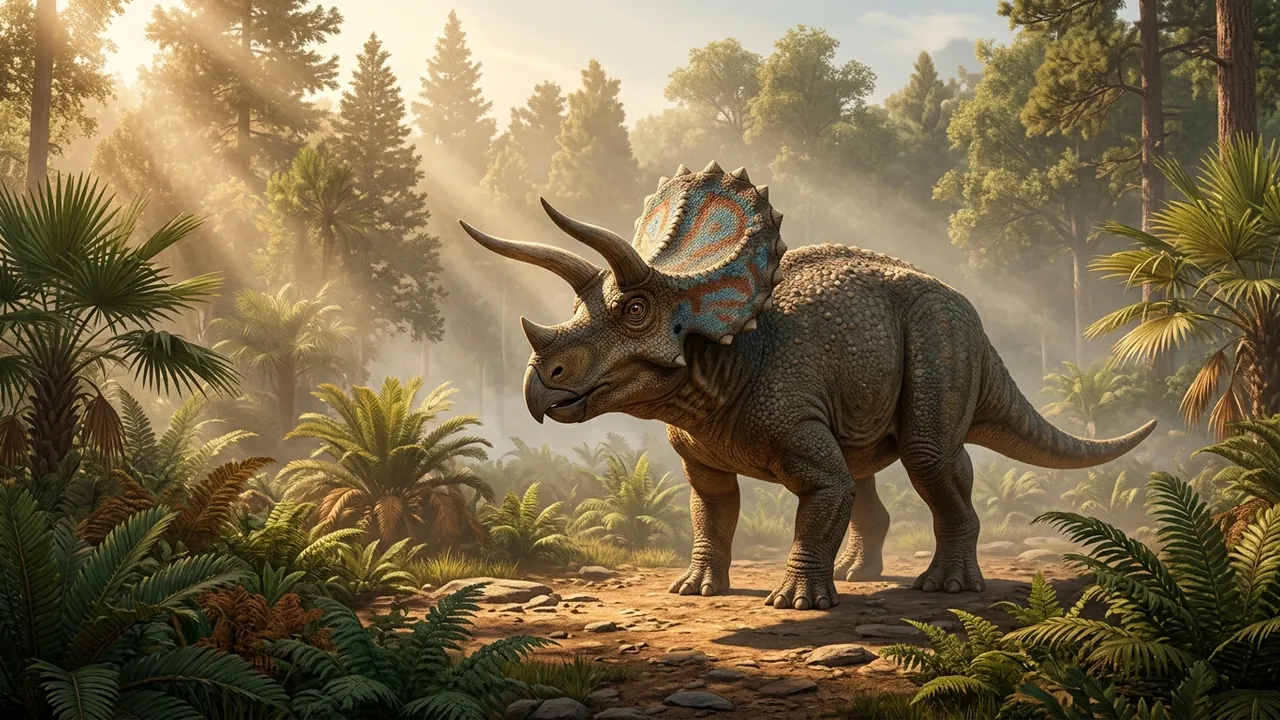
At the close of the Mesozoic Era, Triceratops stood as the ultimate evolutionary fortress among horned dinosaurs. Classified within the branch of Ceratopsidae, mature adults reached twenty-six to thirty feet in length, stood nearly ten feet high at the pelvis, and weighed between six and twelve metric tons. Nearly one-third of that total length belonged to a colossal cranium armed with a stout nasal horn, twin meter-long supraorbital brow horns, and an expansive saddle-shaped neck shield.
Unlike earlier chasmosaurine relatives such as Chasmosaurus or Pentaceratops—whose frills contained wide, skin-covered openings called parietal fenestrae to reduce cranial weight—Triceratops secondarily closed those windows into a continuous, solid vault of thick parietal and squamosal bone.
Cladistic studies place Triceratops alongside massive cousins like Torosaurus and Eotriceratops at the culmination of seventy million years of marginocephalian evolution, descending from agile, bipedal, parrot-beaked Early Cretaceous ancestors such as Psittacosaurus that weighed less than a medium-sized dog.
Over tens of millions of years across Asia and western North America, natural selection steadily enlarged ceratopsian skulls, fused anterior neck vertebrae into shock-absorbing rods, and transformed slender running legs into four muscular pillars capable of carrying multi-ton armor.
Understanding Triceratops also required tracking its remarkable from hatchling to elder, as horn orientations and frill borders transformed dramatically across life stages. Paired with a low center of gravity, barrel-like ribcage, and heavily muscled quadrupedal limbs, this armored browser thrived across western North America right up to the final day of the Cretaceous Period.
Lost World Habitat: Hell Creek Stratigraphy
Our sharpest portrait of Triceratops comes from the famed Hell Creek Formation of Montana and the Dakotas, alongside Wyoming's Lance Formation and Alberta's Scollard Formation. By applying high-precision argon-argon dating to volcanic bentonite ash beds interlayered with floodplain mudstones, geologists have bracketed Triceratops's reign tightly between sixty-eight and sixty-six million years ago.
During this late Maastrichtian stage, braided river channels wound eastward toward the retreating Western Interior Seaway through humid subtropical forests of bald cypress, dawn redwood, ginkgoes, palms, and diverse flowering angiosperms. Warm wet summers alternated with mild frost-free winters, sustaining rich communities of freshwater guitarfish, Champsosaurus, soft-shelled turtles, multituberculate mammals, and feathered maniraptorans.
Even more exciting, decade-long field surveys mapping precise vertical across ninety meters of Hell Creek rock uncovered an evolutionary lineage in action! Older lower strata preserve Triceratops horridus with a short blunt nasal horn and long rostrum, whereas younger upper strata preserve its descendant Triceratops prorsus, sporting a longer forward-inclined nasal horn and deeper beak.
Because intermediate skulls bridge middle rock horizons without species overlap, paleontologists recognize horridus-to-prorsus as a textbook case of anagenesis—one ancestral population evolving directly into a descendant species over roughly one million years.
Sedimentology also reveals subtle habitat preferences across those ancient lowlands: while hadrosaur skeletons cluster more frequently in sandy river-channel point bars, Triceratops skeletons occur abundantly inside dark, organic-rich swamp and overbank mudstones, showing this heavy browser favored wet, densely vegetated floodplain backwaters away from wide open sandbars.
What's on the Prehistoric Menu?
Across Hell Creek , Triceratops accounts for roughly forty percent of all large dinosaur skeletons recovered, making this browser the ecological cornerstone of western Laramidia's floodplain flora. While tall-necked sauropods were absent from northern Hell Creek ecosystems and duck-billed Edmontosaurus grazed mid-level foliage, low-slung Triceratops dominated dense woody understories below one and a half meters.
Its narrow premaxillary and predentary beak, sheathed in continuously growing rhamphotheca keratin, plucked fibrous palm petioles, cycad fronds, and woody angiosperm shoots with wrenching leverage. Food bundles then passed rearward into thirty-six to forty vertical tooth columns per jaw ramus, each column housing three to five stacked replacement teeth.
Whereas contemporaneous hadrosaurs pulverized leaves across obliquely angled grinding pavements, Triceratops operated strict orthogonal shearing blades. Massive jaw adductor muscles originating deep across the solid parietal-squamosal frill drove upper and lower enamel ridges past each other like industrial guillotines.
Scanning electron microscopy of dental microwear confirms crisp, parallel vertical scratches across each tooth facet with virtually zero lateral grinding. Finely chopped lignified stems then entered an immense fermentative hindgut supported by flare-hipped pelvic bones, converting tough Late Cretaceous brush into multi-ton herbivore biomass.
Stable carbon and oxygen isotope ratios measured directly from fossilized Triceratops tooth enamel corroborate this closed-canopy browsing lifestyle, showing distinct chemical signatures compared with open-floodplain hadrosaurs and confirming how specialized jaw mechanics partitioned botanical energy resources across Late Cretaceous river valleys, palm thickets, and misty coastal forests throughout western North America. No wonder this adaptable giant outnumbered nearly every neighbor on land!
Superpowers & Anatomy: Ontogeny of a Giant Skull
One of modern paleobiology's signature detective breakthroughs involved reconstructing Triceratops cranial across dozens of growth-stage skulls. Hatchling and juvenile skulls barely thirty-five centimeters long bore stubby supraorbital horns that curved distinctly backward, while nineteen triangular epoccipital ossifications scalloped the rear margin of the frill like decorative arrowheads.
As subadults entered rapid adolescent growth, internal osteoclast cells resorbed bone along the rear horn surface while osteoblasts deposited dense bone anteriorly, gradually bending both brow horns upward and then menacingly forward! Simultaneously, those jagged marginal epoccipitals flattened and fused smoothly into the thickened adult shield.
High-resolution computed tomography scans reveal how Triceratops supported such immense cranial armor without buckling its spine. Cavernous postfrontal sinuses hollowed the skull roof right beneath the horn bases, acting as lightweight structural trusses and impact shock absorbers during forceful blows.
Digital endocasts of the braincase and inner ear labyrinth show enlarged olfactory bulbs for keen scent detection alongside elongated cochlear ducts tuned to low-frequency booming calls that traveled easily through dense swamp timber to coordinate nearby herd members.
Behind the braincase, a nearly spherical ten-centimeter occipital condyle articulated with a fused four-vertebra syncervical rod, granting smooth multi-axis head rotation. Externally, preserved Wyoming integument molds reveal large polygonal belly and flank scales arranged in bold geometric rosettes around raised conical tubercles—wrapping the entire dinosaur's muscular body from shoulder to hip in rugged, flexible dermal armor built for heavy-duty prehistoric survival across every growth stage from nimble juvenile to twelve-ton adult.
Flight vs. Fight Arena! Evolutionary Trade-Offs
Every herbivore lineage sharing a landscape with gigantic tyrannosaurids faced a fundamental evolutionary trade-off between cursorial Flight and armored Fight. Coexisting ornithopods such as Thescelosaurus and subadult Edmontosaurus prioritized elongated distal limb segments, elevated visual lookouts, and swift escape bursts. Triceratops committed unequivocally to Team Fight, channeling metabolic calcium and protein into dense cranial bone, meter-long horn cores, and massive forelimb musculature.
Digital musculoskeletal simulations confirm that while Triceratops held its hind limbs upright beneath the pelvis, its stout forelimbs maintained a semi-flexed elbow posture slightly wider than the ribcage. Rather than slowing the animal down, this wide stance generated exceptional rotational torque, enabling an eight-ton to pivot rapidly on soft floodplain mud.
Finite-element engineering models testing horn-to-horn combat demonstrate that arched supraorbital horns interlocked securely without snapping, channeling compressive stresses safely into the thickened brow bosses and unfenestrated squamosal shield during intraspecific dominance contests.
Against an ambushing Tyrannosaurus rex capable of multi-ton bite forces, turning tail invited a fatal strike to the muscular hindquarters. Even though biomechanical models suggest adult Triceratops could reach short galloping speeds near twenty-five kilometers per hour across firm ground, standing resolute offered far higher survival odds.
By holding its ground, angling its solid shield over vulnerable neck vessels, and lunging upward with twin keratin-tipped spears, an alert adult Triceratops imposed an unacceptably high risk of crippling skeletal on even North America's mightiest apex predator during sudden close-quarters forest encounters—proving active defense worked brilliantly!
Fossil Detective Secrets: Paleopathology Evidence
Skeletal preserved in Hell Creek collections provides irrefutable forensic testimony of how Triceratops deployed its weapons in life. In systematic surveys comparing solid-frilled Triceratops skulls against thin-frilled Centrosaurus skulls, researchers found localized periosteal lesions and healed punctures concentrated ten times more frequently on Triceratops squamosal bones—precisely where locked brow horns pressed during intraspecific combat.
Even more dramatic are predator-prey pathologies preserved across upper Maastrichtian . One celebrated museum specimen exhibits a left supraorbital horn core bitten partway through alongside deep, parallel tooth scores matching adult Tyrannosaurus rex dentition. Thin-section histology and micro-CT imaging reveal dense woven callus bone and reorganized vascular canals bridging the fracture, proving the injured defender escaped and healed over many months!
Historically, paleontologists since Barnum Brown's 1902 expeditions viewed Triceratops as strictly solitary because isolated skulls weather frequently out of channel sandstones. However, a 2013 southeastern Wyoming quarry excavation uncovered at least five Triceratops spanning multiple stages of buried together in a single low-energy floodplain mudstone without other species mixed in.
Microscopic growth rings inside their fossilized limb bones further indicate rapid, warm-blooded juvenile growth rates that gradually slowed once mature adults shifted energy toward thickening their massive horns and solid shields.
Whether banding together seasonally along winding river corridors or standing resolute guard among lush palm groves, Triceratops endured as an evolutionary masterpiece of natural armor, herd resilience, and fearless courage across ancient western North America right until the end-Cretaceous asteroid impact transformed life on Earth forever.