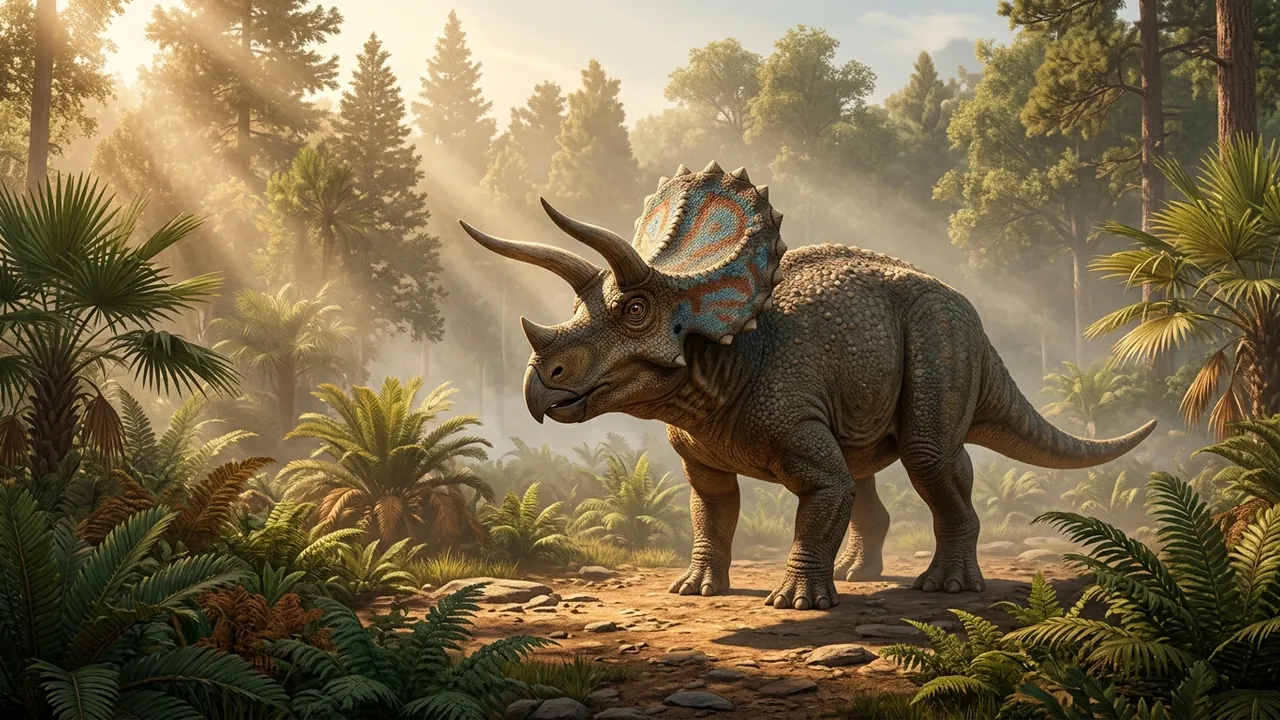
Meet the Legend: School-Bus Tank
Picture a four-legged tank as long as a yellow school bus and heavier than two full-sized pickup trucks stacked together! That giant was Triceratops (try-SAIR-uh-tops), whose Greek name means three-horned face. Its massive head alone stretched eight feet long—longer than a grown-up's mattress!
Two brow horns longer than baseball bats jutted forward above its dark eyes, while a shorter horn topped its snout. Behind its skull curved a solid bony coated in tough that likely gleamed with bright eye-catching patterns.
Lost World Habitat: Subtropical West
Sixty-eight million years ago, western North America looked nothing like today's dry rocky badlands. Warm, humid coastal plains stretched beside a glittering inland sea. Towering cypress trees, flowering magnolia bushes, and stiff palms lined lazy, winding riverbanks.
Triceratops shared these green woods with duck-billed dinosaurs, club-tailed Ankylosaurus, and giant river turtles as wide as car tires. Even when a hungry prowled among the shadows, warm summer rainstorms kept fresh green leaves sprouting all year across ancient Montana, Wyoming, and the Dakotas.
What's on the Prehistoric Menu?
Feeding a ten-ton dinosaur took hundreds of pounds of plants every single day! Because its heavy head hung low near its knees, Triceratops grazed bushes under five feet tall like a giant garden clipper. First, its narrow hooked beak wrapped in hard snipped tough ferns, palm shoots, and spiky stems.
Deep inside its jaws sat tall stacks of interlocking teeth that slid past each other like sharp scissors. Instead of grinding grass in circles like a modern cow, Triceratops sliced woody branches cleanly in half before swallowing!
Superpowers & Anatomy: Built-In Armor
Museum skeletons show bare bone cores, yet in life each horn wore a smooth outer sleeve of —the exact same tough material found in rhino horns, bird beaks, and your own fingernails! That glossy sheath added several extra inches of length and wickedly sharp tips to both brow horns.
Meanwhile, its solid bone anchored giant jaw muscles and protected its neck like a firefighter's helmet. Thick, pebbly skin covered in round five-sided scales wrapped its wide belly and muscular shoulders from nose to tail.
Flight vs. Fight Arena! Holding the Line
When booming footsteps warned that a giant like Tyrannosaurus rex was sneaking through the ferns, Triceratops could not climb trees or sprint at highway speeds. It could trot nearly as fast as a charging rhinoceros—close to twenty miles per hour—but its best survival choice was Team Fight!
Planting its wide front legs firmly in the mud, Triceratops swiveled its round neck joint like a smooth bowling ball. It kept its solid bony and three sharp horns aimed straight at the attacker until danger backed away!
Fossil Detective Secrets: Bison Mystery!
In 1887, quarry workers near Denver, Colorado, mailed famous Othniel Charles Marsh a pair of huge fossil horn cores. At first, Marsh guessed they belonged to a giant ice-age bison! Two years later, fossil explorer John Bell Hatcher dug up a nearly complete horned skull in Wyoming.
Seeing three horns and a sweeping bone together, every paleontologist realized a brand-new dinosaur giant had been found! Today, healed bite grooves on fossil shields prove brave Triceratops stood up to Tyrannosaurus rex and won.