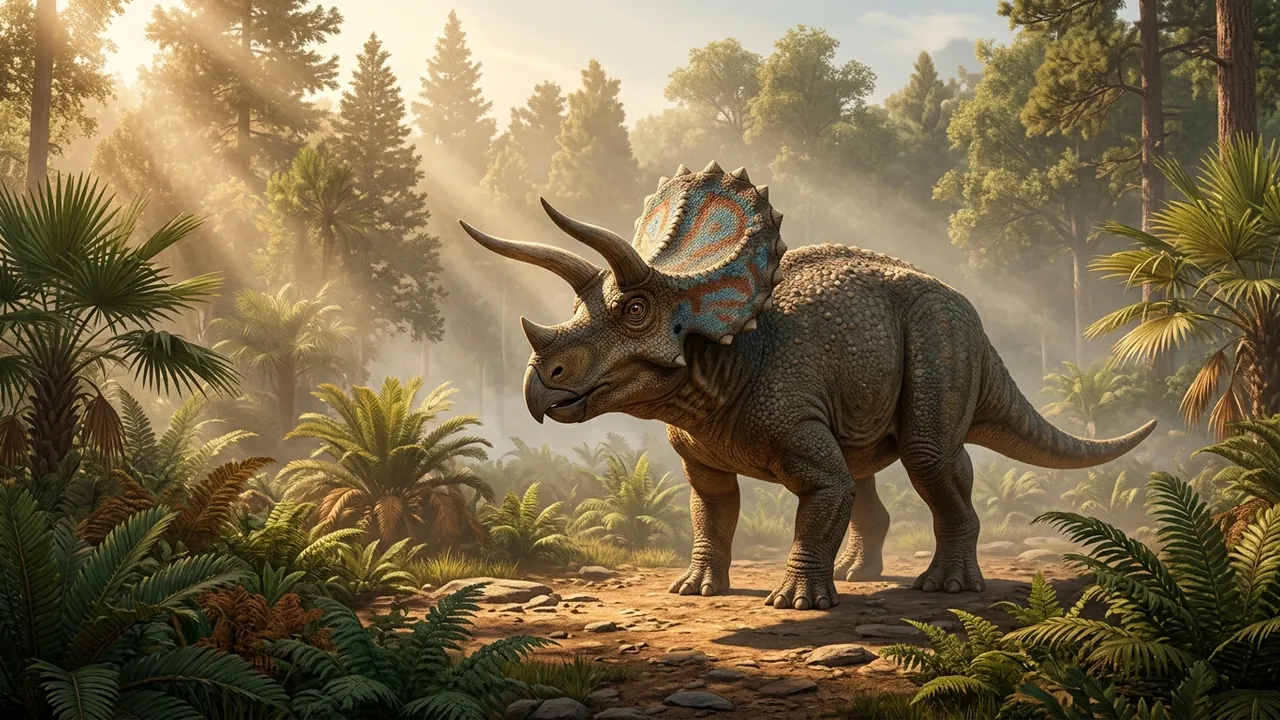
Meet the Legend: Engineering a Living Fortress
Standing nearly ten feet tall at the hips, stretching thirty feet from beak to tail tip, and tipping the scales at up to twelve tons, Triceratops horridus represented the pinnacle of horned dinosaur design. Its massive skull alone reached eight and a half feet in length—almost one-third of its entire body—making it one of the largest cranial structures ever built by a land vertebrate.
Three formidable weapons gave the genus its Greek name meaning three-horned face: a stout nasal horn above the nostrils and twin supraorbital brow horns arching more than three feet forward above the eye sockets. In life, tough sheaths of fibrous extended those bony cores even farther into curved, resilient spears.
Behind the brow horns swept a broad, saddle-shaped shield of solid bone nearly two inches thick along reinforced ridges. Unlike earlier horned cousins that carried fragile openings in their shields, Triceratops wore continuous bony plate armor.
Researchers studying dinosaur marvel at how four muscular, pillar-like limbs balanced that front-heavy skull against a thick counterbalancing tail. Rather than lumbering clumsily, Triceratops combined armored bulk with surprising agility.
Lost World Habitat: Subtropical Coastal Webs
Between sixty-eight and sixty-six million years ago, Triceratops dominated the warm, humid coastal lowlands of western North America along the retreating Western Interior Seaway. Meandering rivers carved broad floodplains carpeted with horsetails, ferns, cycads, conifers, and rapidly spreading flowering trees such as palms, figs, sycamores, and magnolias.
Within this thriving Late Cretaceous food web, Triceratops occupied an essential primary consumer level alongside duck-billed Edmontosaurus and club-tailed Ankylosaurus. Because different herbivores browsed at distinct heights—a principle ecologists call niche partitioning—the river valleys supported enormous plant-eating biomass without stripping woodlands bare.
Studying feeding shows that low-browsing Triceratops cleared tangled underbrush below five feet, while taller duck-billed herds reached leafy branches up to twelve feet above the ground. Together, these peaceful giants converted solar energy stored inside fibrous leaves into tons of living muscle.
By knocking down dense palm thickets, trampling muddy trails, and returning rich nutrients to floodplain soils, wandering Triceratops acted as true ecosystem engineers. Their sunny forest clearings allowed young ferns and wildflowers to sprout quickly while sheltering insects, frogs, small mammals, river turtles, and agile feathered raptors.
What's on the Prehistoric Menu?
Fueling ten tons of muscle required hundreds of pounds of fibrous foliage every day, and Triceratops possessed specialized jaw to process woody plants few rivals could chew. A narrow, hook-tipped rostral bone wrapped in sharp cropped tough palm stems, cycad crowns, and low branches cleanly near the ground.
Behind that beak sat an extraordinary : thirty-six to forty vertical columns in each jaw side, stacking three to five replacement teeth per column for up to eight hundred teeth in total! Unlike horses or cows that grind grass across flat horizontal crowns, Triceratops's jaws closed in a high-pressure vertical shear.
Powerful adductor muscles anchored onto the broad bony frill pulled the lower jaw upward like industrial hedge shears. As upper and lower tooth walls sliced past each other, hard outer enamel wore against softer inner dentine, maintaining a razor-sharp cutting edge throughout life.
Whenever gritty twigs wore down an active crown, a fresh tooth pushed upward from below in an endless conveyor belt. Chopped plant fibers then passed into a massive barrel-shaped hindgut where billions of symbiotic microbes unlocked rich nutrients.
Superpowers & Anatomy: Ball-Joint Physics
Supporting and aiming a thousand-pound skull demanded remarkable skeletal engineering. At the rear base of the cranium sat a nearly spherical bone knob called the , measuring roughly four inches across. Fitting smoothly into a cup formed by four fused neck vertebrae, this ball-and-socket joint gave Triceratops frictionless pitch, yaw, and roll mobility without risking neck sprains.
Inside the skull roof beneath the brow horns lay air-filled sinuses and spongy honeycombs of bone that acted like shock-absorbing crumple zones during heavy collisions. Externally, branching vascular channels supplied blood to thick plates covering both the solid bone frill and all three horns.
Sensory casts of its inner ear canals show that Triceratops held its muzzle tilted slightly downward at a natural forty-five-degree angle, keeping both brow horns poised forward while giving its wide-set eyes panoramic side vision across dense fern meadows. Enlarged nasal cavities also sharpened its sense of smell and helped cool warm blood flowing toward the brain.
Remarkable fossilized skin impressions—preserved on famous Wyoming specimens nicknamed Lane and Kelsey—reveal one more defensive secret: large polygonal flank scales surrounded raised conical scutes, armoring Triceratops's sides like studded leather plate!
Flight vs. Fight Arena! Horn-Lock Biomechanics
In an ecosystem patrolled by apex predator Tyrannosaurus rex—whose massive jaws delivered over eight thousand pounds per square inch of bone-crushing bite force—survival depended on split-second . Computer locomotion models estimate Triceratops could trot or gallop at sixteen to twenty miles per hour, impressive for an eight-ton quadruped, yet rarely fast enough to outrun a surprise ambush across muddy floodplains.
Consequently, Triceratops excelled at the top of Team Fight! Wide-set forelimbs powered by huge shoulder and triceps muscles acted like sturdy outriggers, spinning its heavy torso rapidly in place while the spherical kept twin three-foot horns locked on the attacker.
Charging headfirst into those lowered spears risked catastrophic injury to a predator's chest, belly, or legs, halting energy transfer to the top tier before a hunt even finished. Meanwhile, the solid two-inch-thick bone frill blocked downward bites aimed at vulnerable neck muscles and major arteries.
Within its own herds, rival Triceratops also locked arched brow horns in controlled shoving matches, testing muscular endurance to win mates and defend prime feeding clearings along the riverbank without causing fatal harm.
Fossil Detective Secrets: Scars of Survival
Forensic paleontology has transformed how scientists test hypotheses about dinosaur armor. In a landmark 2009 study, researchers inspected dozens of museum skulls under angled sidelights and documented healed punctures and fractures along squamosal frill bones—exactly where opposing horn tips pressed during intraspecific wrestling matches between rival Triceratops.
Other fossils capture unforgettable clashes at the very peak of the Hell Creek pyramid. One celebrated Montana skull preserves a supraorbital brow horn bitten partway through alongside deep, U-shaped grooves matching the spacing and serrations of Tyrannosaurus rex teeth.
When paleontologists examined that damaged horn under powerful microscopes, they discovered smooth rings of remodeled new bone sealing the fracture edges. Because bone tissue takes weeks and months to rebuild inside a living animal, that single fossil proved beyond doubt that Triceratops absorbed a direct strike from the tyrant king, drove its attacker back, and survived!
Together with quarry bonebeds holding multiple juveniles and adults buried side by side in Wyoming mudstone, these thrilling discoveries reveal Triceratops as an active, social, and fiercely resilient survivor that defended its place across North America's final dinosaur age.