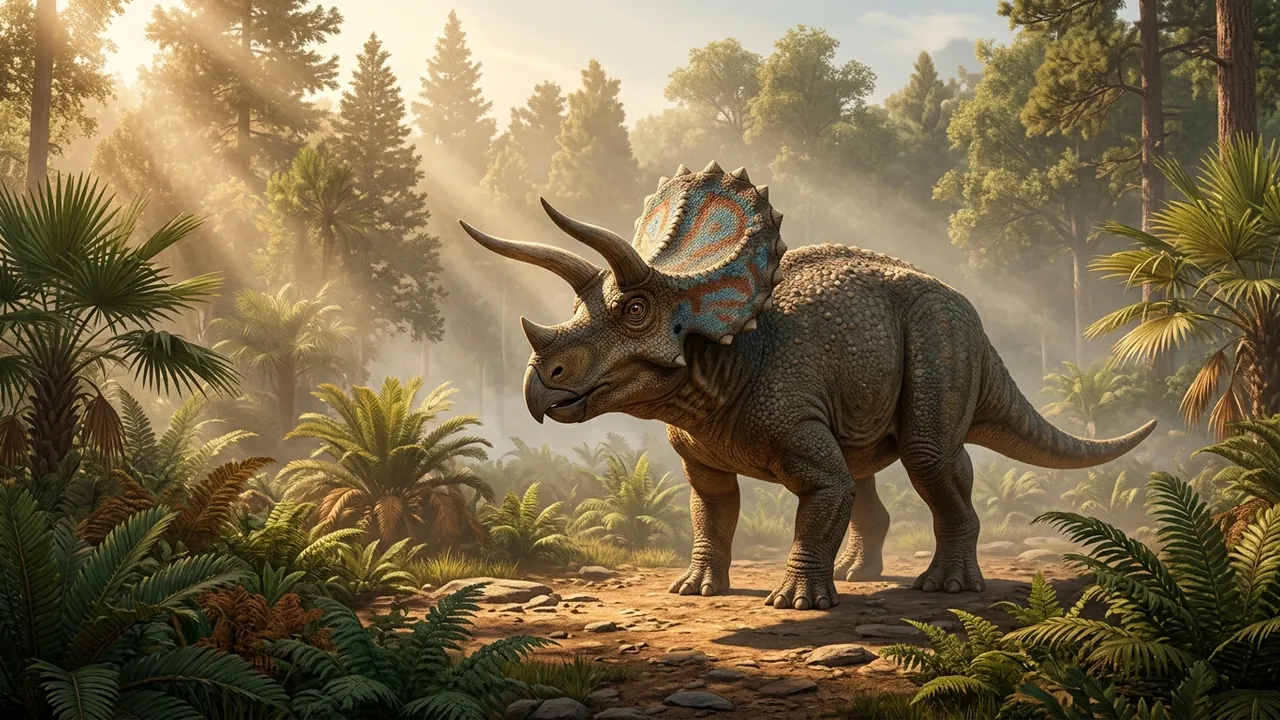
Meet the Legend: Armored Ceratopsian
Few prehistoric animals are as unmistakable as Triceratops, the largest and most famous —or horned dinosaur—ever to roam the Earth. Measuring up to thirty feet from nose to tail and weighing between six and twelve tons, an adult Triceratops matched the bulk of a huge African elephant while standing lower to the ground on four sturdy, column-like legs.
Its Greek name means three-horned face, a clue to its most dramatic physical . Two forward-curving brow horns each stretched over three feet above its deep-set eyes, paired with a stout nasal horn right behind its hooked beak.
Sweeping up behind its jaws flared a thick, saddle-shaped shield of solid bone. Together, horns and shield formed a giant skull over eight feet long—turning this peaceful browser into a living fortress that protected its soft neck and shoulders from hungry meat-eaters!
Lost World Habitat: Laramidia's Coast
Sixty-eight to sixty-six million years ago, Triceratops thrived across humid coastal floodplains in what are now Montana, Wyoming, the Dakotas, and western Canada. During that Late Cretaceous era, the warm Western Interior Seaway split North America into two separate landmasses: western Laramidia and eastern Appalachia.
While Virginia's Culpeper Basin preserves much older Early Mesozoic dinosaur footprints pressed into red quarry sandstone on the eastern side, Triceratops ruled western Laramidia's swampy river valleys millions of years later. Warm seasonal rains watered towering bald cypress groves, fan-leaved ginkgo trees, horsetails, ferns, and early flowering magnolias.
Every in this lush shared winding muddy creeks with soft-shelled river turtles, crocodile-like Champsosaurus, club-tailed Ankylosaurus, and noisy herds of duck-billed dinosaurs. Mild frost-free winters meant fresh leafy shoots kept growing twelve months a year across the misty plains, supporting thousands of hungry prehistoric browsers!
What's on the Prehistoric Menu?
In the Late Cretaceous floodplain , warm sunlight fueled thick mats of green ferns, cycads, and palms, while Triceratops acted as a giant primary consumer . Because its heavy neck held its mouth low near knee height, Triceratops cleared dense ground bushes under five feet tall that taller browsers ignored.
First, its narrow toothless beak cropped tough woody branches and leathery palm fronds cleanly from the stem. Next, tall columns of interlocking cheek teeth slid up and down past each other like self-sharpening garden shears, slicing stubborn plant fibers into neat bite-sized ribbons.
Behind its wide ribs sat an enormous barrel-shaped belly where helpful gut microbes fermented coarse leaves into steady energy. By pruning thick shrubs every afternoon, hungry Triceratops opened sunny forest clearings where young ferns and wildflowers quickly sprouted to feed smaller creatures!
Superpowers & Anatomy: Swivel Fortress
Every bone in a Triceratops skeleton revealed a smart structural for survival and herd communication. Unlike cousin species whose neck shields contained thin, skin-covered windows to save weight, Triceratops grew a solid, unbroken wall of thick bone across its entire frill.
Shallow branching grooves etched across that bone show where blood vessels nourished a tough outer coat of horn-like keratin. Scientists think Triceratops could pump extra warm blood into its shield to display vivid colors or recognize herd members across misty meadows!
Even more impressive, where the skull met the spine sat a polished ball-and-socket joint shaped like a round bowling ball. Backed by four fused neck bones for shock support, that smooth swivel allowed Triceratops to whip its thousand-pound head sideways or upward in seconds whenever sharp ears heard twigs snap.
Flight vs. Fight Arena! Facing the King
Sharing the forested floodplain with forty-foot Tyrannosaurus rex meant every needed a dependable defense plan. Smaller, lighter dinosaurs relied on speed to sprint out of reach, and Triceratops could certainly lumber into a brisk rhino-like trot across firm ground when startled.
Yet trying to outrun a long-legged ambush hunter through muddy ferns was risky for an eight-ton giant. Instead, Triceratops relied on a bold behavioral —standing firm on Team Fight rather than fleeing!
At the first rustle of danger, an alert adult planted its wide front elbows, dropped its chin low, and swiveled rapidly on its round neck joint. Keeping three sharp horns and an unbreakable bone shield aimed straight at the hunter's chest turned a sudden ambush into a dangerous standoff that forced many hungry predators to retreat into the trees!
Fossil Detective Secrets: Floodplain Clues
Why have paleontologists unearthed hundreds of Triceratops skulls across western badlands? Whenever heavy seasonal rains flooded Late Cretaceous rivers, swirling water buried sturdy bones beneath thick blankets of mud, sand, and volcanic ash .
Locked safely away from air and bone-chewing scavengers, dissolved minerals slowly seeped into tiny pores and turned those heavy skulls into solid stone over millions of years. Today, wind and rain erode soft hillsides across Montana, Wyoming, and South Dakota, exposing giant fossil horns and broad frills to sharp-eyed museum explorers!
Several museum skulls even preserve deep oval tooth gouges matching Tyrannosaurus rex jaws—surrounded by smooth, newly regrown bone tissue. Because dead bone never heals, those remarkable fossil scars prove beyond any doubt that real Triceratops fought back bravely against the tyrant king, survived the encounter, and kept grazing peacefully for years afterward!