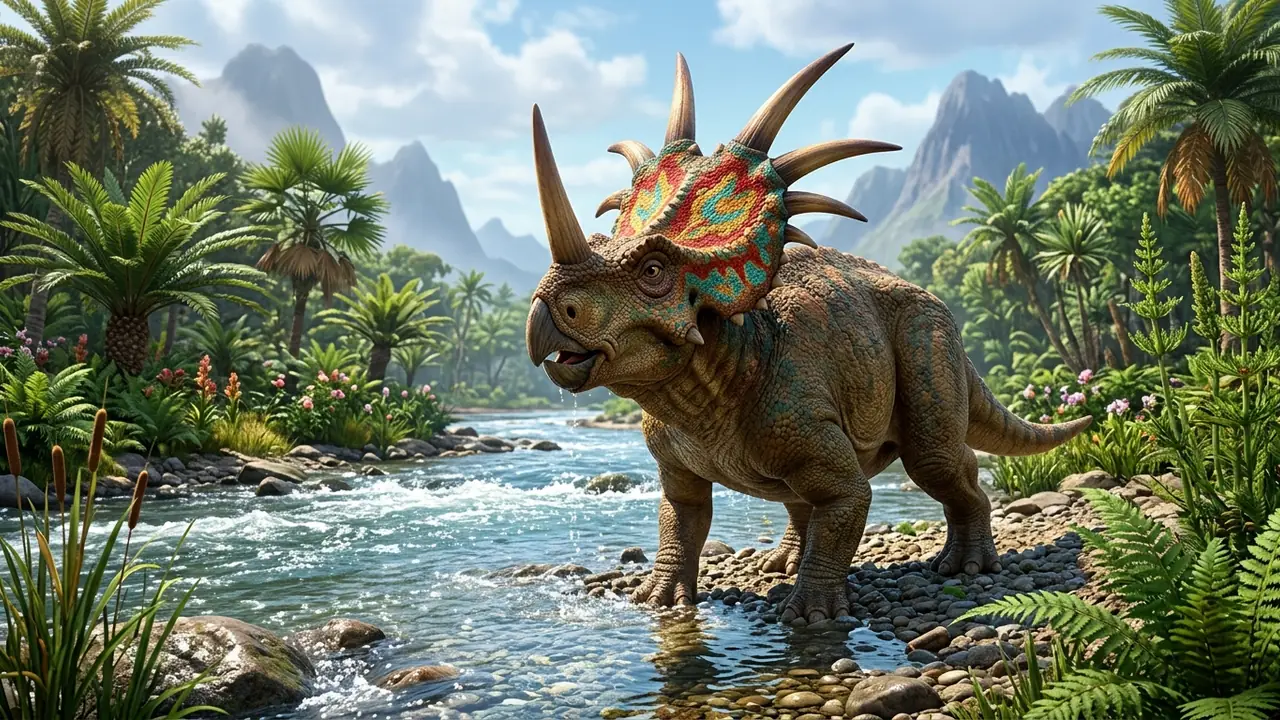
Meet the Legend: Ornamented Icon of Centrosaurinae
During the late Campanian stage of the Late Cretaceous Period, Styracosaurus albertensis reigned across western Canada as one of the most flamboyantly ornamented herbivores in vertebrate history. Measuring roughly five and a half meters from rostral beak to tail tip and weighing between two point seven and three metric tons, this stocky quadrupedal browser belonged to Centrosaurinae, one of the two major evolutionary subfamilies within Ceratopsidae.
Whereas contemporary chasmosaurine relatives such as Chasmosaurus—and later Maastrichtian giants like Triceratops—emphasized elongated brow horns and broad triangular shields, architecture concentrated formidable front weaponry onto a single hypertrophied nasal horn core reaching fifty-seven centimeters—nearly two full feet—above the nostrils, leaving only low, rugose bony bosses over the eye sockets.
Posteriorly, the vaulted parietal and squamosal frill supported an astonishing sunburst corona of elongated epoccipital processes: locus pair three and pair four radiated backward and outward as sword-like bony spikes up to fifty-five centimeters long, flanked by shorter forward-curving hooks and lateral cheek tabs.
Beneath tough keratinous sheaths and vividly patterned skin, wide paired parietal fenestrae lightened the massive cranium without sacrificing visual display area or jaw-muscle attachment space across the rear skull arches.
Tracing dramatic spike growth across cranial further demonstrated that no two mature adults carried identical crowns, equipping each three-ton defender with an unmistakable social badge alongside potent front-line armor. Robust five-toed forelimbs, four-toed hind feet, and a barrel-shaped torso anchored ten fused sacral vertebrae into a low, unshakable center of gravity built for wet delta terrain.
Lost World Habitat: Dinosaur Park Stratigraphy
Every confirmed fossil of Styracosaurus albertensis derives from the upper mudstone and sandstone horizons of the Dinosaur Park Formation exposed across the sculpted badlands of Dinosaur Provincial Park in southern Alberta, Canada. High-precision argon-argon dating of volcanic sanidine crystals extracted from interlayered bentonite ash beds anchors Styracosaurus's geological window tightly between seventy-five point five and seventy-five million years ago.
Detailed centimeter-scale rock across seventy meters of exposed canyon walls documents a striking ecological turnover: lower sandy river-channel deposits dominated by ancestral Centrosaurus apertus transition upward into muddier, lower-gradient coastal marshes and estuarine bayous ruled by Styracosaurus albertensis as the warm Western Interior Seaway expanded westward across Laramidia.
Fossilized tree trunks, preserved leaf cuticles, and microscopic spore and pollen assemblages reconstruct a humid, warm-temperate to subtropical coastal plain crisscrossed by meandering rivers, oxbow lakes, peat swamps, and brackish tidal creeks.
Lush canopies of Metasequoia dawn redwoods, bald cypresses, ginkgoes, podocarp conifers, cycads, tree ferns, and dense woody angiosperm shrubs thrived under seasonal summer monsoons and mild, frost-free coastal winters that kept green browse growing continuously throughout the year.
Within this extraordinarily productive lowland wetland, migrating Styracosaurus herds shared floodplain habitats with chasmosaurine Chasmosaurus, crested hadrosaurs Corythosaurus, Lambeosaurus, and Parasaurolophus, club-tailed ankylosaur Euoplocephalus, giant alligatoroids, freshwater sawfish, soft-shelled turtles, feathered dromaeosaurs, and powerful tyrannosaurid apex predators patrolling the wooded riverbanks. Because no two species overlapped inside the exact same rock horizon, field geologists can trace rapid species replacement step by step right up the steep Canadian canyon cliffs!
What's on the Prehistoric Menu?
Supporting more than a dozen coexisting megaherbivore species across Dinosaur Park Formation required fine-grained ecological niche partitioning among coastal plant-eaters. Quantitative comparisons of muzzle width, lower-jaw depth, and microscopic tooth-wear scratches demonstrate exactly how Styracosaurus avoided direct food competition with neighboring chasmosaurines, wide-muzzled ankylosaurs, and towering duck-billed hadrosaurids.
Held less than one meter above the damp floodplain soil on sturdy forelimbs, its narrow, hook-tipped rostral and predentary beak—sheathed in continuously growing, sharp keratin—acted like heavy-duty pruning pliers to selectively snap fibrous palm stems, stiff cycad fronds, woody angiosperm twigs, and coarse fern rhizomes near knee height.
Cropped bundles of tough coastal brush passed immediately rearward into twenty-eight to thirty tightly packed vertical tooth columns per jaw side, where three to five replacement crowns stacked neatly beneath each active cutting tooth in an endless conveyor belt.
Driven upward by massive jaw adductor muscles threading through the upper skull openings onto reinforced parietal bone struts, opposing upper and lower enamel blades sliced past one another in a strict vertical shear with virtually zero horizontal grinding motion.
Throughout juvenile-to-adult , expanding tooth column counts and deepening dentary bones multiplied slicing leverage so mature three-ton adults dismantled coarse, woody coastal underbrush untouched by higher-browsing Corythosaurus herds. Finely chopped plant fibers then entered a spacious barrel-ribbed hindgut where symbiotic microbes fermented stubborn cellulose into steady metabolic energy across every season of the Late Cretaceous year, fueling long coastal migrations across ancient Alberta's lush river plains.
Superpowers & Anatomy: Cranial Ontogeny & Asymmetry
Reconstructing cranial across juvenile, subadult, and adult skulls from Alberta illuminated how Styracosaurus balanced mechanical strength with vivid social signaling. Young juveniles possessed short, unadorned frills rimmed by small triangular bone scallops alongside modest, laterally flattened nasal horn cores that barely rose above the narrow snout.
Only as subadults neared reproductive maturity did rapid bone remodeling elongate parietal spike pairs three and four into sweeping fifty-centimeter blades while thickening the upright nasal horn into a formidable cylindrical spear. Simultaneously, wide paired parietal fenestrae hollowed out non-load-bearing central plate bone beneath tough, vascularized skin, keeping the six-foot display crown light enough to pivot smoothly atop its spherical occipital condyle and fused four-vertebra neck rod.
Remarkably, articulated skulls such as the celebrated Dinosaur Provincial Park specimen nicknamed Hannah exhibit pronounced left-right fluctuating asymmetry—carrying different spike counts, hook shapes, and angles on opposite halves of the very same frill!
Detailed quarry and microscopic bone-surface histology confirm these asymmetrical crowns reflect genuine biological individuality rather than post-burial rock distortion, acting much like unique facial badges inside crowded migrating herds.
Paired with cavernous nasal chambers capable of cooling warm arterial blood during strenuous summer marches and resonating low-frequency herd calls across misty bayous, Styracosaurus united sensory communication, individual recognition, and structural physics inside one iconic skull. Branching blood-vessel impressions etched deep across each bone core prove that glossy sheaths of tough keratin extended every crown spike and nasal spear even farther in life, creating an unmistakable silhouette!
Flight vs. Fight Arena! Tyrant vs. Herd Defense
Sharing waterlogged coastal floodplains with nine-meter, three-ton tyrannosaurid Daspletosaurus torosus—alongside slightly lighter, long-legged cousin Gorgosaurus libratus—placed intense evolutionary pressure on survival tactics. Skeletal limb proportions, featuring muscular bowed forelimbs and pillar-like hind legs anchored to ten fused hip vertebrae, granted Styracosaurus rapid rotational agility and a brisk twenty-five-kilometer-per-hour charge, yet soft delta mud penalized solitary flight away from danger.
Consequently, Styracosaurus excelled squarely on Team Fight through coordinated gregarious defense! Whereas solitary chasmosaurines relied on twin meter-long brow spears, a startled Styracosaurus herd closed ranks shoulder to shoulder in seconds, sheltering vulnerable juveniles behind adult flanks while presenting a bristling wall of fifty-seven-centimeter keratin-tipped nasal horns.
Tilting their chins downward swung six-spiked parietal crowns high overhead, magnifying apparent herd size across misty reed beds and deterring exploratory stalks by young tyrannosaurs before physical contact ever began along wooded river levees.
Whenever an adult Daspletosaurus pressed a riverbank ambush, wide forelimb stances and smooth ball-jointed necks allowed front-line defenders to pivot in unison, threatening devastating upward horn thrusts toward a predator's unarmored chest, belly, or throat.
Meanwhile, late-developing frill spikes shaped during adult allowed rival herd mates to settle social dominance through dramatic head-bobbing displays and broadside shoving contests without inflicting fatal puncture injuries on fellow herd defenders. United in numbers along every muddy riverbank crossing, an alert Styracosaurus herd formed one of prehistoric North America's toughest living fortresses, turning cooperative vigilance and overlapping nose spears into unbeatable group survival power!
Fossil Detective Secrets: Bonebed Taphonomy & Discovery
Scientific discovery of Styracosaurus began in 1913 when veteran fossil explorer Charles H. Sternberg excavated a breathtaking spiked holotype skull from Campanian badland cliffs along Alberta's Red Deer River, described later that year by paleontologist Lawrence Lambe as Styracosaurus albertensis. Astonishingly, museum crews returned to Sternberg's exact hillside quarry twenty-two years later in 1935 and recovered the matching lower jaws and articulated body skeleton still waiting inside the stone!
Even deeper behavioral insights emerged from forensic bonebed across Dinosaur Provincial Park, where single mudstone and sandstone horizons—most famously Bonebed 42—preserve disarticulated skeletons from dozens to hundreds of Styracosaurus individuals with almost zero other herbivore species mixed in.
Water-current alignments, bone weathering stages, and hydraulic sorting patterns indicate that catastrophic coastal storms or swollen monsoon river crossings drowned entire multi-generational herds simultaneously during seasonal migrations across the lush coastal plain.
Scavenging Daspletosaurus and small theropods left shed serrated teeth and shallow bite grooves across limb bones before river silts sealed the graves, while argon-argon ash dates pinned these herd events inside a narrow half-million-year slice of upper Dinosaur Park .
By uniting historic quarry maps with modern taphonomic forensics and medical CT growth series, paleontologists turned silent Canadian badlands into vivid proof of social, spiky-crowned unicorn tanks standing strong together against Late Cretaceous predators. Ongoing summer excavations along Alberta's Red Deer River continue to uncover fresh skulls and juvenile bones that deepen our understanding of herd life with every field season.