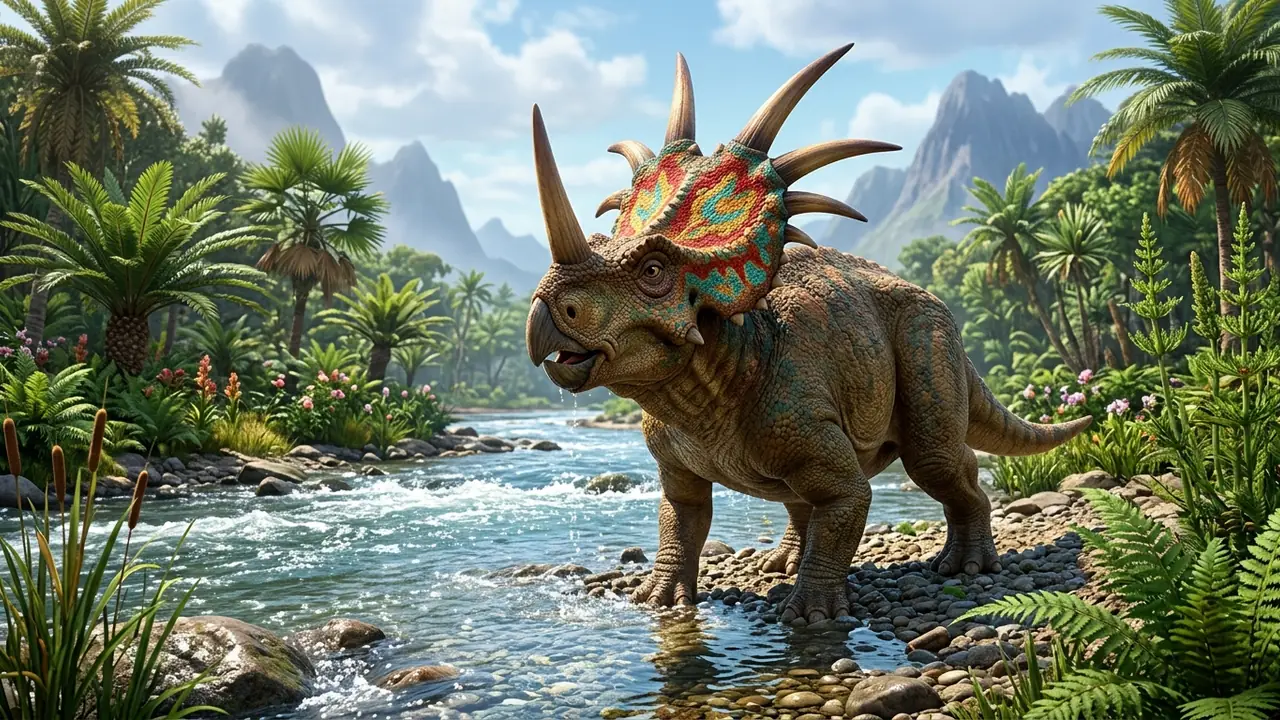
Meet the Legend: Spiky-Crowned Centrosaurine
Measuring eighteen feet from beak to tail tip and weighing close to three tons, Styracosaurus wore some of the boldest headgear ever grown by any land animal on Earth! Scientists classify this muscular four-legged browser as a —a specialized branch of horned dinosaurs celebrated for towering nose horns, tiny brow bumps, and flamboyant spiked neck shields.
Right behind its hooked parrot-like beak rose a straight nasal horn two feet tall, thicker than a grown-up's forearm and pointed skyward like a rhino spear. Above its deep-set dark eyes sat only low rounded bosses, saving the biggest visual surprise for the back of its skull.
Flaring upward from its neck rim radiated six spectacular bony spikes—plus smaller curved cheek hooks—turning its head into a living sunburst crown! Every gleaming spike and horn served as a vital for herd recognition and fearless front-line defense.
Lost World Habitat: Laramidia's Coastal Bayou
Seventy-five million years ago during the Late Cretaceous Period, Styracosaurus roamed lush coastal floodplains in what is now Dinosaur Provincial Park in southern Alberta, Canada. Back then, the warm, shallow Western Interior Seaway split North America right down the middle into western Laramidia and eastern Appalachia.
While Virginia's Culpeper Basin on eastern Appalachia preserves much older Early Mesozoic dinosaur footprints pressed into red sandstone quarries, Styracosaurus flourished millions of years later along western Laramidia's humid eastern shoreline. Wide, lazy rivers meandered through misty swamps of bald cypress, dawn redwood, ginkgoes, tree ferns, and tough palmetto thickets.
Inside this rich wetland , every herd shared muddy watering holes with trombone-crested Parasaurolophus, club-tailed ankylosaurs, giant soft-shelled river turtles, crocodile-like swimmers, and stalking thirty-foot tyrannosaurs. Warm sea breezes and summer rainstorms kept Alberta's coastal deltas lush, green, and frost-free all year long!
What's on the Prehistoric Menu?
Within Alberta's coastal floodplain , warm sunlight fueled dense tangles of ferns, cycads, palms, and woody bushes, while Styracosaurus served as a powerhouse primary consumer . Because four sturdy, column-like legs held its muzzle less than three feet above the mud, it specialized in clearing tough ground shrubs below the reach of taller duck-billed browsers.
First, its deep toothless beak plucked fibrous stems and stiff palm fronds cleanly from the stalk with strong lever action. Next, towering stacks of interlocking cheek teeth slid past each other vertically like heavy-duty pruning shears, chopping woody plant fibers into neat bite-sized ribbons instead of grinding them flat.
Swallowed greens then fermented inside an enormous barrel-shaped gut packed with helpful digestive microbes. As hundreds of hungry herbivore mouths pruned thick riverside brush together, migrating Styracosaurus herds recycled rich nutrients into floodplain soils and opened sunny glades for sprouting wildflowers!
Superpowers & Anatomy: Lightweight Crown Design
How could Styracosaurus hold up a massive five-foot skull crowned with six long spikes without straining its neck muscles every step of the day? Looking closely at a museum skeleton reveals a brilliant structural : two wide, oval openings pierced right through the bone floor of its neck shield!
In life, thick leathery skin and colorful horn-like keratin stretched smoothly across both openings like tight drumheads, trimming away dozens of pounds of extra bone weight while keeping the dramatic spiked silhouette wide and tall. Shallow branching grooves etched into the fossil spikes show where living blood vessels nourished those gleaming outer horn sheaths from base to tip.
Paired with huge, cavernous nasal passages inside the snout that cooled warm blood and amplified deep rumbling calls, headgear worked like a billboard and megaphone combined—helping herd mates spot leaders across misty coastal marshes!
Flight vs. Fight Arena! Standing Against Tyrants
Sharing wooded riverbanks with twenty-nine-foot Daspletosaurus—a muscular three-ton tyrannosaur armed with thick, bone-crushing teeth—meant every needed a dependable defense plan. Although Styracosaurus could trot briskly on sturdy legs across dry ground when startled, soft delta mud made outrunning a long-legged ambush hunter far too risky.
Instead, Styracosaurus combined sharp physical armor with cooperative group behavior squarely on Team Fight! At the very first alarm snort from a watchful lookout, mature adults pivoted rapidly on wide front stances, locking muscular shoulders into a tight outward-facing semicircle in front of vulnerable calves and youngsters.
Confronted by an unbroken wall of straight two-foot nasal spears and waving six-spiked crowns, charging headfirst risked serious injury for even the boldest Daspletosaurus! That smart behavioral transformed individual grazers into a united herd fortress that forced hungry predators to back down.
Fossil Detective Secrets: Stories in the Bonebeds
How do paleontologists know for sure that Styracosaurus traveled in big social groups instead of wandering through ancient forests alone? Across Alberta's rugged Dinosaur Provincial Park, scientists have mapped extraordinary single-species quarries where dozens—and sometimes hundreds—of skeletons lie preserved together inside one flood sandstone layer!
Seventy-five million years ago, powerful coastal storms or swollen monsoon rivers occasionally caught entire migrating herds crossing wide channels, burying juveniles, teenagers, and full-grown adults simultaneously beneath protective blankets of sand and river silt.
Studying skulls from every age group preserved inside a single bonebed let fossil detectives watch Styracosaurus grow up step by step! Youngsters hatched with short, smooth frills and small triangular nose bumps, then sprouted sweeping curved crown spikes only as mature adults—proving flashy frill spikes signaled adulthood, health, and herd status across ancient Canada!