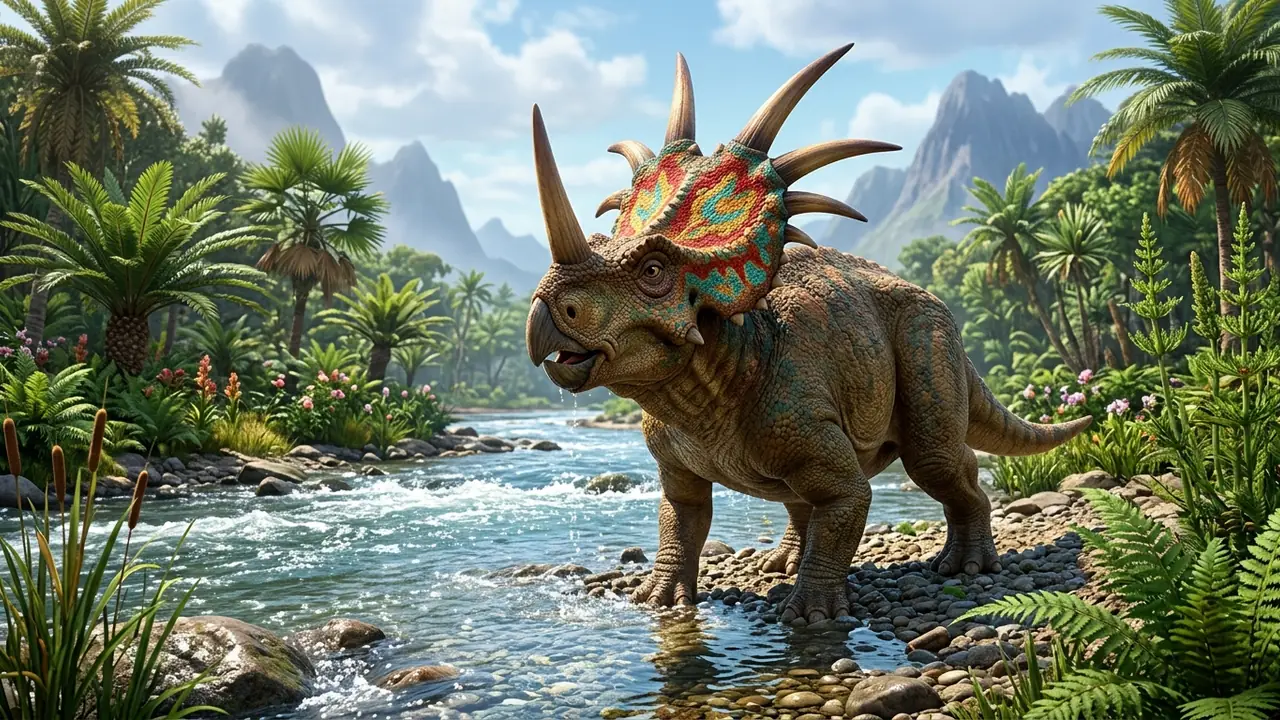
Meet the Legend: Engineering the Spiked Unicorn
Stretching eighteen feet from rostral beak to tail tip, standing six feet tall at the shoulders, and weighing close to three tons, Styracosaurus albertensis ranks among the most visually dramatic horned dinosaurs ever unearthed. Unlike later Triceratops—which carried long brow horns and a solid bone shield—Styracosaurus belonged to the centrosaurine branch, investing its armor into a straight two-foot nasal spear and a dazzling crown of neck spikes.
Six elongated bony spikes radiated outward and upward from the top rear margin of its parietal frill, with the longest central pairs rivaling the twenty-four-inch nose horn itself! Smaller curved bony tabs lined the lower cheek borders while low, rounded bosses sat harmlessly above the deep-set eyes.
To prevent that massive five-foot skull from overloading its neck, twin oval openings called parietal pierced the shield floor beneath tough, colorful skin and glossy keratin sheaths.
Specialists in dinosaur admire how compact, muscular hindquarters and a round ball-and-socket neck joint balanced that ornate head. Stocky five-toed forefeet and four-toed hind feet spread six thousand pounds of body mass firmly across soft coastal delta mud without sinking during long seasonal marches.
Lost World Habitat: Alberta's Coastal Food Web
Around seventy-five million years ago, Styracosaurus thrived across the warm, waterlogged coastal lowlands of southern Alberta, Canada, right along the western margin of the Western Interior Seaway. Braided rivers flowing down from young Rocky Mountain highlands spilled across lush alluvial plains carpeted with dawn redwoods, bald cypresses, ginkgoes, tree ferns, cycads, and woody flowering shrubs.
Within this extraordinarily rich Late Cretaceous food web, Styracosaurus occupied a vital primary consumer position alongside crested duck-billed dinosaurs like Corythosaurus and Parasaurolophus, flat-headed hadrosaurs, and heavily armored club-tailed ankylosaurs.
How did so many giant herbivores share one coastal strip without stripping the forest bare? Detailed jaw studies point to ecological niche partitioning: tall hadrosaurs browsed softer leaves four to twelve feet overhead, wide-muzzled ankylosaurs cropped low ground herbs, and narrow-beaked Styracosaurus sheared tough woody thickets near knee level.
By bulldozing dense coastal brush in migrating herds and fertilizing wet floodplain soils, Styracosaurus opened sunlit marsh channels across the wide river delta. Warm summer rains kept fresh green shoots sprouting rapidly all year, supporting soft-shelled river turtles, armored gars, freshwater rays, crocodile-shaped Champsosaurus, small climbing mammals, and swift feathered theropods.
What's on the Prehistoric Menu?
Sustaining nearly six thousand pounds of active muscle demanded relentless daily foraging from dawn to dusk, and Styracosaurus carried precision jaw built to dismantle tough coastal vegetation. A deep, narrow rostral beak wrapped in sharp keratin pinched and snapped fibrous palm stems, stiff cycad fronds, and woody branches near ground level without wasting a single bite.
Immediately behind that cropping beak sat a powerhouse containing twenty-eight to thirty tightly packed vertical tooth columns in each jaw side, with multiple replacement crowns stacked beneath every active tooth! Rather than grinding sideways across flat surfaces like modern cows or horses, upper and lower tooth walls met in a steep, scissor-like vertical shear.
Massive jaw adductor muscles threaded upward through skull openings to anchor along the sturdy bony struts framing the parietal , generating tremendous slicing force with every chomp. Hard outer enamel wore more slowly than softer inner dentine, keeping each cutting ridge razor-sharp throughout life.
Chopped woody plant fibers then passed into a huge barrel-shaped hindgut supported by wide ribs, where billions of helpful microbes fermented stubborn cellulose into steady energy for the entire migrating herd.
Superpowers & Anatomy: Fenestrated Shield Physics
Balancing dramatic display grandeur against skeletal weight required clever structural engineering inside Styracosaurus's giant cranium. Had its expansive frill been cast from solid two-inch plate bone from edge to edge, lifting six sword-like spikes would have strained even its fused four-vertebra neck rod. Instead, paired parietal hollowed out two wide windows inside the shield floor while thick bony beams reinforced the outer spike-bearing rim.
Covered in life by tough vascularized skin and horn-like keratin, those lightweight windows created a broad, brightly patterned visual sail for species recognition and herd communication without adding excess mass. Meanwhile, a polished spherical joint at the base of the skull let Styracosaurus pivot its twenty-four-inch nasal horn swiftly left, right, or upward in a split second.
Enormous arched nasal cavities occupied over half the snout volume directly beneath that straight horn core, housing scrolled tissues that cooled warm blood during strenuous summer marches and amplified low-frequency rumbling calls.
Computer tests of ceratopsian skull confirm that centering its tallest weapon right above the thick nasal arch channeled upward thrust forces safely into the muscular neck, wide shoulders, and sturdy front limbs!
Flight vs. Fight Arena! The Spiked Phalanx
Patrolling Alberta's forested riverbanks was Daspletosaurus torosus, a thirty-foot, three-ton apex tyrannosaur whose bone-splintering jaws sat right at the summit of the coastal pyramid. Locomotor indicate Styracosaurus could charge or trot at roughly fifteen to eighteen miles per hour across firm ground, yet slippery delta mud rarely favored solitary sprints away from a sudden ambush.
Instead, Styracosaurus mastered collective defense on Team Fight by uniting individual weapons into a disciplined herd ! Whenever watchful sentinel adults smelled or spotted a stalking Daspletosaurus in the cypress shadows, mature three-ton defenders wheeled shoulder to shoulder, tucking smaller calves safely behind their wide, muscular hips.
Dropping their chins tilted six-spiked crowns high into an intimidating visual wall while leveling dozens of straight two-foot nasal spears right at tyrannosaur chest and belly height. Charging into a locked phalanx meant risking a devastating upward horn thrust before jaws could ever reach an exposed neck or shoulder.
Within the herd itself, tall spiked frills let rival adults settle social rank through dramatic head-bobbing displays and controlled flank-pushing contests without injuring herd allies needed for daily protection along dangerous waterways.
Fossil Detective Secrets: Mass Bonebed Clues
In 1913, legendary fossil explorer Charles H. Sternberg excavated an extraordinary spiked skull from steep badland cliffs along Alberta's Red Deer River, prompting paleontologist Lawrence Lambe to name Styracosaurus albertensis. Over the century that followed, researchers mapping Dinosaur Provincial Park uncovered vast single-species bonebeds holding scores of Styracosaurus skeletons buried together inside ancient flood channels.
Because every adult skull preserved slightly different spike curves and angles around its parietal , early twentieth-century scientists mistakenly named extra species from natural individual variation—much like mistaking two elk with slightly uneven antlers for separate species!
Assembling complete growth series from tiny juveniles to mature elders inside one shared bonebed solved that mystery while illuminating social herd life in vivid detail. Youngsters carried short, smooth frills and modest triangular nose horns, sprouting long curved parietal spikes and full twenty-four-inch nasal spears only as mature breeding adults.
Combined with hundreds of worn teeth shed from active columns and trampled coastal mudstones along ancient river bends, Alberta's bonebeds prove Styracosaurus migrated in multi-generational family herds that stood together like spiked fortresses across prehistoric western Canada!