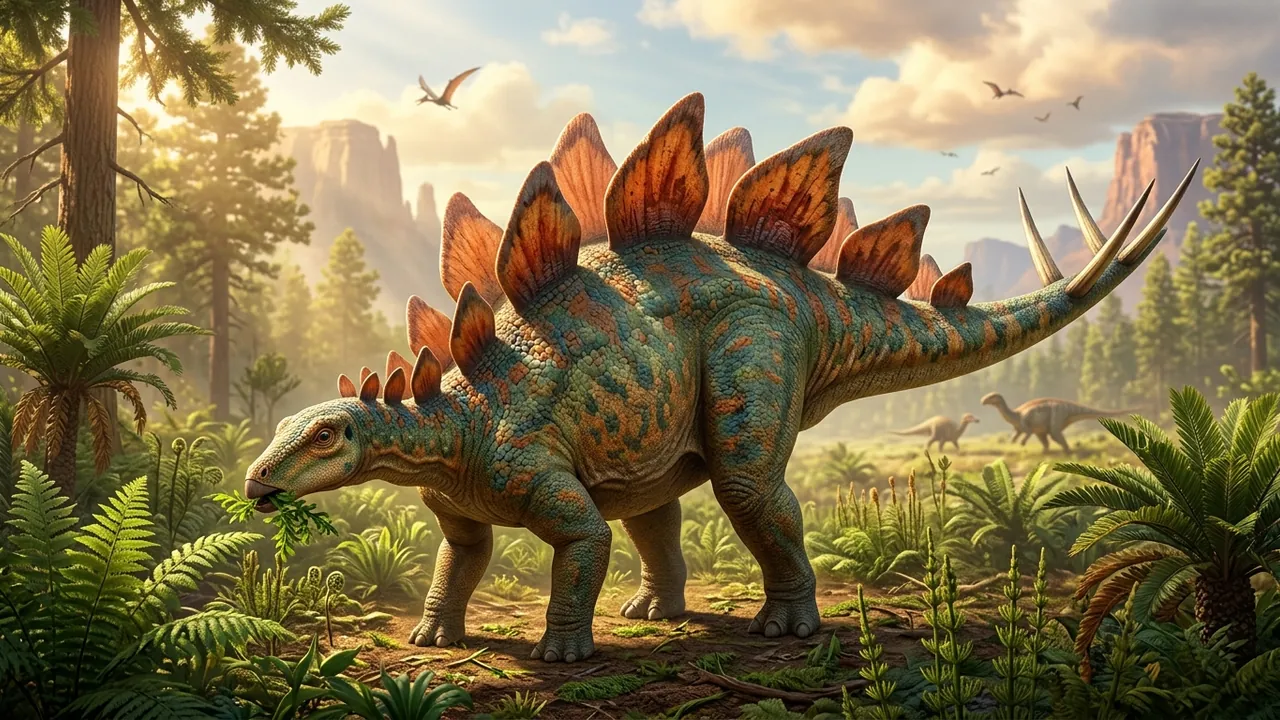
Meet the Legend: Masterpiece of Thyreophoran Design
Among all armored dinosaurs of the clade Thyreophora—the evolutionary lineage uniting plated stegosaurs and club-tailed ankylosaurs—Stegosaurus stenops stands as an unmistakable icon of the Late Jurassic Period. Adult individuals measured twenty-six to thirty feet in length and weighed between five and seven metric tons, balancing a remarkably small, elongated cranium against a cavernous barrel-shaped torso and muscular, high-held tail.
Disproportionate limb proportions defined its posture: short, heavily muscled forelimbs with five broad digits held the shoulders low, whereas elongated, pillar-like hind limbs with three hoofed toes elevated the pelvis nearly ten feet above the ground.
Crowning that steeply arched vertebral column rose seventeen enlarged dermal plates arranged in two staggered, alternating rows running from the axis neck bone to the distal tail. Each upright plate developed within the deep skin dermis as a specialized rather than fusing directly to underlying neural spines.
Near the tail tip projected four conical dermal spikes up to one meter long—sheathed in tough horn in life—pointing posterolaterally to create a formidable defensive array against large theropods.
Cladistic comparisons link Stegosaurus to older Middle Jurassic relatives from Europe and China such as Huayangosaurus, showing how early spiky shoulder armor gradually gave way to enlarged midline plates across sixty million years of evolution.
Microscopic bone further reveals rapid juvenile fibrolamellar bone deposition, proving young Stegosaurus grew swiftly toward multi-ton adult size before investing heavy mineral resources into thickening its signature dorsal plates and lethal tail spikes.
Lost World Habitat: Morrison Formation Stratigraphy
Paleontologists reconstruct Stegosaurus's world primarily from the renowned Morrison Formation, an expansive sedimentary rock sheet spanning over one million square kilometers across Colorado, Utah, Wyoming, Montana, and New Mexico. High-precision uranium-lead and argon-argon dating of volcanic ash horizons places Stegosaurus's reign during the Kimmeridgian and Tithonian stages of the Late Jurassic, roughly 155 to 145 million years ago.
Detailed Morrison reveals a dynamic seasonal landscape shaped by rain shadows east of rising western mountain ranges. Braided rivers and alkaline floodplain lakes bordered by gallery conifer, ginkgo, and tree-fern forests gave way to sun-baked fern savannas dotted with drought-hardy cycads and horsetails.
Carbonate soil nodules, mud cracks, and fossilized lungfish aestivation burrows confirm pronounced dry seasons punctuated by flash monsoon floods that swept dinosaur carcasses onto sandy riverbars.
Within the Morrison sequence, Stegosaurus fossils occur most abundantly across middle Brushy Basin Member mudstones alongside Camptosaurus, Dryosaurus, and gargantuan sauropods Diplodocus, Apatosaurus, Brontosaurus, and Brachiosaurus.
Remarkably, in 2006 researchers excavated a partial Stegosaurus skeleton inside coastal delta mudstones of the Lourinhã Formation in western Portugal! That transatlantic discovery proved ephemeral Late Jurassic land bridges briefly reconnected eastern North America with the Iberian Peninsula across the young, rifting North Atlantic Ocean.
On both continents, Stegosaurus navigated open fern plains, cycad thickets, and wooded river corridors patrolled day and night by apex theropods Allosaurus fragilis, blade-horned Ceratosaurus, and massive Torvosaurus. Rich bonebeds across both regions show plated stegosaurs thrived wherever seasonal water sustained lush ground ferns.
What's on the Prehistoric Menu?
Because flowering angiosperms and silica-rich grasses had not yet evolved during Late Jurassic , primary production across the Morrison basin relied entirely on spore-bearing ferns, equisetalean horsetails, clubmosses, seed ferns, cycadophytes, ginkgoes, and tall conifers. Within this crowded megaherbivore guild, Stegosaurus occupied a dedicated low-browsing ecological tier within one meter of the ground.
For generations, anatomists assumed Stegosaurus's narrow rostrum and small, leaf-shaped dentary teeth restricted it to mushy aquatic mosses. In 2016, however, paleobiologists built finite-element biomechanical models from high-resolution CT scans of Stegosaurus stenops and early stegosaurian relatives.
Their digital stress simulations overturned the weak-bite stereotype: Stegosaurus stenops generated posterior bite forces exceeding five hundred Newtons—comparable to modern sheep and cattle—allowing its sharp keratinous predentary beak and crenulated cheek teeth to shear tough cycad fronds, woody conifer twigs, and fibrous horsetail stems!
Dental enamel and scanning electron microwear analyses confirm rapid tooth replacement rates paired with microscopic chips from biting gritty stems coated in windblown floodplain dust.
Deeply inset tooth rows bordered buccal emarginations that anchored muscular cheeks, retaining clipped plant matter inside the oral cavity for repeated orthal chopping strokes rather than horizontal grinding.
Absence of polished gastrolith stomach stones inside articulated ribcages indicates Stegosaurus relied on prolonged microbial hindgut fermentation inside an expansive barrel-shaped abdominal cavity to extract rich metabolic energy from coarse, fibrous Jurassic flora all year round, even when long dry-season droughts withered softer green shoots along riverbanks and forced herds to subsist on tough, leathery cycad crowns.
Superpowers & Anatomy: Vascular Plates and Dermal Armor
Thin-section bone has settled a century-long debate over whether Stegosaurus's seventeen dorsal plates served primarily as passive shield armor, thermal regulators, or visual signaling devices. Slicing fossilized plates under polarized light microscopes revealed a thin outer cortex surrounding highly porous, cancellous bone riddled with wide vascular canals—structurally poorly suited to absorb direct bone-crushing bites.
Instead, arterial blood pumped into dense external vascular grooves etched beneath a smooth, translucent keratinous sheath. Forced-convection wind-tunnel tests demonstrated that Stegosaurus's staggered, alternating plate geometry generated localized airflow turbulence that dissipated excess metabolic heat far more effectively than paired rows.
Simultaneously, rapid vasodilation could flush tall hip plates—some exceeding seventy-five centimeters in height—with vivid crimson hues for species recognition and intraspecific courtship displays, especially as plate histology confirms dramatic enlargement as subadults reached sexual maturity.
Computed tomography scans of the narrow cranium also reveal enlarged olfactory bulbs giving Stegosaurus an acute sense of smell to detect approaching predators across low fern thickets.
For genuine bite protection along vulnerable soft tissues, Stegosaurus grew a tightly packed pavement of pebble-like gular ossicles embedded directly within its ventral throat and chest skin.
Meanwhile, detailed endocranial and sacral casts finally retired the Victorian 'second brain' myth: while its cerebral braincase weighed barely eighty grams, the enlarged neural canal inside its fused hip vertebrae housed a bird-like glycogen body—an energy-storing carbohydrate organ that supplied steady metabolic fuel to rear nerves and powerful tail muscles during sudden defensive maneuvers!
Flight vs. Fight Arena! Caudal Weaponry vs. Speed
Evolutionary survival across Morrison floodplains demanded clear specialization along the Flight-versus-Fight spectrum. Small bipedal ornithopods such as Dryosaurus possessed long shins and lightweight skeletons built for high-speed evasion, whereas adult sauropods achieved near-immunity through sheer multi-ton gigantism. Weighing five to seven tons with short femora-dominated limbs that limited top speed below eight kilometers per hour, Stegosaurus committed completely to Team Fight!
Crucially, while most ornithischian dinosaurs stiffened their tails with crisscrossing lattices of ossified tendons to counterbalance bipedal running, Stegosaurus lacked caudal tendon ossification entirely. Articulated caudal vertebrae preserved spacious joints and massive transverse processes anchoring powerful caudofemoralis and ilio-ischiocaudalis muscles.
Computer range-of-motion reconstructions of 'Sophie'—the eighty-five-percent-complete Stegosaurus stenops mounted in London—confirm its held-high tail flexed smoothly across wide horizontal and vertical arcs without dragging on the ground.
Unlike porous dorsal plates, thin-section of the four distal tail spikes reveals thick, dense cortical bone walls framing a stout spongy core, engineered specifically to resist bending and shear fractures under high-velocity impacts.
Extended further by razor-sharp horn sheaths, those four spikes projected outward and backward at lethal angles capable of striking targets from ankle height up to two meters above the ground.
By pivoting swiftly on wide-set forelimbs to keep its muscular rear quadrant facing a stalking Allosaurus or Ceratosaurus, an alert Stegosaurus turned every close-quarters ambush attempt into a perilous gamble risking crippling skeletal —proving active tail defense decisively outweighed cursorial speed across open Late Jurassic savannas and woodlands!
Fossil Detective Secrets: Paleopathology of a Rivalry
Few fossil detective investigations illustrate prehistoric behavior more vividly than the skeletal linking Stegosaurus and Allosaurus across Morrison Formation quarries. For decades, skeptics wondered whether Stegosaurus's tail spikes were purely decorative visual ornaments rather than functional weapons.
First, systematic surveys of museum collections documented that roughly ten percent of recovered Stegosaurus dermal tail spikes exhibit antemortem fractured tips sealed by remodeled bone calluses—proof that living animals struck unyielding targets repeatedly during their lifetimes.
Then paleontologist Ken Carpenter and colleagues unveiled a remarkable Allosaurus caudal vertebra excavated from Utah's Cleveland-Lloyd Dinosaur Quarry. Part of the vertebra's lateral transverse process had been cleanly punched out from below by a smooth, conical object matching the exact taper and cross-section of a Stegosaurus spike!
Reactive bone overgrowth and fistulous drainage channels surrounding the hole proved the injured predator survived the initial blow, yet chronic bacterial osteomyelitis deformed the surrounding bone tissue for many painful months afterward.
Complementing that discovery, museum researchers also identified a Stegosaurus cervical neck plate bearing a distinct U-shaped bite notch matching the exact width and spacing of the upper tooth arcade of an adult Allosaurus!
Combined with preserved Morrison sandstone footprints showing small juvenile tracks walking beside broad adult prints, and anchored by precise volcanic ash dates across four western states, these remarkable fossilized battle scars immortalize Stegosaurus stenops as a courageous, heavily armed defender that held its own across the Late Jurassic plains for ten million years.