Meet the Legend: Bus Body, Tiny Brain!
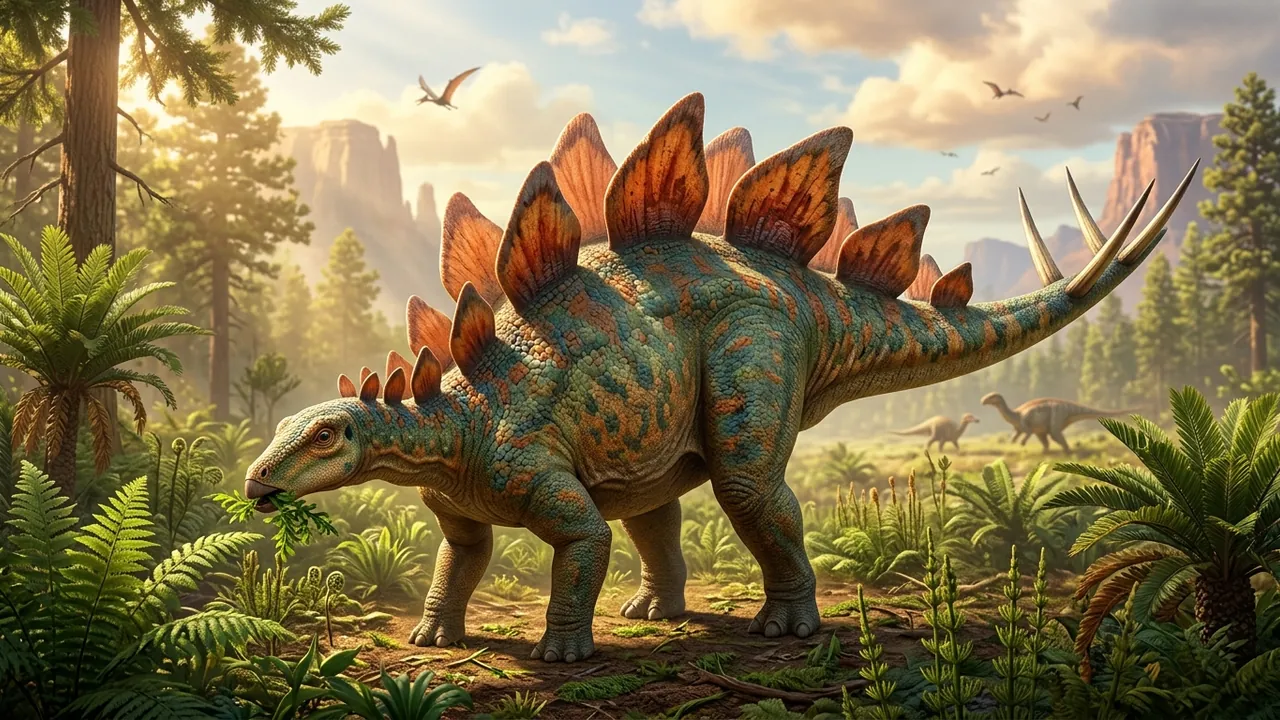
Imagine an animal as long as a yellow school bus and as heavy as an African elephant, steered by a brain no bigger than a green lime! That amazing dinosaur was Stegosaurus (STEG-uh-SOR-us), whose name means roofed lizard. Its stubby front legs and tall back legs gave its spine a high, dramatic arch.
Seventeen diamond-shaped plates stood upright in two staggered rows along its back like giant kites. At the end of its muscular tail jutted four wickedly sharp spikes called a , each coated in glossy !
Lost World Habitat: Jurassic Fern Prairies
One hundred fifty million years ago during the Late Jurassic Period, not a single blade of grass or colorful daisy grew anywhere on Earth! Instead, Stegosaurus wandered across a sunlit fern in western North America dotted with ginkgo trees, spiky cycads, and towering conifers.
Long dry seasons turned creeks shallow, followed by drenching rains that flooded the valleys green again. Stegosaurus shared waterholes with four-story Brachiosaurus and whip-tailed Diplodocus, while staying alert whenever a sleek like Allosaurus prowled nearby.
What's on the Prehistoric Menu?
With short front legs holding its slender head barely three feet above the dirt, Stegosaurus was built like a specialized low-level garden trimmer! Its toothless front beak wrapped in sharp snipped mosses, crunchy horsetails, fern fronds, and pineapple-like cycad sprouts across the sunny .
Small, ridged cheek teeth shaped like miniature oak leaves chopped tough stems into coarse chunks before swallowing. Scientists once thought Stegosaurus had a super-weak bite, yet modern computer tests prove its jaws crunched woody twigs as strongly as a sheep or cow!
Superpowers & Anatomy: Living Radiators
Surprisingly, Stegosaurus's famous back plates did not attach to its backbone at all! Instead, they grew directly inside its thick skin as special dermal . Grooves carved across every fossil plate show where dozens of blood vessels carried warm blood under a smooth sheath.
Standing sideways in a cool morning breeze helped dump extra body heat like natural radiator fins, while pumping warm blood into those plates likely flashed vivid colors to impress friends! Beneath its chin, hundreds of pebble-sized bone beads formed flexible chainmail armor.
Flight vs. Fight Arena! Beware the Thagomizer
Top speed for heavy-footed Stegosaurus was only about four or five miles per hour—about as fast as a brisk human walk! Running away from a swift like Allosaurus or Ceratosaurus was completely out of the question, placing Stegosaurus proudly on Team Fight.
Unlike stiff-tailed dinosaurs, Stegosaurus had super-flexible tail bones powered by thick hip muscles. Spinning on its sturdy front feet to keep its side turned toward danger, it whipped its three-foot-long spikes sideways like a medieval morningstar!
Fossil Detective Secrets: Comic-Strip Science!
When Othniel Charles Marsh named Stegosaurus in 1877 from Colorado rocks, he imagined its plates lying flat like roof tiles—and that mistake inspired the name roofed lizard! Later skeletons proved the plates stood tall in two alternating rows while four spikes armed the tail.
For over a century, scientists had no special name for those tail spikes until cartoonist Gary Larson drew a funny 1982 comic calling them the ! Paleontologists loved the joke, adopted the word, and later found an Allosaurus bone pierced by a real -stopping spike!