Meet the Legend: Architecture of an Armored Icon
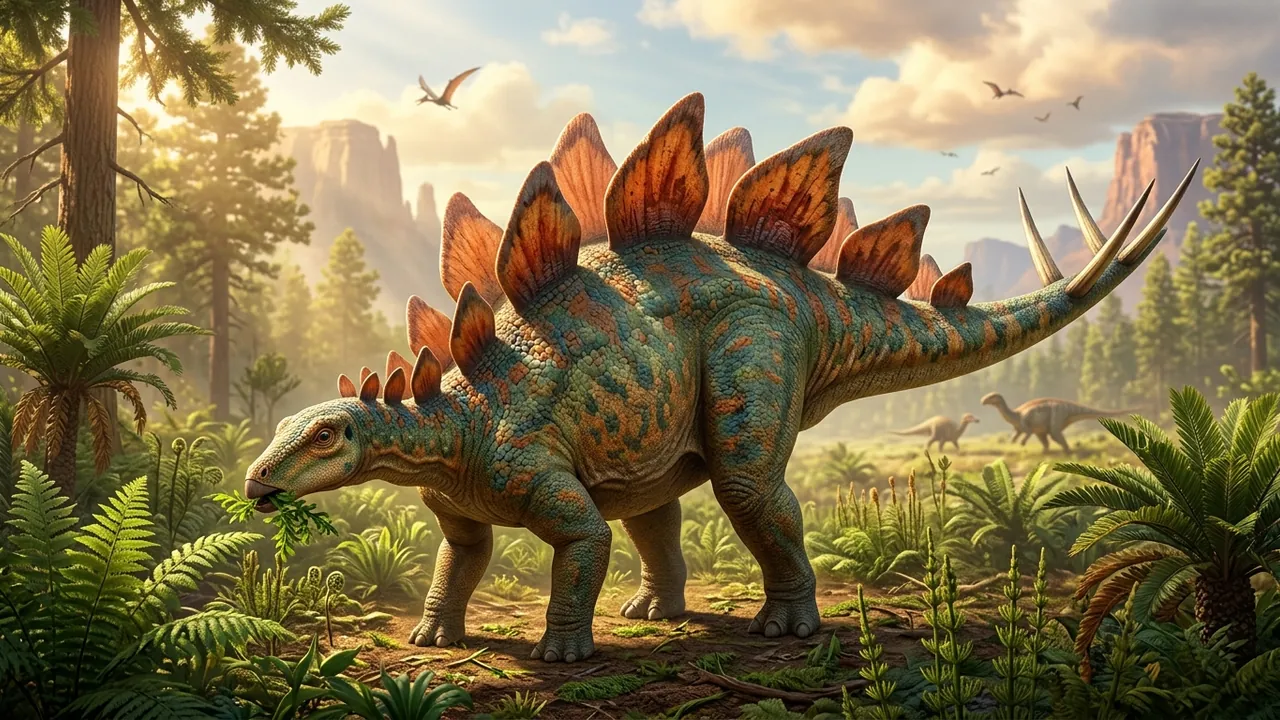
Measuring up to thirty feet long, standing over twelve feet tall to the tips of its highest hip plates, and weighing between five and seven tons, Stegosaurus stenops remains one of paleontology's greatest marvels of skeletal . Its unmistakable profile combined an elongated, narrow skull with short, heavily muscled forelimbs and towering, pillar-straight hind legs.
Crowning its arched spine stood seventeen flat, pentagonal bony plates arranged in two staggered, alternating rows. Rather than fusing to the vertebrae below, every plate developed inside thick skin tissue as a giant wrapped in protective keratin.
Counterbalancing its heavy torso stretched a muscular tail held well clear of the ground and armed at the tip with a deadly four-spiked .
Wide, elephant-like foot pads cushioned each heavy step across dry Jurassic riverbeds, while five broad front toes and three stout rear hooves distributed multi-ton body mass evenly without sinking into soft mud.
Although casts of its tiny braincase measure barely three ounces—earning Stegosaurus an unfair reputation for clumsiness—this remarkably successful armored browser thrived across western North America and Europe for nearly ten million years!
Lost World Habitat: Niche Partitioning on the Plains
One hundred fifty million years ago during the Late Jurassic Period, seasonal river channels wove across vast semi-arid floodplains stretching from Montana to New Mexico. Long dry spells alternated with torrential monsoon rains that nourished gallery forests of araucaria conifers, ginkgoes, and tree ferns bordering sunlit prairies of horsetails and cycads.
Ecologists often ask how one Late Jurassic food web supported so many multi-ton plant-eaters—including Brachiosaurus, Apatosaurus, Diplodocus, Camptosaurus, and Stegosaurus—all at once. The secret lay in precise !
Studying feeding across those species shows how each body plan harvested a distinct layer of green solar energy: towering Brachiosaurus cropped conifer crowns forty feet up, whip-tailed Diplodocus raked mid-level fern thickets, and low-slung Stegosaurus sheared tough ground cycads and horsetails within three feet of the soil.
During harsh dry seasons when smaller shallow ponds shrank, mixed dinosaur herds followed winding evergreen river corridors where cool underground water kept deep-rooted horsetails lush and green.
By dividing plant resources cleanly across different canopy tiers, primary consumers avoided stripping one food source bare while sustaining apex predators like Allosaurus, Torvosaurus, and Ceratosaurus.
What's on the Prehistoric Menu?
Feeding six tons of body mass without flowering grasses demanded steady daily foraging and surprising jaw . Because its forelimbs were less than half the length of its hind limbs, Stegosaurus carried its slender snout naturally close to its ankles, right amid coarse ground flora.
For decades, textbooks assumed Stegosaurus could only nibble mushy mosses because its small leaf-shaped teeth lacked flat grinding crowns. In 2016, however, researchers ran three-dimensional engineering stress tests on skulls of three different stegosaur species and discovered a major surprise!
Stegosaurus stenops generated bite forces between roughly one hundred fifty and five hundred seventy-five Newtons at its back teeth—comparable to modern sheep and cattle! Its narrow keratin beak sheared woody cycad stems, horsetail stalks, and conifer cones cleanly near the roots.
Inset tooth rows supported fleshy muscular cheeks that kept chopped vegetation inside the mouth, while gave Stegosaurus exclusive access to tough low shrubs that giant sauropods swallowed less efficiently.
Once swallowed, hundreds of pounds of coarse Jurassic plant fiber fermented slowly over several days inside a cavernous hindgut packed with helpful digestive microbes that unlocked steady energy.
Superpowers & Anatomy: Heat Fins and Throat Armor
Why did Stegosaurus grow seventeen giant back plates up to thirty inches tall if thin porous bone snapped easily under direct predator bites? Wind-tunnel experiments and CT scans revealed an ingenious dual-purpose answer combining species display with active !
Deep vascular pipes branched upward through the spongy core of each and exited onto surface grooves beneath a smooth keratin sheath. Because the plates stood in two alternating rows rather than side-by-side pairs, cool breezes swirled turbulently across both sides of every plate—shedding excess body heat like aluminum fins on a radiator!
At the same time, flushing warm blood into those keratin-covered plates could shift skin pigments to signal herd members or intimidate rivals across open fern prairies without wasting precious energy fighting.
To protect vulnerable soft tissue during real attacks, Stegosaurus grew a tight mosaic of pebble-sized osteoderm ossicles embedded directly inside its throat skin like chainmail.
Meanwhile, modern anatomy debunked another famous myth: the enlarged hollow inside its hip vertebrae did not hold a 'second brain,' but a bird-like glycogen organ storing quick sugar fuel for nerves and muscles!
Flight vs. Fight Arena! Physics of the Tail Strike
In the Flight-versus-Fight arena, limb left Stegosaurus zero room to run. Because its heavy thigh bones were much longer than its lower shin bones, Stegosaurus topped out near four to five miles per hour—easily overtaken by an athletic Allosaurus sprinting above twenty miles per hour.
Instead of fleeing, Stegosaurus turned tail physics into one of the Mesozoic Era's deadliest counterweapons! Unlike duck-billed dinosaurs or ankylosaurs whose tails were stiffened by crisscrossing bony tendons, Stegosaurus possessed completely free, flexible caudal vertebrae anchored to huge caudofemoralis muscles along its wide hips.
Pivoting swiftly on bowed, muscular forelimbs to keep its hindquarters angled toward the predator, Stegosaurus whipped its muscular tail horizontally from side to side at blinding velocity.
Four solid spikes—extended up to four feet by sharp keratin sheaths—jutted outward from the tail tip at optimal puncture angles rather than pointing straight up into empty air.
Mathematical strike calculations show that the swinging concentrated hundreds of pounds of kinetic impact onto spike tips narrower than a pencil point, effortlessly penetrating thick predator hide and fracturing solid bone on contact!
Fossil Detective Secrets: Forensic Proof in Stone
When Yale paleontologist Othniel Charles Marsh first described Stegosaurus in 1877 during the famous Bone Wars, jumbled quarry slabs led him to reconstruct the plates lying flat like roof tiles—inspiring the Greek name Roofed Lizard. Fourteen years later, an articulated skeleton excavated in Colorado proved the plates stood upright along the midline while four spikes armed the tail.
Amazingly, those tail spikes lacked a formal anatomical term until 1982, when cartoonist Gary Larson coined '' in a comic strip—a term paleontologist Ken Carpenter used at a scientific conference and cemented into textbooks forever!
Carpenter's research also delivered hard forensic proof of dinosaur combat . Examining an Allosaurus tail vertebra from Utah's Cleveland-Lloyd Quarry, he identified a conical puncture hole shattered from below that matched a Stegosaurus thagomizer spike like a key in a lock!
Partially healed bone distortion around that wound showed the injured Allosaurus survived the initial impact, limping for weeks with a severe bone infection.
Paired with a separate Stegosaurus neck plate bearing a U-shaped Allosaurus bite notch, these remarkable fossils prove these two Jurassic legends clashed repeatedly across ancient Colorado and Utah!