Meet the Legend: Plated Marvel of the West
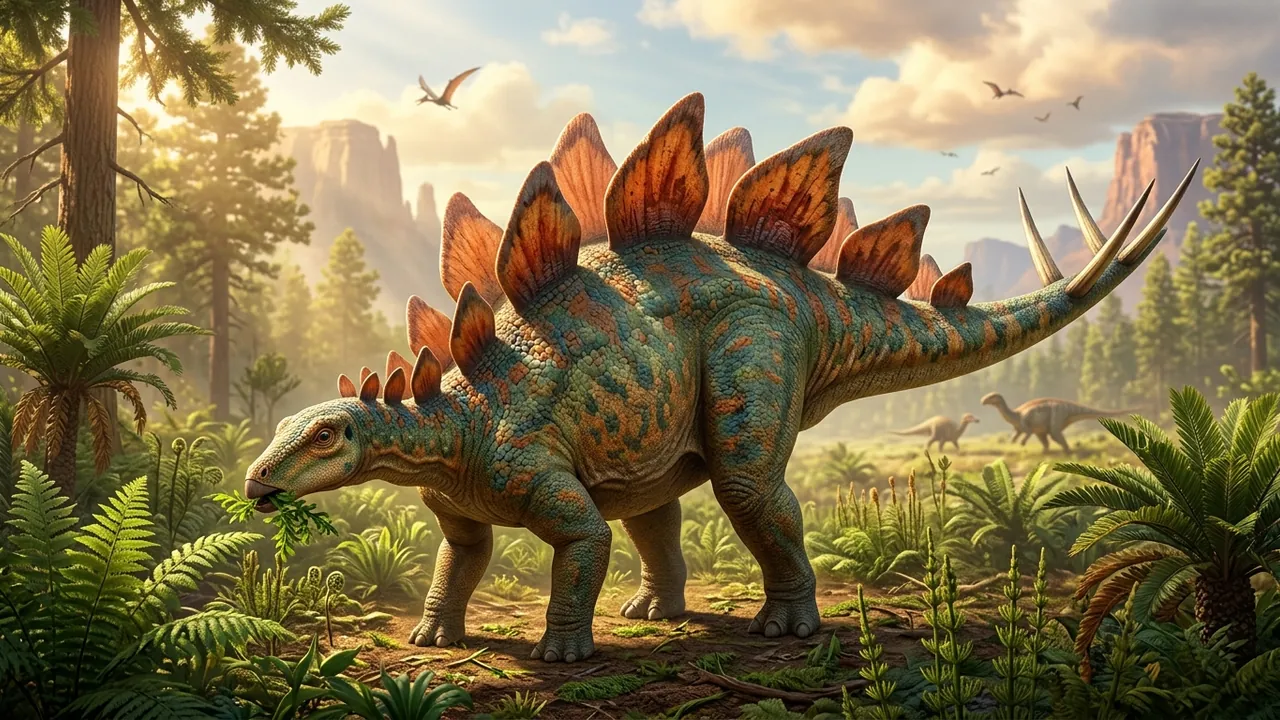
Long before horned dinosaurs evolved, Stegosaurus ruled the Late Jurassic landscape as one of Earth's most recognizable armored plant-eaters. Stretching up to thirty feet long and weighing five to seven tons, this peaceful combined a tiny, low-slung head with a steeply arched back supported by short, muscular front legs and pillar-like hind limbs.
Running from behind its ears to the base of its tail stood seventeen alternating, diamond-shaped plates. Each giant plate was actually an —a special bone anchored inside thick skin rather than bolted directly onto the spine!
Near the tip of its muscular, held-high tail jutted four sharp spikes up to three feet long, forming a defensive scientists call a . Together, tall plates and gleaming tail spikes made Stegosaurus impossible to mistake for any other creature.
Lost World Habitat: Jurassic Fern Savannas
Between 155 and 145 million years ago, Stegosaurus roamed a vast semi-arid fern stretching across modern Colorado, Utah, Wyoming, and Montana. Millions of years earlier, during the Early Jurassic, small armored dinosaur ancestors and three-toed hunters had pressed footprints into wet mud across Virginia's Culpeper Basin on the eastern side of North America.
By the Late Jurassic, western river valleys hosted the greatest land giants Earth had ever seen! Because flowering plants and grass had not evolved yet, sunny floodplains were carpeted with green ferns, horsetails, mosses, and pineapple-shaped cycads, shaded by tall araucaria conifers and ginkgoes along seasonal creeks.
Every Stegosaurus shared these sparkling watering holes with towering Brachiosaurus, whip-tailed Diplodocus, and burrowing lungfish, while keeping watchful eyes peeled for hungry Allosaurus and blade-horned Ceratosaurus patrolling the tree line.
What's on the Prehistoric Menu?
In the Jurassic food chain, sunlight energized vast carpets of spore-bearing ferns and cycads, and Stegosaurus thrived as a specialized low-browsing . Because its short forelimbs tilted its shoulders downward, its narrow snout hovered less than three feet off the ground—a smart feeding right inside thick mats of horsetails, clubmosses, and tender fern fronds.
Sharing a habitat with eighty-foot sauropods required peaceful food sharing! While Brachiosaurus harvested conifer needles forty feet overhead, Stegosaurus cropped low ground plants without competing for the same branches.
A sharp, toothless front beak snipped stems cleanly, while fleshy cheeks held mouthfuls steady as rows of small, ridged cheek teeth chopped coarse fibers. Computer jaw models reveal that this narrow skull packed a surprisingly firm bite—strong enough to crunch woody cycad crowns that fueled its huge fermenting gut!
Superpowers & Anatomy: Plates and Chainmail
Why did Stegosaurus invest so much energy growing seventeen thin, upright plates up to two and a half feet tall? Studying each fossil closely reveals networks of branching channels where blood vessels wove beneath a protective outer horn coating. That dual-purpose acted both as a solar heat-exchange fin to cool or warm its multi-ton body and as a colorful billboard to signal herd mates!
Because those tall back plates were thin and spaced apart, Stegosaurus wore hidden armor where predators actually aimed bites. Embedded inside the tough skin under its throat and chest sat hundreds of rounded bone pebbles called gular ossicles, forming flexible chainmail!
Meanwhile, its tail ended in a fearsome whose four solid bone spikes grew outward at sideways angles—ready to strike low at an attacker's ribs or legs.
Flight vs. Fight Arena! Swinging the Spikes
With heavy elephant-like legs and short front strides, Stegosaurus could only lumber across the fern at about five miles per hour. Outrunning a swift, thirty-foot Allosaurus was impossible, which meant Stegosaurus depended 100 percent on Team Fight!
Many plant-eating dinosaurs had stiff bony rods locking their tails straight for balance, yet Stegosaurus evolved loose, flexible tail joints and massive tail-swinging muscles anchored to its wide hip bones. That clever anatomical turned its entire rear half into a whip-fast defensive catapult!
When cornered, this brave planted its muscular front feet like a pivot point, swung its hindquarters sideways to keep its armored flank facing the hunter, and lashed its four-spiked horizontally at blazing speed. One accurate swing drove razor-tipped keratin spikes deep enough to stop any Jurassic predator in its tracks!
Fossil Detective Secrets: Pierced Bone Proof!
Paleontologists have pieced together Stegosaurus's life story like true rock detectives since 1877, when quarry crews near Morrison, Colorado, uncovered giant plates locked in Jurassic sandstone. Early reconstructions mistakenly laid every flat across its back like turtle shingles—giving Stegosaurus its name meaning roofed lizard—until complete skeletons buried in original life positions proved the plates stood upright in two alternating rows!
Even better, museum researchers led by paleontologist Ken Carpenter uncovered smoking-gun proof of real Jurassic showdowns. One fossilized Allosaurus tail vertebra preserves a neat, cone-shaped hole punched right through solid bone—matching the exact diameter and angle of a Stegosaurus spike!
In the same rock formation, detectives also found a Stegosaurus neck plate bearing a U-shaped bite notch matching Allosaurus jaws, proving these two famous rivals clashed face-to-tail across ancient Colorado!