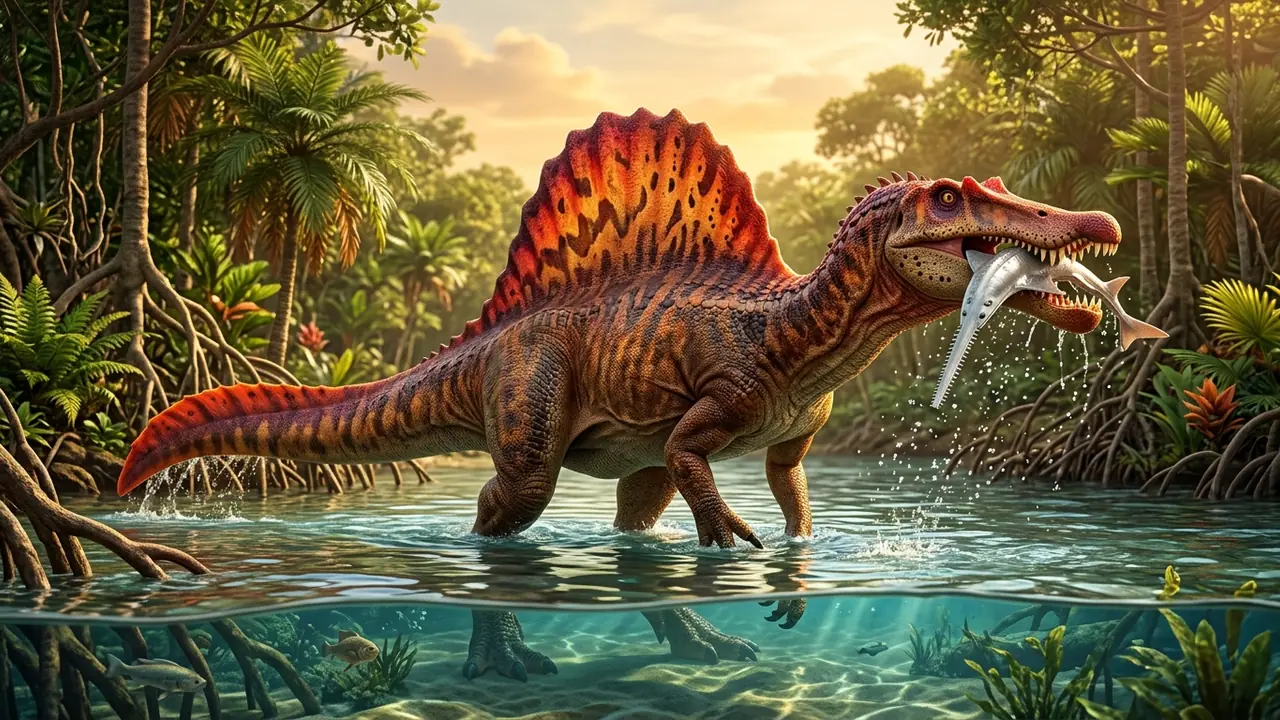
Meet the Legend: Radical Departure in Theropod Design
Across more than 160 million years of Mesozoic evolution, nearly all large non-avian theropods adhered to a remarkably conserved bipedal body plan: deep laterally compressed skulls, blade-or-crusher dentition, hollow pneumatized limb bones, and stiffened tapering tails balanced over long cursorial legs. Spinosaurus aegyptiacus shattered almost every rule of that ancestral blueprint during the stage, stretching fourteen to fifteen meters in length and weighing roughly seven metric tons.
Cladistically nested within Spinosauridae alongside Early Cretaceous European Baryonyx and African Suchomimus, Spinosaurus pushed riverine specialization to its morphological extreme. Hyper-elongated dorsal neural spines soared up to 1.8 meters above the thoracic vertebrae, framing an imposing axial sail richly supplied with vascular grooves and wrapped in tough integument.
Even more startlingly, Moroccan fossil discoveries between 2014 and 2020 revealed drastically reduced pelvic and hindlimb proportions—nearly twenty-five percent shorter relative to body length than in earlier spinosaurids! Behind the hips, tall strap-like caudal neural spines and elongated ventral chevrons transformed the tail into a vertically expanded undulatory propulsor.
Up front, a narrow premaxillary-maxillary rostrum bore unsculpted conical teeth protected at rest by smooth extra-oral labial tissues, while muscular three-fingered forelimbs wielded recurved manual unguals rotated palms-inward.
Together, these derived traits establish Spinosaurus not merely as history's longest known terrestrial-lineage predator, but as dinosaur evolution's boldest anatomical experiment in large-bodied semiaquatic .
From coastal lagoons in Morocco across to delta channels in Egypt, this sail-backed specialist redefined the ecological boundaries of predatory archosaurs and proved theropod evolution could master sprawling river realms.
Lost World Habitat: Kem Kem & Bahariya River Systems
Understanding Spinosaurus requires examining the stratigraphy of northern Gondwana—specifically Egypt's coastal Bahariya Formation and southeastern Morocco's Kem Kem Group, subdivided into the cross-bedded fluvial sandstones of the Ifezouane Formation below and the lagoonal mudstones of the Aoufous Formation above. Correlated through microfossil biostratigraphy and regional marine transgressions to roughly 99 through 93.9 million years ago, these red-bed sequences preserve colossal low-gradient river deltas draining northward into the warm Tethys Ocean.
Early twentieth-century geologists marveled at an apparent ecological paradox dubbed 'Stromer's Riddle': Kem Kem strata yield thousands of shed teeth and bones from giant Spinosaurus, Carcharodontosaurus, abelisaurids, and crocodylomorphs alongside comparatively sparse terrestrial herbivore skeletons.
Modern taphonomic surveys and stable-isotope geochemistry resolve this mystery by tracing primary energy flow through an extraordinarily productive aquatic food web rather than dry savanna browse alone. Oxygen-18 ratios locked inside spinosaurid tooth enamel closely match coexisting freshwater turtles and crocodylomorphs while diverging sharply from land-dwelling theropods.
Warm deltaic channels swarmed with giant actinistian Mawsonia coelacanths exceeding three meters, massive Neoceratodus lungfish, armored polypterid bichirs, lepisosteid gars, and car-sized sclerorhynchid sawfish such as Onchopristis numidus.
By channeling immense estuarine fish biomass directly into apex , North Africa's Cenomanian river corridors sustained multi-ton spinosaurids without overtaxing upland rebbachisaurid and titanosaur sauropod herds.
Surrounding gallery forests of tree ferns, horsetails, and early angiosperms stabilized muddy levees where giant azhdarchid and ornithocheirid pterosaurs soared overhead between tidal sandbars and brackish mangrove flats. Periodic monsoon floods continually reshaped these delta channels, burying fish scales, turtle shells, and shed dinosaur teeth together in iron-rich sands.
What's on the Prehistoric Menu? Mechanics of Piscivory
Capturing multi-hundred-kilogram aquatic vertebrates inside turbid, fast-moving currents demanded radical cranial re-engineering toward specialized . Finite-element beam modeling demonstrates that the narrow, tubular rostrum of Spinosaurus sacrificed extreme vertical bone-crushing force in exchange for minimal hydrodynamic drag and rapid angular jaw velocity when sweeping sideways or downward underwater.
At the anterior tip of the jaws, the premaxilla expanded into a terminal spoon-shaped rosette opposing a raised dentary cluster and matching palatal notch—a textbook example of evolutionary convergence with modern fish-eating Indian gharials (Gavialis gangeticus).
Rather than bearing laterally flattened ziphodont serrations built to shear mammal or dinosaur flesh, spinosaurid crowns were straight, sub-circular cones reinforced with longitudinal enamel flutes. Those fluted cones punctured slippery ganoid scales and locked thrashing Onchopristis sawfish or giant coelacanths securely without slicing prey free in strong currents.
Meanwhile, fleshy external nares migrated posteriorly partway up the snout toward the orbits, permitting uninterrupted air breathing while the tooth-lined terminal rosette waited submerged below murky delta eddies.
Supplementing cranial capture, heavily muscled humeri and enlarged manual claw I functioned as gaffing hooks to haul heavy fish ashore, while acid-etched pterosaur vertebrae and juvenile ornithopod bones preserved inside spinosaurid gut cavities confirm opportunistic shoreline foraging whenever droughts concentrated prey in shrinking oxbow pools.
Calcium isotope ratios across Kem Kem tooth assemblages confirm that giant ray-finned and cartilaginous fishes supplied the overwhelming majority of adult Spinosaurus caloric intake across wet and dry seasons alike, cementing its trophic status as Mesozoic Gondwana's supreme riverine apex consumer.
Superpowers & Senses: Snout Sonar & Ballast
High-resolution X-ray computed tomography of a Moroccan Spinosaurus premaxilla exposed an intricate internal canal branching into dozens of external foramina clustered densely across the snout tip. Analogous to integumentary sensory organs lining extant crocodylian jaws, this trigeminal nerve network transduced subtle hydrodynamic pressure waves into instantaneous neural signals—enabling precision strikes inside silt-laden estuaries where visibility dropped near zero.
Digital endocast reconstructions of spinosaurid braincases further reveal enlarged floccular lobes and semicircular ear canals oriented to stabilize ocular gaze and slightly downturned head posture during rapid strikes into shallow or chest-deep water.
Postcranially, quantitative bone-compactness phylogenies published in 2022 demonstrated extreme across Spinosaurus femora and dorsal ribs, contrasting sharply with the thin-walled, air-sac-pneumatized limb shafts of terrestrial carnosaurs and tyrannosaurids. This dense internal mineral ballast counteracted positive lung buoyancy much like hippopotamus or penguin skeletal histology, anchoring the seven-ton hunter firmly on shifting channel substrates.
Simultaneously, flexible foil experiments inside laboratory water flumes showed its vertically expanded caudal fin generated nearly eightfold greater propulsive thrust and more than double the efficiency of tapering terrestrial theropod tails.
Today, paleobiomechanists actively test three-dimensional digital buoyancy models comparing fully submerged pursuit diving against stabilized deep-water heron-style wading—illustrating how quantitative physics sharpens paleontological hypotheses.
Regardless of exact swimming depth, every sensory canal, dense femur shaft, and broadened pedal ungual functioned together in unmistakable harmony with aquatic delta physics and low-visibility ambush hunting along North Africa's warm coastal waterways. Even the dorsal positioning of its external nostrils near mid-snout reinforced stealthy surface breathing while scanning murky eddies below.
Flight vs. Fight Arena: Niche Partitioning & Terrain
Extreme morphological commitment to riverine imposed unmistakable locomotor trade-offs on dry land. Because shortened hindlimbs, dense , and an anteriorly shifted center of mass required deliberate bipedal balance—kept stable by its heavy muscular paddle tail—Spinosaurus forfeited high-speed cursorial pursuit across firm floodplains, ceding open savanna sprints entirely to long-legged Carcharodontosaurus saharicus.
Within overlapping Kem Kem river corridors, direct lethal combat between seven-ton apex theropods carried severe fitness penalties for both rivals, since a fractured jaw or infected limb wound could prove fatal. Consequently, fine-scale ecological niche partitioning minimized daily competition while elaborate cranial crests and Spinosaurus's 1.8-meter dorsal sail served as unmistakable long-range visual signals across flat delta horizons.
By turning broadside in bright equatorial sunlight, Spinosaurus maximized its lateral profile—a classic Team Fight agonistic display deterring encroaching competitors from contesting stranded dry-season catches without trading physical blows.
Whenever drought crowded predators along shrinking lagoon margins and forced a standoff, microhabitat physics decided the victor: firm sandstone terraces favored Carcharodontosaurus's swift footwork and deep shark-toothed bite, whereas waist-deep mud and channel drop-offs handed decisive stability and grappling leverage to wide-footed, hook-clawed Spinosaurus.
Millions of years of coexistence proved that niche partitioning and terrain mastery rivaled raw jaw force as evolutionary survival strategies.
Even giant crocodylomorphs sharing those waterways yielded right-of-way when a fifty-foot spined silhouette waded purposefully into main estuarine channels to claim prime fishing eddies, showcasing how specialized anatomy governed hierarchy across prehistoric wetlands and prevented costly territorial attrition.
Fossil Detective Secrets: From Bombed Museum to Neotype
Few episodes in the history of science rival the century-long detective quest to reconstruct Spinosaurus aegyptiacus. Excavated in Egypt's Bahariya Oasis in 1912 by collector Richard Markgraf and formally described by Bavarian paleontologist Ernst Stromer in 1915, the original holotype skeleton stood in Munich's Paleontological Museum until an Allied air raid in April 1944 reduced the building—and Africa's strangest dinosaur—to ashes, leaving researchers only Stromer's meticulous lithographs, measurements, and surviving photographs.
Nearly seventy years later, paleontologist Nizar Ibrahim recognized distinctive purple-red sandstone veining inside privately collected Moroccan bones that matched field outcrops along a steep Kem Kem escarpment near Erfoud.
Officially designated as the replacement specimen (FSAC-KK 11888), that single subadult individual preserved osteosclerotic hindlimbs, pelvic girdles, pedal phalanges, dorsal spines, and—following systematic cliffside excavations between 2018 and 2020—over thirty articulated caudal vertebrae proving a tall, fin-like tail.
Just as Cretaceous and Miocene sedimentary clays across Virginia's Potomac bluffs and Coastal Plain preserve crocodile teeth, shark crowns, and marine scallops where dry towns stand today, Saharan red beds archive vanished Tethyan estuaries.
Synthesizing century-old archival sketches, Kem Kem stratigraphy, micro-CT scans, and robotic hydrodynamics, twenty-first-century paleontologists resurrected a lost giant and revealed that non-avian dinosaurs conquered mighty rivers as boldly as dry continents.
New spinosaurid fossils emerging from Niger, Algeria, and Morocco continue expanding this aquatic chapter of dinosaur evolution every single decade as desert expeditions probe deeper rock horizons, partner with North African universities, and build permanent paleontological collections.