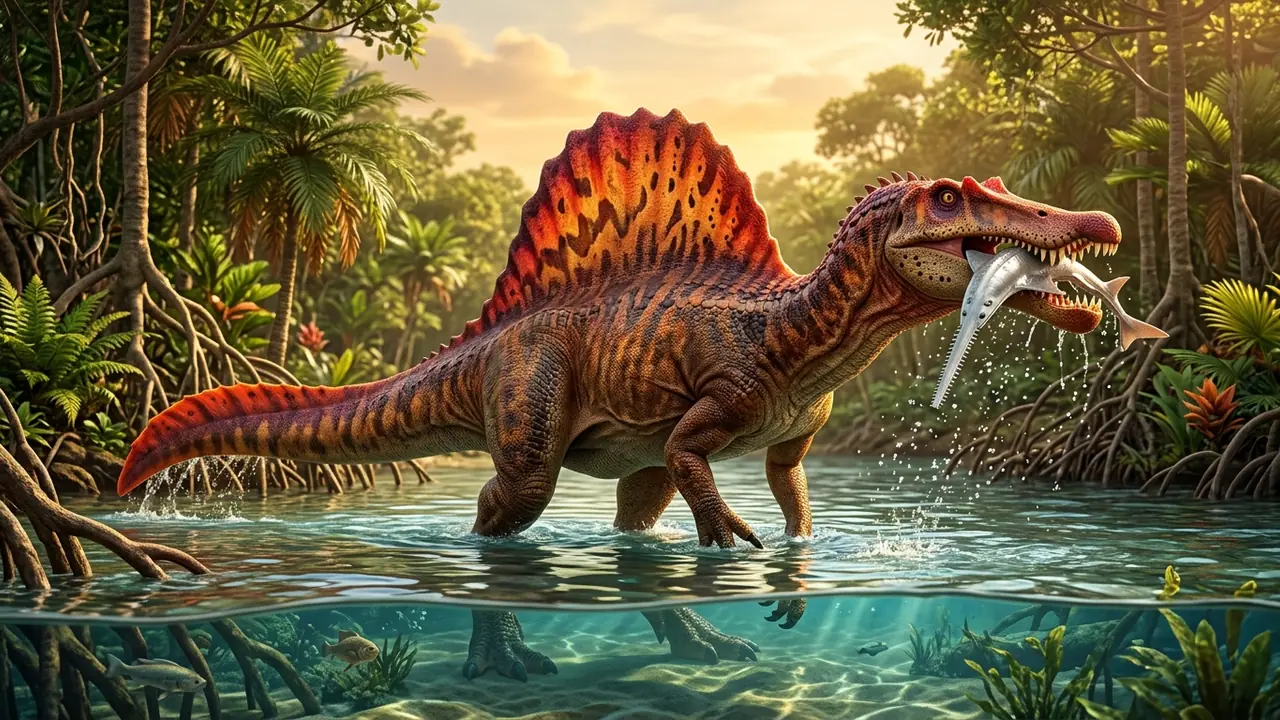
Meet the Legend: Stretching the Limits of Theropods
Measuring forty-six to fifty feet from snout tip to tail end and weighing roughly seven to eight tons, Spinosaurus aegyptiacus surpassed even Tyrannosaurus rex in total body length. Yet length alone barely captures why this Mid-Cretaceous giant fascinates biomechanics researchers around the globe.
Along its muscular back, blade-shaped spines towered up to six feet tall—longer than an adult human—anchoring a dramatic dorsal sail wrapped in tough, colorful scaly skin. Behind its pelvis, slender chevron bones below and two-foot neural spines above transformed its flexible tail into a vertically tall, ribbon-like paddle.
Up front, its skull stretched nearly six feet long with a narrow, crocodile-like profile, high-set nostrils, and smooth extra-oral scales edging dozens of interlocking cone teeth.
Meanwhile, brawny three-fingered forelimbs carried twelve-inch curved thumb claws with palms facing inward toward each other, paired with surprisingly compact hind legs and wide, flat-clawed feet built to grip soft mud.
Together, this remarkable blueprint turned a two-legged meat-eating dinosaur lineage into the undisputed ruler of North Africa's prehistoric river deltas and tidal lagoons.
No other known carnivore of the Mesozoic Era combined giant body length, sensory jaw pores, and a finned tail in one unified skeleton.
Lost World Habitat: Solving Stromer's Riddle
Ninety-seven million years ago, high global sea levels flooded lowlands across North Africa, creating an immense network of braided deltas, brackish lagoons, and forested floodplains stretching across modern Morocco, Algeria, Tunisia, and Egypt. For decades, paleontologists puzzled over a food-web mystery called 'Stromer's Riddle': why do Mid-Cretaceous North African rocks preserve three or four giant predator species alongside comparatively fewer land plant-eater skeletons?
Trophic energy mapping and ecological resource provide a crystal-clear answer! Instead of relying on sparse upland desert shrubs alone, tropical sunlight powered vast river estuaries packed with aquatic plants, shellfish, turtles, and colossal prehistoric fish.
Armored Mawsonia coelacanths grew twelve feet long, lungfish reached massive weights in muddy backwaters, and twenty-five-foot Onchopristis sawfish cruised murky river channels in huge seasonal schools.
By tapping directly into this super-productive aquatic food web, Spinosaurus thrived on abundant river biomass while long-legged Carcharodontosaurus hunted giant titanosaur sauropods across drier inland savannas.
Clever habitat partitioning allowed multiple seven-ton carnivores to flourish side by side across ancient Africa without exhausting a single shared prey supply.
Meanwhile, flying pterosaurs and armored river crocodylomorphs harvested smaller fish along shallow reed beds, completing a richly layered wetland ecosystem.
What's on the Prehistoric Menu?
Catching fast, slime-coated fish weighing several hundred pounds requires completely different jaw physics than crunching land-dinosaur hip bones. Whereas Tyrannosaurus rex concentrated 12,800 pounds of clamping force at its back teeth, Spinosaurus engineered its long narrow jaws for lightning-fast underwater strikes!
Because liquid water is roughly eight hundred times denser than air, swinging a wide flat shovel-snout sideways underwater creates a heavy bow wave that pushes alert fish out of reach. By narrowing its jaws into a sleek cylinder, Spinosaurus sliced through river currents with minimal drag.
At the very tip of its snout, an expanded spoon-shaped rosette held long, fluted, cone-shaped teeth that pierced tough fish scales at high velocity, trading extreme rear-jaw PSI for rapid closing speed and a secure four-way grip.
Once a sawfish or giant coelacanth was impaled, strong S-curved neck muscles hoisted the thrashing catch upward while muscular arms drove twelve-inch thumb claws inward like steel boat hooks.
During dry-season droughts when delta pools shrank, trapped lungfish, young crocodylomorphs, and careless shoreline pterosaurs rounded out its high-protein menu.
Continuous tooth replacement ensured that any cone chipped against armored ganoid fish scales was quickly succeeded by a sharp new crown.
Superpowers, Senses & Anatomy: Built-In Sonar & Ballast
Medical X-ray scans of a fossilized Spinosaurus snout uncovered an extraordinary internal superpower: a branching central nerve tunnel feeding dozens of external pores across the jaw tip! Packed with sensitive nerve endings, these tiny pits measured faint water-pressure waves in Pascals—allowing Spinosaurus to strike unseen fish inside muddy brown delta currents without needing clear underwater vision.
Meanwhile, retracted nostrils positioned halfway up the skull near the eyes let the patient hunter breathe fresh air effortlessly while keeping its toothy sensory rosette completely submerged.
Deeper inside the skeleton lay a second biomechanical marvel: extreme ! Typical land-striding theropods possess hollow limb bones lined with light air sacs, boosting running speed while lowering body weight.
In Spinosaurus, thick mineral bone walls nearly filled the marrow cavities of its thigh and shin shafts, acting like a scuba diver's lead weight belt to counter upward lung buoyancy in moving currents.
Behind the hips, robotic water-tunnel experiments proved its tall -spined tail beat side to side like a giant oar, generating nearly eight times more forward thrust than stiff land-theropod tails!
Wide, flat-bottomed foot claws spread weight across soft delta silt like natural mudshoes, keeping the seven-ton giant steady during sudden strikes.
Flight vs. Fight Arena: Masters of Separate Domains
Every evolutionary superpower carries a clear mechanical trade-off. Investing in short, -weighted hind legs, a forward-shifted center of mass, and a heavy paddle tail made Spinosaurus noticeably slower on dry ground than long-legged Carcharodontosaurus, which could sprint past twenty miles per hour across open floodplains.
How did Spinosaurus handle tense shoreline meetings when dry seasons shrank delta lagoons and drew rival predators toward the water's edge? First came dramatic visual deterrence: pivoting sideways raised a six-foot-tall billboard of spines and boldly patterned skin, broadcasting giant body size across flat sandbars so competitors backed down peacefully.
Second came terrain mastery rooted in ecological ! Out on firm red-earth savannas, agile Carcharodontosaurus held faster footwork and deep, shark-toothed slicing jaws.
Yet a single backward step into chest-deep delta water flipped every biomechanical advantage: tall-legged land hunters lost footing in soft river silt, while dense-boned Spinosaurus planted wide flat-clawed feet firmly on the riverbed and swung powerful three-clawed arms.
In North Africa's Prehistoric Arena, smartly choosing watery home turf proved stronger than any reckless land chase.
By respecting habitat boundaries most of the year, both apex hunters conserved precious energy for catching their own specialized prey.
Fossil Detective Secrets: Rebuilding a Lost Giant
Reconstructing Spinosaurus stands as one of paleontology's most dramatic detective comebacks! In 1912, fossil collector Richard Markgraf unearthed giant spines and jawbones in Egypt's Bahariya Oasis for German paleontologist Ernst Stromer. Displayed proudly in Munich, that priceless skeleton was tragically destroyed during an Allied bombing raid in April 1944—leaving scientists with only Stromer's careful measurements, sketches, and black-and-white photographs for seventy years.
The long-awaited breakthrough arrived when paleontologist Nizar Ibrahim matched distinctive red sandstone mineral veins inside newly dug museum bones back to steep desert cliffs in southeastern Morocco's Kem Kem region!
Returning repeatedly to that exact rock layer between 2014 and 2020, an international team excavated dense hindlimbs, wide toe claws, and over thirty connected tail vertebrae preserving tall paddle spines.
Engineers then laser-scanned Stromer's surviving archival drawings alongside the new Moroccan fossils to 3D-print missing pieces and test flexible robotic tail fins inside Harvard water tanks.
Today, researchers continue testing computer buoyancy models to debate how often Spinosaurus dived deep channels versus wading shallow drop-offs—proving that great fossil detective stories never stop evolving!
Each new bone from North Africa's red cliffs sharpens our picture of how dinosaurs adapted to rivers and seas.