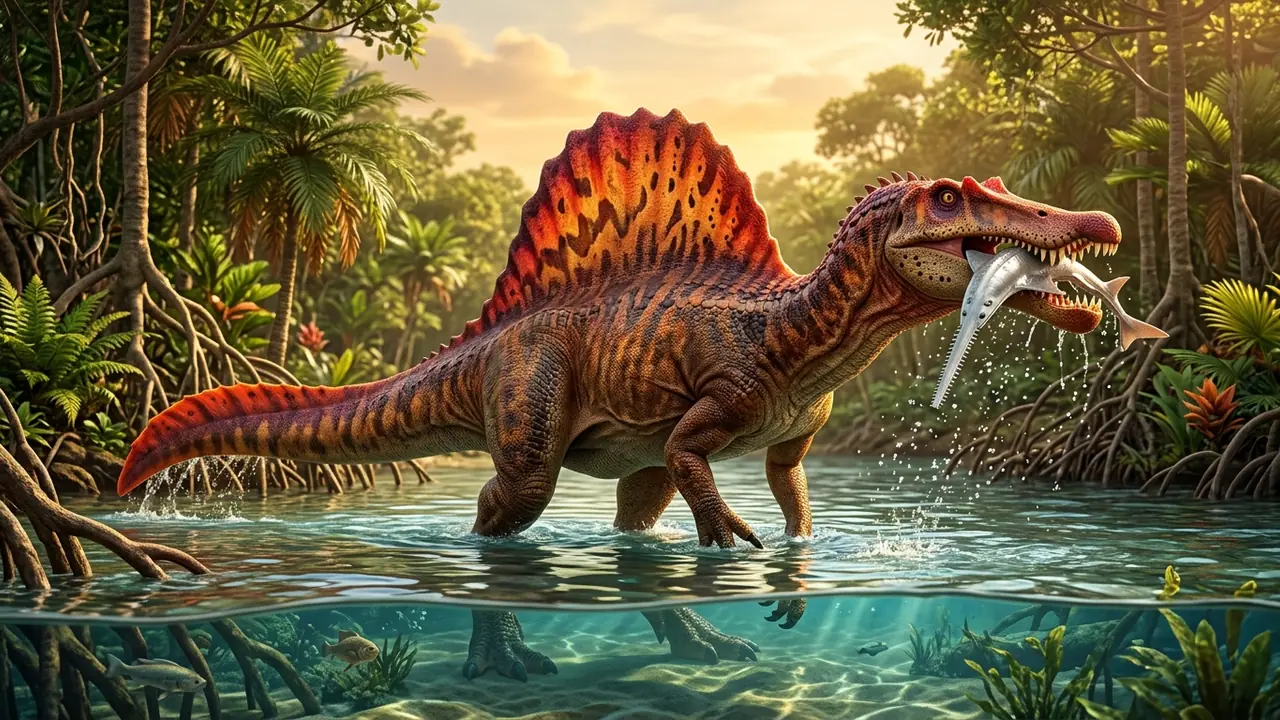
Meet the Legend: A Dinosaur Built for Rivers
Stretching nearly fifty feet from snout tip to tail end, Spinosaurus aegyptiacus holds the crown as the longest meat-eating dinosaur ever discovered! Yet if you saw this seven-ton giant wading through ancient North Africa, you would notice immediately how different it looked from land hunters like Tyrannosaurus rex.
Instead of long sprinting legs and a deep bone-crushing skull, Spinosaurus evolved remarkable body proportions. Tall bony rods rising six feet above its backbone supported a vivid skin sail, while elongated spines along its tail created a vertically tall swimming fin that swayed gracefully through deep currents.
Up front, a long narrow jaw lined with straight, smooth cone teeth paired with muscular arms and curved three-fingered hands facing inward. Smooth protective lip scales edged its jaws, and every single physical pointed clearly toward life along giant tropical waterways.
Lost World Habitat: North Africa's River Kingdom
Ninety-five million years ago during the Mid-Cretaceous Period, northern Africa looked nothing like today's sun-baked Sahara Desert. Warm greenhouse climates and high sea levels turned Morocco and Egypt into a sprawling maze of braided rivers, freshwater swamps, and coastal mangrove lagoons.
Inside this watery food chain, microscopic algae, horsetails, and riverside tree ferns supported snails, soft-shelled turtles, and astonishing giant fish. Armored coelacanths as heavy as kitchen refrigerators drifted quietly past twelve-foot lungfish and twenty-five-foot Onchopristis sawfish.
Such abundant river life supported multiple large carnivores at once because each predator claimed its own ecological ! Flying pterosaurs skimmed surface fish from above, armored crocodylomorphs lurked in shallow reeds, swift Carcharodontosaurus stalked plant-eating dinosaurs inland, and Spinosaurus commanded the deep main river channels without overcrowding its neighbors or draining a single shared food source across the delta.
What's on the Prehistoric Menu?
Hunting slippery, fast-swimming river giants required specialized tools and patient behavioral strategies. Unlike serrated steak-knife teeth that slice meat cleanly on dry land, Spinosaurus grew smooth, cone-shaped teeth that slanted slightly forward at the tip of its jaws to pierce and lock wriggling prey.
Paleontologists picture Spinosaurus wading quietly into chest-deep channels where murky brown water hid its sturdy legs and torso. Holding just its watchful eyes and raised nostrils above the current, it dipped its sensitive snout tip into the stream like a colossal fifty-foot wading heron.
Whenever a giant sawfish or lungfish darted close, rapid neck muscles snapped the narrow jaws shut before powerful three-clawed hands pinned the heavy catch onto a muddy sandbar. During harsh dry seasons when channels shrank into shallow pools, this versatile hunter also snatched young turtles, careless pterosaurs, or stranded shoreline prey.
Superpowers, Senses & Anatomy
How could Spinosaurus pinpoint a hidden sawfish inside muddy brown river currents? Scanning fossil snouts revealed dozens of tiny bone pits called connected to branching nerve tunnels! Just like modern crocodiles, these sensitive pressure sensors detected faint water ripples made by flicking fins in total darkness.
Staying balanced in moving currents required another clever physical deep inside its skeleton. Most two-legged meat-eating dinosaurs had hollow leg bones filled with light air sacs for fast running on land, which would make them bob awkwardly in deep rivers.
Microscopic bone cross-sections show Spinosaurus evolved thick-walled, solid leg bones much like modern hippos and diving penguins! Combined with wide, flat-clawed toes that kept its feet from sinking into squishy silt, those dense bones gave this hunter rock-steady footing while its tall paddle tail steered smoothly.
Flight vs. Fight Arena!
In North Africa's crowded river basins, surviving meant knowing when to display peacefully and where to stand your ground. Because Spinosaurus specialized in an , its shorter hind legs were slower on dry baked mudflats than long-legged land hunters like Carcharodontosaurus.
Instead of risking clumsy footraces inland, Spinosaurus relied on bold visual deterrence and smart terrain choices! Turning broadside in bright morning sunlight showcased its six-foot dorsal sail—making the dinosaur appear twice as massive to warn hungry rivals away from a fresh river catch without trading dangerous bites.
If a stubborn challenger pressed closer along a lagoon bank, stepping backward into chest-deep channel currents instantly flipped the arena odds! Buoyed comfortably by water and armed with foot-long curved thumb claws, Spinosaurus became virtually untouchable inside its watery home stronghold.
Fossil Detective Secrets: Reading Ancient Shorelines
How can dry desert cliffs hold stone skeletons of giant river fish and water-loving dinosaurs? Over tens of millions of years, drifting continents and shifting sea levels transform Earth's landscapes completely, leaving clues locked safely inside layered rock.
Students in Virginia can explore this exact geological story right across their own state! Along Virginia's Potomac River bluffs and eastern Coastal Plain, sedimentary clays preserve prehistoric crocodile teeth, shark teeth, and fossil Chesapecten scallops miles away from today's ocean beach—proving warm waters once covered dry towns and forests.
Across the Atlantic in Morocco's red Kem Kem sandstones, paleontologists used century-old 1915 sketches from Egypt's lost skeleton to match newly excavated dense leg bones and a complete thirty-bone paddle tail in 2020. Piece by careful piece, sedimentary fossil detectives brought history's greatest river dinosaur back to life!