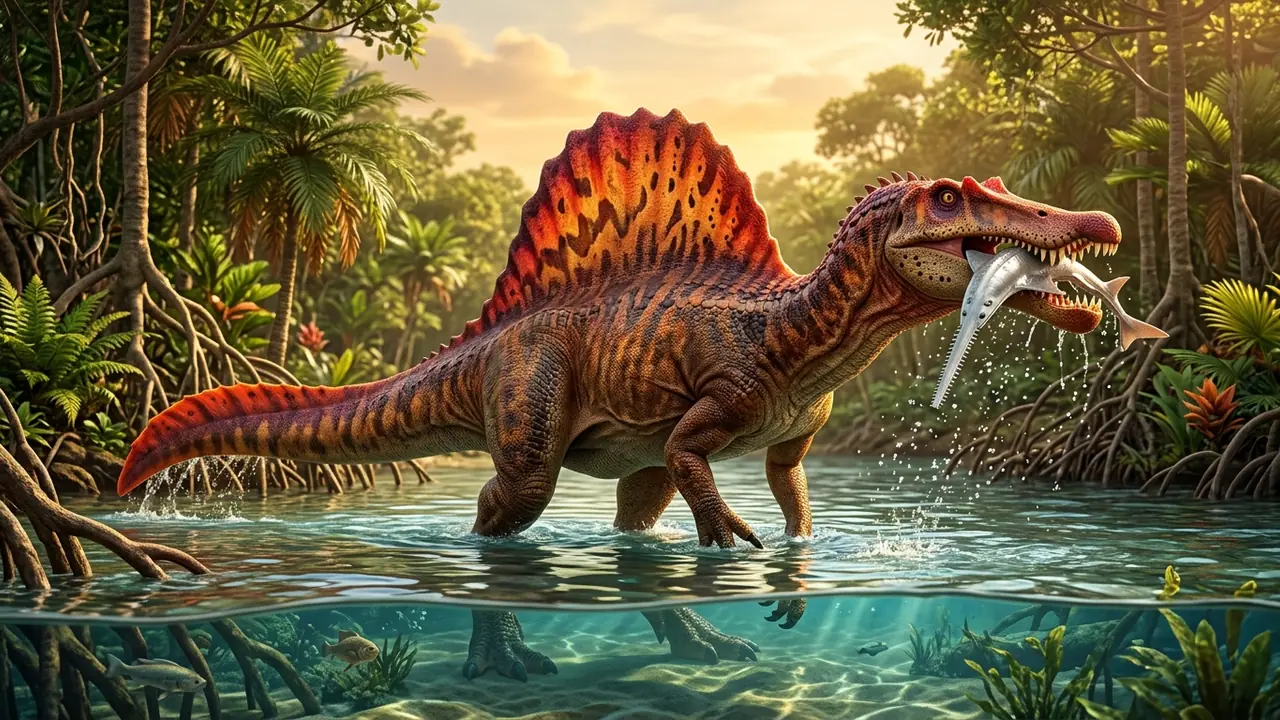
Meet the Legend: Longer Than Any Other Hunter
Imagine parking a yellow school bus next to a pickup truck—that fifty-foot line matches the astonishing length of an adult Spinosaurus! Living ninety-five million years ago in North Africa, this seven-ton giant stretched even longer from nose to tail than Tyrannosaurus rex.
Nothing else in the dinosaur kingdom looked quite like it. Bony spines rising from its back held up a six-foot sail taller than a surfboard! Behind its hips, tall tail bones formed a flexible swimming fin, while short sturdy back legs and inward-facing hooked hands completed nature's ultimate river monster.
Lost World Habitat: Ancient Rivers of the Sahara
If you visit Morocco or Egypt today, golden Sahara sand dunes stretch to the horizon. Yet during the Mid-Cretaceous Period, giant tropical rivers poured northward across North Africa into a warm sea! Vast mangrove swamps, muddy islands, and winding tidal channels formed a bustling .
Those waterways teemed with oversized creatures. Lungfish bigger than surfboards burrowed in mudbanks, giant coelacanths drifted beside submerged logs, and twenty-five-foot crocodylomorphs patrolled shady lagoons. Overhead, toothy pterosaurs with twenty-foot wingspans glided across warm breezes while Spinosaurus ruled every deep river bend.
What's on the Prehistoric Menu?
With so many large hunters nearby, how did Spinosaurus find plenty to eat? It became a master —a specialized fish hunter! Instead of chasing fleet-footed dinosaurs across hot dry plains, it waded chest-deep into cool channels where giant fish schooled.
Its favorite prize was Onchopristis, an ancient sawfish as long as a family minivan! Spinosaurus dipped the tip of its narrow snout beneath the surface and waited motionless like a giant stork. The instant a sawfish swam past, interlocking teeth snapped shut and curved twelve-inch thumb claws hauled dinner onto a sandbar.
Superpowers, Senses & Anatomy
Every part of Spinosaurus's skull and skeleton worked together for watery detective work. Its long narrow jaws flared at the tip into a spoon-shaped rosette packed with straight teeth—just like a modern gharial crocodile! Tiny nerve openings dotting its snout sensed faint water ripples even in muddy currents where eyes could not see.
Most meat-eating dinosaurs had hollow leg bones filled with air pockets, which would make them bob awkwardly in deep water. Spinosaurus evolved solid, heavy leg bones that controlled , anchoring its feet on slippery mud while tall tail swayed smoothly.
Flight vs. Fight Arena!
Sharing North Africa with forty-two-foot Carcharodontosaurus meant two heavyweight champions lived side by side! Usually, different diets kept them apart: Carcharodontosaurus chased long-necked plant-eaters inland while Spinosaurus fished along the .
During dry seasons when shrinking pools forced rivals close together, Team Fight intimidation took center stage! Turning sideways made Spinosaurus's six-foot sail look gigantic—like raising a colorful billboard warning trespassers away. If a confrontation grew tense near the riverbank, Spinosaurus held the advantage in waist-deep water where its heavy balance and hooked claws shone.
Fossil Detective Secrets
Few dinosaur mysteries have taken more twists than the story of Spinosaurus! In 1912, fossil hunters in Egypt uncovered huge spined and a lower jaw, shipping them to a museum in Munich, Germany. Tragically, wartime bombing in 1944 destroyed those priceless bones, leaving only black-and-white photographs and careful drawings behind.
Decades later, paleontologist Nizar Ibrahim tracked matching red-rock bones back to desert cliffs in Morocco! Between 2014 and 2020, his team excavated hind legs and more than thirty connected tail vertebrae—proving at last that Spinosaurus wagged a giant paddle tail.