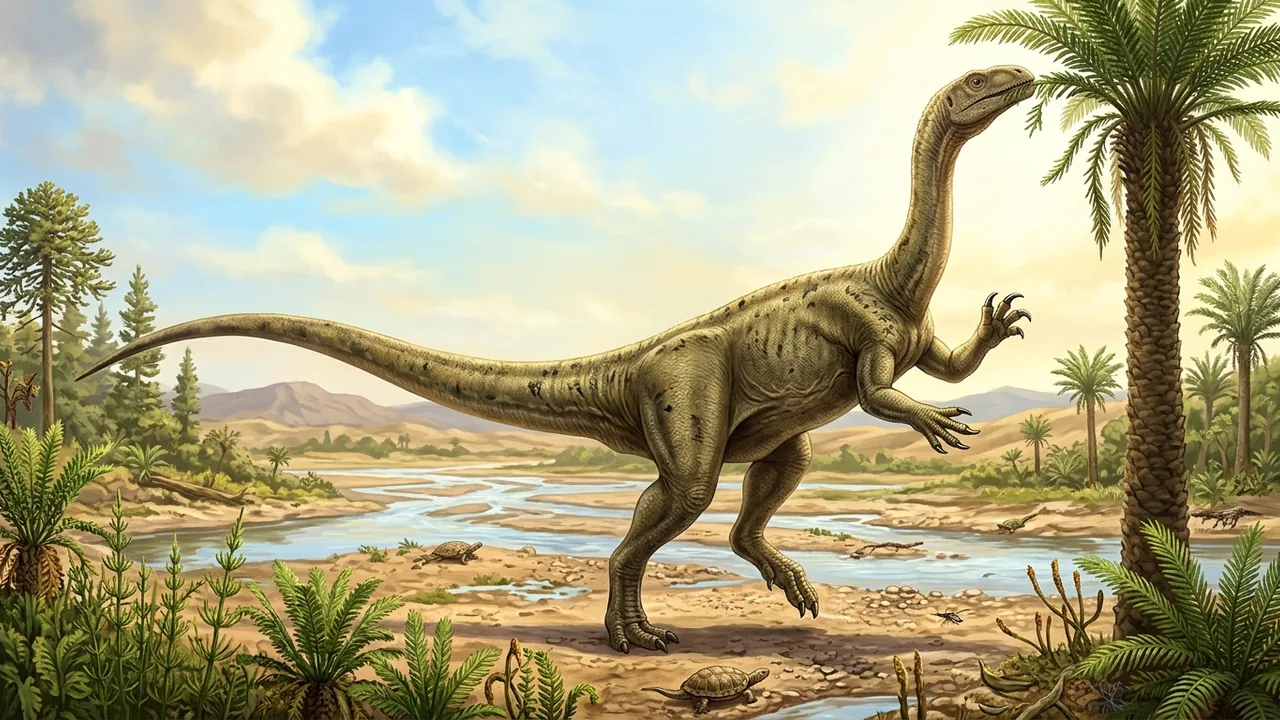
Meet the Legend: Triassic Blueprint of Gigantism
Fifty million years before colossal neosauropods dominated Morrison or Patagonian floodplains, their evolutionary foundations took shape during the Norian stage of the Late Triassic inside an agile bipedal pioneer: Plateosaurus trossingensis. Initially named Plateosaurus engelhardti in 1837 by German paleontologist Hermann von Meyer—five years prior to Richard Owen coining Dinosauria in 1842—and formally stabilized around rich Trossingen neotype material by the ICZN in 2019, Plateosaurus anchors the basal radiation of Sauropodomorpha.
Across Central Europe and Greenland between 214 and 204 million years ago, this pioneering became the first dinosaurian herbivore to achieve multi-ton body mass, spanning roughly 4.8 to ten meters in length and seven hundred to four thousand kilograms at maturity.
Crucially, twenty-first-century digital overturned a century of drooping, quadrupedal textbook reconstructions by demonstrating that Plateosaurus remained an obligate biped throughout its entire lifespan!
Combining a lightly built skull, an elongated ten-vertebra cervical column, prehensile five-digit hands, and an expansive digestive trunk balanced over muscular hindlimbs, Plateosaurus assembled the core anatomical modules that later fueled quadrupedal sauropod gigantism.
Whereas earlier Carnian dinosauromorphs such as Eoraptor and Buriolestes weighed mere kilograms and hunted small prey, Plateosaurus scaled herbivorous body volume upward by two full orders of magnitude within fifteen million years.
Studying its articulated osteology and bone captures dinosaurian evolution mid-stride—right as early saurischians transitioned from small omnivorous runners into Earth's dominant terrestrial megaherbivores across supercontinent Pangaea, establishing morphological traits that endured for the next 140 million years until the end of the Cretaceous Period.
Lost World Habitat: Norian Pangaea & Trossingen Flats
Reconstructing the Late Triassic world of Plateosaurus requires examining continental across the Germanic and Swiss basins—most famously the Trossingen Formation (Knollenmergel) of Baden-Württemberg and the coeval Klettgau Formation at Frick, Switzerland. Between 214 and 204 million years ago, Europe and eastern North America sat sutured together inside northern Pangaea around twenty-five to thirty-five degrees paleolatitude, sharing a warm, strongly seasonal megamonsoon climate.
Thick successions of purplish-red, pedogenically mottled smectitic mudstones, carbonate caliche nodules, and sheet-flood sandstones record broad alluvial plains where prolonged dry seasons alternated with intense summer monsoon downpours.
Along perennial river channels flourished riparian woodlands of voltzialean and cheirolepidiaceous conifers, bennettitaleans, true cycads, seed ferns, and dense Equisetites horsetail reedbeds—mirroring Late Triassic rift-basin floras preserved in Virginia's Culpeper and Taylorsville formations across western Pangaea!
Plateosaurus dominated this Norian vertebrate community alongside early stem-turtle Proganochelys quenstedti, armored aetosaurs, aquatic phytosaurs, sphenodontians, early mammaliaforms like Morganucodon, and swift neotheropod Liliensternus.
Geochemical stable-isotope analyses of pedogenic carbonate nodules confirm elevated Late Triassic atmospheric carbon dioxide and pronounced wet-dry seasonality across these inland basins, driving episodic river flooding across broad low-relief clay plains.
Careful basin reveals that whenever monsoon rains saturated expansive smectite clay pans bordering gallery woodlands, deceptive mud crusts turned tranquil floodplains into sticky, size-selective traps for multi-ton browsers while preserving delicate fossil pollen, charcoalified wood, and vertebrate burrows throughout central Europe's scenic Keuper outcrops for modern field geologists and paleobotanists to study and map across ancient continental landscapes.
What's on the Prehistoric Menu?
Throughout the Early and Middle Triassic, dicynodont synapsids and rhynchosaurian reptiles restricted terrestrial herbivory largely to ground-level ferns within one meter of the substrate. As a tall bipedal , Plateosaurus shattered that vertical ceiling—elevating its cranium three to four meters high to harvest gymnosperm foliage across an uncontested upper understory canopy stratum!
Unlike derived neosauropods that stripped branches strictly with anterior peg teeth, Plateosaurus retained laterally compressed, lance-shaped teeth lining both maxilla and dentary, each crown rimmed with coarse, forty-five-degree denticles suited for orthal puncture-crushing and shearing of tough cycad, bennettitalean, and conifer shoots.
Cranial finite-element indicates a lightly built skull roof paired with a ventrally deflected jaw joint that distributed bite force evenly along the entire tooth row without requiring heavy mammalian-style cheek musculature.
Simultaneously, grasping pentadactyl forelimbs armed with an enlarged, trenchant first-digit pollex ungual hooked resilient branches directly toward the snout, while scleral-ring aperture ratios calculated by Lars Schmitz indicate cathemeral foraging activity across both bright daylight and cool twilight hours.
Fleshy muscular cheeks or keratinous beak margins along the premaxilla further guided sheared stems cleanly backward into the throat without spilling valuable green browse.
Once coarsely sheared foliage entered its barrel-shaped trunk, prolonged microbial fermentation inside an elongated hindgut extracted steady metabolic energy from fibrous Late Triassic gymnosperms across both wet and arid months, while occasional opportunistic consumption of small invertebrates may have supplemented protein and mineral intake during severe seasonal droughts across warm Pangaean river valleys every year.
Superpowers, Senses & Anatomy
Two landmark modern scientific investigations transformed paleontological understanding of Plateosaurus physiology, growth, and posture. First, in 2010, paleontologist Heinrich Mallison constructed high-resolution 3D digital skeletons from undistorted Trossingen specimens to test appendicular quantitatively—proving that the proximal radius lacked the rounded pivot needed to cross over the ulna and pronate the manus palms-down onto the ground!
Because forcing the hands flat onto the substrate would dislocate both the wrist and elbow joints, and because volumetric modeling placed the whole-body center of mass cleanly above the hip socket, Plateosaurus walked and ran as an obligate biped from hatching right through four-ton adulthood.
Second, in 2005, Martin Sander and Nicole Klein analyzed long-bone across dozens of German and Swiss femora and tibiae, discovering densely vascularized fibrolamellar bone—indicative of elevated, bird-like metabolic growth rates—interrupted by annual lines of arrested growth (LAGs) whose spacing varied dramatically among individuals!
Unlike modern mammals or birds, which reach nearly uniform adult body sizes, this basal exhibited strong developmental plasticity: healthy individuals reached full skeletal maturity anywhere between 4.8 meters (700 kg) and ten meters (4,000 kg) depending on local climate and plant abundance!
Later Jurassic eusauropods suppressed those seasonal growth pauses completely, locking in uninterrupted fibrolamellar bone deposition to surpass forty metric tons.
Angled dorsal ribs and incipient vertebral fossae in Plateosaurus further point toward avian-style unidirectional airflow ventilating its active, fast-growing frame across warm Triassic river valleys, bridging primitive archosaurian traits with advanced dinosaurian energetics across early Mesozoic ecosystems.
Flight vs. Fight Arena: Outrunning Liliensternus
Sharing Central Europe's Norian river corridors was the largest known Late Triassic European theropod: Liliensternus liliensterni, a sleek five-point-two-meter, two-hundred-kilogram basal neotheropod armed with recurved ziphodont teeth, grasping three-fingered hands, and gracile cursorial hindlimbs! Whereas later multi-decade sauropods traded speed for fifty-ton graviportal invulnerability, bipedal Plateosaurus anchored Team Flight through brisk cursorial locomotion across firm alluvial flats.
Musculoskeletal modeled in three dimensions by Heinrich Mallison demonstrates that massive caudofemoralis longus musculature—originating along deep anterior caudal transverse processes and inserting onto a prominent femoral fourth trochanter—generated rapid hindlimb retraction and agile stride frequencies across firm floodplain substrates!
Bone confirms rapid juvenile fibrolamellar growth carried young individuals swiftly past the body-size threshold vulnerable to smaller coelophysoid predators, while subadults relied on cathemeral visual vigilance and alert herd spacing along open riverbars.
Dynamic gait simulations indicate moderately flexed knee and ankle joints acted as elastic shock absorbers during brisk bipedal running, allowing two-ton individuals to maintain impressive terrestrial speeds without exceeding limb-bone safety factors.
If ambushed at close range by Liliensternus near dense horsetail thickets or slippery clay banks, however, an adult weighing one to four metric tons possessed formidable close-quarters deterrence!
Rearing tall on digitigrade three-toed hind feet, Plateosaurus could pivot rapidly using tail angular momentum and slash downward with robust, sickle-curved manual thumb claws—combining nimble Flight speed on firm ground with decisive defensive reach whenever cornered beside winding Late Triassic streams, sandy channels, and shady conifer groves across ancient Europe.
Fossil Detective Secrets: Taphonomy of the Clay Mires
Why do Norian red mudstones at Trossingen in southern Germany and Frick in northern Switzerland preserve virtually monodominant assemblages of more than one hundred articulated Plateosaurus skeletons while smaller Triassic vertebrates are scarce in the exact same rock beds? Early twentieth-century expeditions led by Eberhard Fraas (1911–1912) and Friedrich von Huene (1921–1923) proposed catastrophic drought marches across arid continental deserts.
In 1992, paleobiologist Martin Sander conducted an exhaustive quarry and sedimentological audit across Trossingen that solved this eighty-year forensic puzzle!
Mapping skeletal completeness and steep vertical limb angles revealed that carcasses had not washed together in river floods or dried flat on sand dunes; instead, intact hindquarters plunged steeply downward into churning smectitic mud profiles while exposed upper ribs displayed theropod tooth marks and scattered surface scavenging.
Applying foot-loading explained the missing juveniles immediately: animals weighing under five hundred kilograms exerted low plantar ground pressure and walked effortlessly across rain-slicked clay crusts, whereas heavy subadult and adult Plateosaurus punched deep through the deceptive surface and became inextricably mired!
Recent excavations at Frick in Canton Aargau corroborated every detail of Sander's mire model while recovering exquisite juvenile skulls from adjacent sandy channel lenses where lighter youngsters foraged safely.
Paired with bone across those trapped adults, Trossingen and Frick's famous mire quarries revealed how Late Triassic pioneers lived, grew, and set the evolutionary stage for Earth's greatest terrestrial giants across leading natural history museums in Stuttgart, Bonn, Zurich, and New York today.