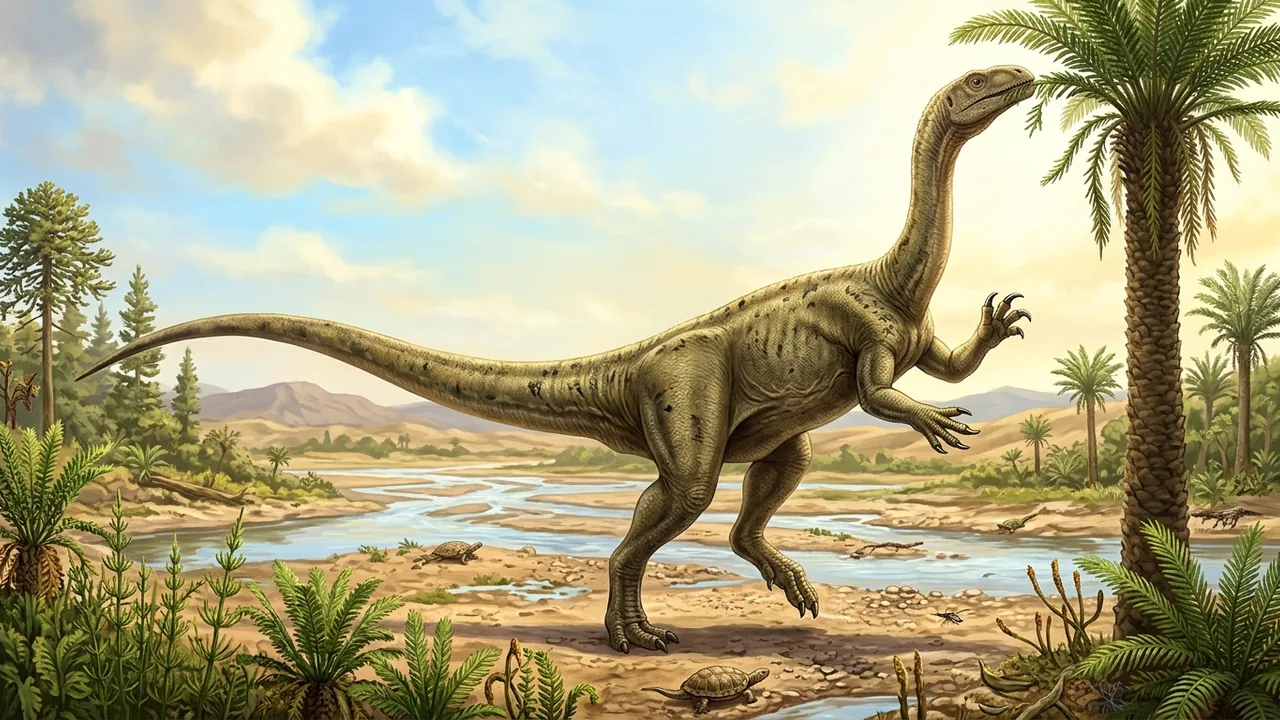
Meet the Legend: Ancestor Blueprint of Titans
Before four-legged giants like Brachiosaurus, Diplodocus, or Argentinosaurus ever shook the ground, their Late Triassic cousin Plateosaurus trossingensis blazed the evolutionary trail! Named broad lizard by German paleontologist Hermann von Meyer in 1837, this pioneering lived across Central Europe between 214 and 204 million years ago.
Depending on local rainfall and seasonal plant supplies, full-grown adults measured anywhere from sixteen to thirty-three feet long and weighed between 1,500 and 8,800 pounds!
Unlike later pillar-legged sauropods, Plateosaurus stood, walked, and ran strictly upright on two muscular hind limbs as a swift, long-tailed across open floodplains.
With its small skull, elongated ten-vertebra neck, strong grasping hands, and barrel-shaped torso, every physical in Plateosaurus previewed the body plan that would soon produce Earth's largest land animals across the entire Mesozoic Era for millions of years!
Lost World Habitat: Pangaea's Red River Valleys
During the Late Triassic Period, the Atlantic Ocean did not exist yet—North America, Europe, Africa, and South America were fused together into one colossal supercontinent called ! Across ancient Germany, Switzerland, and France stretched warm, semi-arid valleys crossed by seasonal monsoon rivers and wide clay mudflats.
Over millions of years, iron-rich river muds and sands compacted into rusty-red rock layers such as Germany's famous Trossingen Formation.
Virginia students share a direct geological connection to Pangaea: Late Triassic red sedimentary rocks in Virginia's Culpeper and Taylorsville basins formed in the very same tropical rift climate belt, preserving fossil cycads, conifers, and early dinosaur footprints!
Sharing Europe's shady river oases with Plateosaurus were early shelled turtles like Proganochelys, armored phytosaurs, burrowing lungfish, small lizard cousins, and swift two-legged predators patrolling the muddy banks after summer rainstorms.
What's on the Prehistoric Menu?
In the Late Triassic river food chain, tough seed ferns, horsetails, conifers, and spiky cycads captured warm solar energy as green producers, while Plateosaurus thrived as the largest primary consumer in its valley! Earlier Triassic plant eaters cropped low bushes near their ankles, leaving treetop leaves completely untouched.
Standing tall on its sturdy hind legs as an agile lifted Plateosaurus's snout over twelve feet high—a game-changing feeding that opened a whole new canopy pantry!
Each muscular arm ended in a five-fingered grasping hand armed with an oversized, sickle-curved thumb claw ideal for hooking stiff evergreen branches close to its jaws.
Lining its jaws were rows of coarse, leaf-shaped teeth edged with tiny serrations that sheared fibrous stems cleanly before billions of helpful gut microbes unlocked rich plant energy inside its long belly.
Superpowers, Senses & Anatomy
How do modern scientists know Plateosaurus never dropped onto four feet to walk? Computer scans of complete skeletons proved the two forearm bones—the radius and ulna—could not cross over each other to twist its palms flat downward! Instead, its palms faced inward for hugging branches while sturdy hind legs and a long muscular tail balanced this obligate cleanly above the ground.
Deep chest ribs angled backward to hold huge bird-like lungs and air sacs that supplied steady oxygen during brisk runs across .
Even more surprising was a life-saving developmental discovered inside microscope slices of its fossil leg bones!
Whereas mammals stop growing at roughly the same adult height, Plateosaurus grew fast to thirty-three feet during rainy, plant-rich decades or matured healthy and strong at sixteen feet during long dry spells!
Flight vs. Fight Arena: Agile Runner of the Mudflats
Patrolling Central Europe's Triassic riverbanks was Liliensternus liliensterni—an agile, seventeen-foot carnivore weighing roughly four hundred pounds, crowned with twin head crests and curved, serrated teeth! Unlike fifty-ton Jurassic sauropods built like slow fortresses, Plateosaurus relied on Team Flight speed and alert agility first whenever predators stalked nearby reeds.
Powerful thigh muscles anchored high along its muscular tail base propelled this long-striding briskly across firm sandbars, outpacing ambush hunters across open valley trails.
Weight and reach provided a strong backup if a hungry predator cut off escape near slick river clay!
A healthy two-ton adult outweighed Liliensternus nearly ten times over and could rear high on sturdy hind toes to lash out with stout, curved inner thumb claws and sweeping tail strikes until the cautious hunter retreated into shady woods.
Fossil Detective Secrets: Trossingen's Mud Traps
Starting in 1911, excavations led by Eberhard Fraas and Friedrich von Huene in Trossingen, Germany—and later in Frick, Switzerland—unearthed over one hundred skeletons of Plateosaurus inside rusty-red mudstones! For decades, scientists wondered whether a desert drought or sudden flood buried an entire migrating herd all at once.
Careful modern quarry mapping by paleontologist Martin Sander revealed a cleverer forensic answer: sticky monsoon mud traps!
Whenever heavy multi-ton adults walked across wet floodplains after storms, their hind feet punched deep into slick clay where a heavy could not pull free, whereas light scavengers and small lizards walked safely across the surface crust.
Preserved upright from 's dawn of giants, those remarkable European skeletons make Plateosaurus one of science's best-understood Triassic dinosaurs anywhere in natural history museums around the globe today!