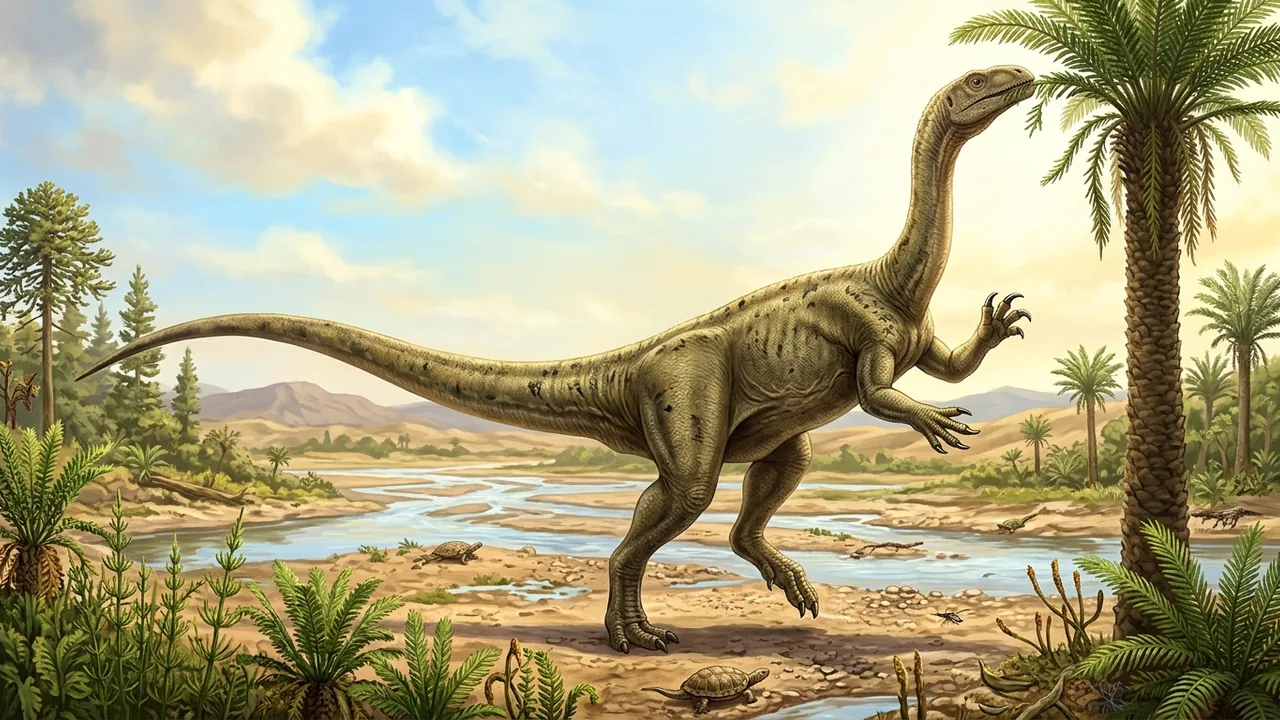
Meet the Legend: Dawn of the Long-Neck Dynasty
Rewind Earth's geological clock more than 210 million years to the Late Triassic Period—fifty million years before Brachiosaurus or Diplodocus walked North America—and meet Plateosaurus trossingensis, the trailblazing pioneer that launched the age of giant plant eaters! First described in 1837 by German paleontologist Hermann von Meyer as 'broad lizard,' Plateosaurus represents the classic early —a basal cousin showing how swift two-legged runners gradually evolved the long necks and cavernous guts of later titans.
Depending on local rainfall and seasonal vegetation across ancient , skeletally mature adults ranged remarkably from sixteen feet and 1,500 pounds all the way to thirty-three feet and four metric tons!
Modern digital overturned a century of sluggish, four-footed museum mounts by proving Plateosaurus stood, walked, and trotted exclusively on two powerful hind limbs throughout its entire life.
With its slender ten-vertebra neck, grasping five-fingered hands, and muscular counterbalancing tail, Plateosaurus combined brisk cursorial agility with high treetop reach across warm river plains.
Every later sixty-ton sauropod inherited foundational anatomical breakthroughs first tested across sunlit Central European river valleys by these adaptable, fast-growing, and enterprising Late Triassic pioneers!
Lost World Habitat: Monsoon Valleys of Pangaea
Between 214 and 204 million years ago during the Norian stage of the Late Triassic, Central Europe sat near thirty degrees north latitude inside the vast supercontinent . Because ocean moisture struggled to reach Pangaea's deep continental interior, strong seasonal megamonsoons drove dramatic swings between baking dry seasons and torrential rainy floods across Germany, Switzerland, France, and Greenland.
Braided rivers carved wide valleys lined with horsetail marshes, seed ferns, tall voltzialean conifers, and tough bennettitalean and cycad groves, surrounded by treacherous red clay overbank flats. Within this dynamic ecosystem, Plateosaurus claimed the first high-browsing dinosaur , feeding meters above squat armored aetosaurs and beak-jawed rhynchosaurs.
Sharing shady river channels were crocodile-like phytosaurs, early terrestrial turtles like Proganochelys, tiny nocturnal mammaliaforms, and slender coelophysoid theropods.
Environmental unpredictability across Pangaea favored adaptable physiology—and Plateosaurus answered with astonishing developmental that tuned adult body mass directly to local plant productivity.
Yet those same monsoon floodplains hid a silent geological hazard after summer downpours: rain-soaked smectite clay depressions that trapped multi-ton browsers upright in deep mire while lighter reptiles trotted safely past along dry riverside sandbars.
What's on the Prehistoric Menu?
Before early dinosaurs evolved in the Late Triassic, almost all land herbivores cropped low ferns and horsetails within three feet of the ground. Plateosaurus revolutionized terrestrial food webs by rising upright on muscular hind legs and extending its flexible neck to browse conifers, ginkgoes, and tall cycads three to four meters overhead—claiming an untapped upper-understory !
Unlike later giant sauropods that lost grasping fingers and chewed nothing at all, Plateosaurus retained dexterous five-fingered hands equipped with an enlarged, strongly curved thumb claw to hook and pull springy evergreen boughs downward toward its jaws.
Its narrow, lightly built skull carried rows of overlapping, lance-shaped teeth lined with coarse serrations angled at forty-five degrees—shearing fibrous stems into swallowable strips while small bony scleral rings around its eyes supported sharp daytime and twilight foraging.
Jaw and occasional swallowed gizzard pebbles indicate Plateosaurus paired quick branch cropping with microbial hindgut digestion inside its deep barrel ribcage.
Some paleontologists also note its serrated teeth could snap up occasional insects or small lizards when severe drought thinned green shoots, giving this hardy pioneer extra dietary resilience across dry months.
Superpowers, Senses & Anatomy
Why did textbooks for decades depict Plateosaurus knuckle-walking or lumbering on four feet, and how did modern computer science prove otherwise? In 2010, paleontologist Heinrich Mallison laser-scanned pristine German skeletons to test joint in three dimensions—discovering that the radius and ulna in the forearm locked together in a way that prevented the palms from rotating downward (pronating) onto the ground without dislocating the elbow and wrist!
Instead, its palms faced inward toward each other as specialized branch-grasping hooks, while its center of mass rested squarely over the hind hips so Plateosaurus walked and ran 100 percent bipedally throughout its entire life!
Angled dorsal ribs and incipient vertebral hollows also point toward unidirectional, bird-like air-sac ventilation fueling sustained aerobic activity across wide river valleys.
Equally groundbreaking was paleobiologist Martin Sander's 2005 bone-slice discovery of extreme developmental —something previously unknown in dinosaurs!
Counting annual growth rings inside dozens of adult femora proved some healthy adults stopped growing at sixteen feet (700 kilograms) while better-nourished individuals surged past thirty-three feet (4,000 kilograms), combining reptile-style growth flexibility with elevated warm-blooded running speed and daily foraging stamina across ancient Europe.
Flight vs. Fight Arena: Speed Against Liliensternus
Hunting along the wooded river corridors of Late Triassic Germany was Liliensternus liliensterni—a swift, seventeen-foot neotheropod armed with recurved, ziphodont teeth, long grasping arms, and twin bony head crests! Unlike seventy-ton Cretaceous titanosaurs that abandoned running altogether, this agile early stood squarely on Team Flight as its primary survival strategy.
Digital musculoskeletal built from complete skeletons show powerful caudofemoralis retractor muscles—anchored along the base of its long tail—pulled the thighbone backward with brisk force, driving long, athletic bipedal strides across firm alluvial sandbars!
Smaller five-meter adults occupying drier scrubland habitats relied especially on alert dusk vision and rapid two-legged acceleration to keep safely ahead of stalking theropods during evening foraging.
Should Liliensternus ambush an individual along a narrow riverbank or muddy crossing, however, Plateosaurus was far from defenseless inside its lush riverside !
An adult weighing two to four tons towered high above a four-hundred-pound predator and could lash downward with trenchant, sickle-shaped pollex thumb claws while pivoting swiftly on sturdy three-toed hind feet until the outnumbered hunter broke off its chase and retreated into dark conifer shadows.
Fossil Detective Secrets: Cracking the Mire Mystery
Few dinosaurs on Earth boast a richer fossil archive than Plateosaurus: quarries at Trossingen in southern Germany, Frick in northern Switzerland, and Halberstadt have yielded well over one hundred partial and complete skeletons! Early twentieth-century excavators Eberhard Fraas and Friedrich von Huene imagined dusty herds perishing together during catastrophic desert marches across .
Decades later, paleontologist Martin Sander re-examined the exact quarry positions, bone weathering stages, and clay sedimentology—uncovering a brilliant forensic solution rooted in body-mass !
Nearly every skeleton in the red mudstone beds belonged to a heavy subadult or adult Plateosaurus, preserved with its hind legs plunged vertically downward while upper ribs showed brief surface scavenging.
Small juvenile individuals and lightweight reptiles were almost completely absent from those mud traps because their low foot pressure let them walk safely across slick, rain-swollen clay crusts where multi-ton adults punched deep and became mired!
Simultaneously, microscopic bone rings across those trapped skeletons revealed Plateosaurus's famous developmental , turning ancient European clay pits into a priceless Rosetta Stone for understanding early dinosaur growth, upright posture, and Late Triassic evolution across museums worldwide today.