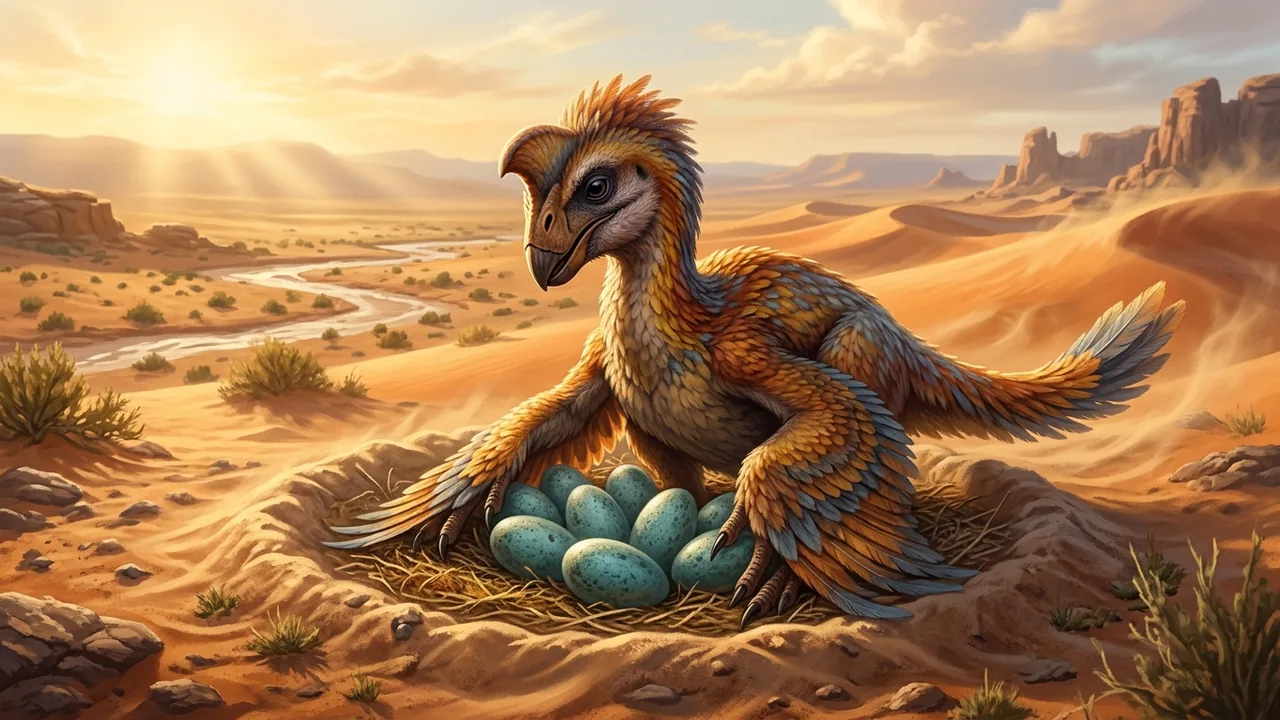
Meet the Legend: Redeeming the 'Egg Thief'
Few taxonomic names in vertebrate paleontology carry sharper historical irony than Oviraptor philoceratops—Latin and Greek for 'egg seizer, lover of ceratopsians.' Coined by Henry Fairfield Osborn in 1924 after an American Museum of Natural History expedition recovered a crushed skull and partial skeleton atop a fossilized nest in Mongolia, the name cast this two-meter Late Cretaceous theropod as a specialized nest plunderer for nearly three-quarters of a century.
Cladistic analyses and extraordinary fossil discoveries since the 1990s have completely overturned that verdict. Oviraptor belonged to Oviraptorosauria, a specialized radiation of feathered theropods closely related to modern birds. Weighing roughly 32 to 41 kilograms (70 to 90 pounds), an adult stood waist-high on long cursorial hindlimbs and balanced its horizontal spine with a muscular, shortened tail.
Instead of ancestral theropod ziphodont teeth, Oviraptor possessed a deep, completely edentulous (toothless) beak crowned by an airy cranial crest. Long three-fingered forelimbs carried symmetrical pennaceous wing feathers, while fused distal tail vertebrae supported a broad rectricial feather fan.
Comparative osteology across dozens of Asian maniraptoran skeletons demonstrates that traits once considered exclusively avian—wishbones (furculae), folding half-moon wrist joints, hollow air-sac vertebrae, and plumed display fans—evolved first among ground-dwelling theropods like Oviraptor. Together, those adaptations formed an integrated anatomical toolkit perfected for visual signaling across sunlit desert dunes, resourceful omnivory, and fiercely devoted parental care.
From its deep jaw mechanics to the brooding posture preserved across Mongolian red beds, Oviraptor bridges the evolutionary gap between ground-running theropods and living birds—inviting modern investigators to look far beyond a century-old case of mistaken identity.
Lost World Habitat: Djadochta Dune Stratigraphy
Oviraptor inhabited the Campanian-stage landscapes preserved within southern Mongolia's world-renowned Djadochta Formation, deposited roughly 75 to 71 million years ago and exposed at classic localities including Bayanzag (the Flaming Cliffs) and Ukhaa Tolgod. High-resolution of these iron-oxide-rich red beds reveals an arid-to-semiarid continental interior shaped by migrating eolian sand dunes, interdune mudflats, and ephemeral braided streams fed by seasonal highland rains.
Despite harsh thermal extremes and periodic droughts, the Djadochta paleoecosystem sustained remarkable vertebrate diversity. Drought-tolerant conifers, cycadophytes, horsetails, and early angiosperm shrubs stabilized oasis margins, supporting multituberculate and placental-grade mammals, gobisuchid crocodyliforms, burrowing lizards, armored ankylosaurs (Pinacosaurus grangeri), abundant horned neoceratopsians (Protoceratops andrewsi), and agile dromaeosaurids (Velociraptor mongoliensis).
Carbonate caliche nodules and root traces embedded within ancient paleosol horizons confirm prolonged dry seasons interrupted by sudden monsoonal cloudbursts. Those brief wet intervals recharged shallow groundwater tables, drawing nesting dinosaurs, insects, and freshwater mollusks together around sheltered interdune valleys.
What makes the Djadochta Formation unrivaled in vertebrate is its signature burial mechanism. Rather than washing carcasses down turbulent rivers that scattered fragile bones, intense rainstorms periodically saturated steep dune faces, triggering sudden, high-viscosity sandflows. These rapid mass-flow deposits entombed nesting adults, embryos, and battling rivals instantaneously in life posture, preserving delicate hollow skulls and uncrushed egg rings across seventy-five million years.
By reading subtle grain sizes, cross-bedding angles, and paleosol root casts within each cliff face, field geologists reconstruct not only how Oviraptor lived between desert oases, but also the exact stormy afternoons that sealed its family history into stone.
What's on the Prehistoric Menu? Cranial Mechanics
Within the Djadochta food web, Oviraptor occupied an adaptable mesoconsumer niche that insulated it against seasonal resource bottlenecks. Whereas dromaeosaurids relied strictly on slicing vertebrate flesh, oviraptorids evolved toothless jaws encased in a thick, continuously growing keratinous rhamphotheca capable of shearing xerophytic foliage, woody seeds, tubers, hard-shelled freshwater mollusks, insects, and small desert reptiles—confirmed directly by a fossil lizard preserved inside the abdominal cavity of the holotype region.
Computed tomography (CT) scans and three-dimensional musculoskeletal modeling reveal the sophisticated engineering behind this toothless bite. Oviraptor's cranium was heavily fenestrated and invaded by air spaces that minimized head mass while maintaining high torsional rigidity across tall nasal and premaxillary struts.
Crucially, its jaw joint (mandibular glenoid) sat depressed well below the biting margin, while a tall coronoid eminence provided expanded attachment for powerful adductor muscles. When this closed its jaws, the lower mandible sheared upward and backward like precision pruning shears, wedging hard shells and seedpods directly against twin tooth-like bony projections on the palate to generate concentrated crushing stress.
Comparative finite-element strain models across Asian oviraptorosaurs further demonstrate how subtle shifts in beak curvature, symphyseal fusion, and jaw-muscle leverage enabled coexisting species across desert and fluvial basins to partition tough plant fibers, hard seeds, and small prey without direct ecological overlap.
Meanwhile, three elongated, recurved manual claws anchored to flexible wrists gave Oviraptor dexterous grasping reach—ideal for pulling fruiting branches toward its beak, excavating shallow oasis roots, or pinning swift desert vertebrates along sandy stream margins.
Superpowers & Anatomy: Avian-Style Nesting
Oviraptorosaurs preserve the most complete fossil record of reproductive anatomy and behavior known for any non-avian dinosaur lineage. High-resolution CT scans of the tall, spongy skull crests in Oviraptor and its close Djadochta relative Citipati osmolskae reveal intricate sinus chambers linked to the nasal cavity, functioning both as vivid socio-sexual display structures and possible respiratory moisture-recovery surfaces in dry desert air.
Digital braincase endocasts reconstructed via X-ray microtomography also reveal enlarged optic lobes, distinct floccular recesses, and finely calibrated semicircular ear canals. Those neurological traits equipped Oviraptor with keen diurnal color vision, rapid gaze stabilization, and agile motor control around crowded colonial nesting grounds.
Their reproductive physiology bridged ancestral reptiles and living birds with striking precision. Fossilized adult pelves containing two shelled eggs side by side prove female oviraptorosaurs retained two active oviducts that ovulated pairs of elongated eggs simultaneously, arranging twenty to thirty eggs radially in two or three concentric tiers around an open central sand platform.
Because those eggs remained partially exposed rather than buried underground like crocodile clutches, chemical mass-spectrometry analyses detected preserved and protoporphyrin IX pigments within the shells! That blue-green coloration camouflaged the clutch against dappled scrubland shadows while the brooding crouched centrally, draping long pennaceous forelimb feathers over the ring to regulate embryonic temperatures around 35 to 40 degrees Celsius.
Microscopic pore canals piercing those blue-green shells balanced gas exchange against arid Gobi evaporation rates, proving that nest architecture, shell chemistry, and adult brooding feathers co-evolved as a unified life-support system.
Flight vs. Fight Arena: Parental Investment Trade-Offs
Evolutionary life-history theory frames survival around a fundamental Flight-versus-Fight trade-off between adult self-preservation and offspring survival. Equipped with elongate hindlimbs, hollow bones, and bird-like unidirectional lung airflow, a lone foraging Oviraptor could sprint swiftly across Gobi flats to evade large predators. Once committed to an open surface clutch containing up to two dozen slow-developing, -tinted eggs, however, abandoning the nest meant total reproductive failure—shifting brooding parents decisively onto Team Fight!
Sympatric dromaeosaurids such as Velociraptor mongoliensis posed a constant threat around Djadochta nesting colonies. Yet in close-quarters nest defense, an adult Oviraptor held substantial biomechanical leverage over its sleeker cousin. Weighing roughly 35 to 40 kilograms—nearly twice the mass of a 15-to-20-kilogram Velociraptor—Oviraptor combined a higher center of hip power with formidable threat displays.
Flaring broad forelimb remiges and its pygostyle tail fan doubled its apparent profile, while powerful three-toed kicks, recurved grasping claws, and a bone-pinching beak deterred raiders. Even more remarkably, bone histology of brooding oviraptorosaur limbs lacks female egg-shell calcium resorption tissue, pointing to dedicated paternal or biparental nest defense just like modern ostriches and emus.
By rotating incubation shifts between paired mates—or uniting communal clutches defended by vigilant males—oviraptorid families ensured an eighty-pound feathered guardian remained stationed over the eggs day and night against both opportunistic predators and sudden desert storms.
This evolutionary shift toward intensive parental investment explains why maniraptoran lineages survived unpredictable Late Cretaceous climates so successfully: fewer, larger, well-defended offspring hatched alert and active under the watchful protection of feathered adults.
Fossil Detective Secrets: Ukhaa Tolgod's Verdict
The seventy-year scientific exoneration of Oviraptor stands as a landmark triumph of paleontological fieldwork and forensic . When George Olsen excavated holotype AMNH 6517 at Bayanzag during Roy Chapman Andrews's 1923 expedition, weathering had stripped embryos from the underlying oblong eggs; surrounded by abundant Protoceratops remains, Osborn understandably—yet mistakenly—cast Oviraptor as a ceratopsian nest thief.
That century-long myth unraveled during joint Mongolian Academy of Sciences and American Museum expeditions to Ukhaa Tolgod between 1993 and 1995. First, paleontologist Mark Norell and colleagues recovered specimen IGM 100/971 from red Djadochta Formation : a weathered elongated egg housing the tiny, articulated embryonic skeleton of an oviraptorid—alongside two tiny Velociraptor skulls nearby, revealing who the true nest lurkers were!
Moments later in field history came specimen IGM 100/979, affectionately dubbed 'Big Mama,' one of several adult Citipati skeletons entombed in life position atop identical multi-ring clutches. With hindlimbs tucked symmetrically inside the central sand ring and feathered forearms spread protectively across twenty eggs during a catastrophic sandflow, these fossils proved avian contact-brooding evolved in ground-dwelling dinosaurs millions of years before modern birds.
Recent synchrotron X-ray imaging of embryonic bone growth lines inside oviraptorosaur clutches continues to deepen this evolutionary story, cementing Oviraptor not as a prehistoric culprit, but as an enduring icon of self-correcting science and dinosaurian family care.
Every time a museum visitor gazes upon a brooding Gobi oviraptorid hugging its ring of stone eggs, they witness direct paleontological proof that curiosity, new fossils, and careful testing can overturn even the oldest scientific myths.