Meet the Legend: Mistaken Identity!
Imagine getting blamed for a crime you never committed! That is exactly what happened to Oviraptor. Its name means egg seizer because early explorers thought it raided other dinosaurs' nests. Today, every knows the exciting truth: Oviraptor was one of prehistory's most devoted and protective parents!
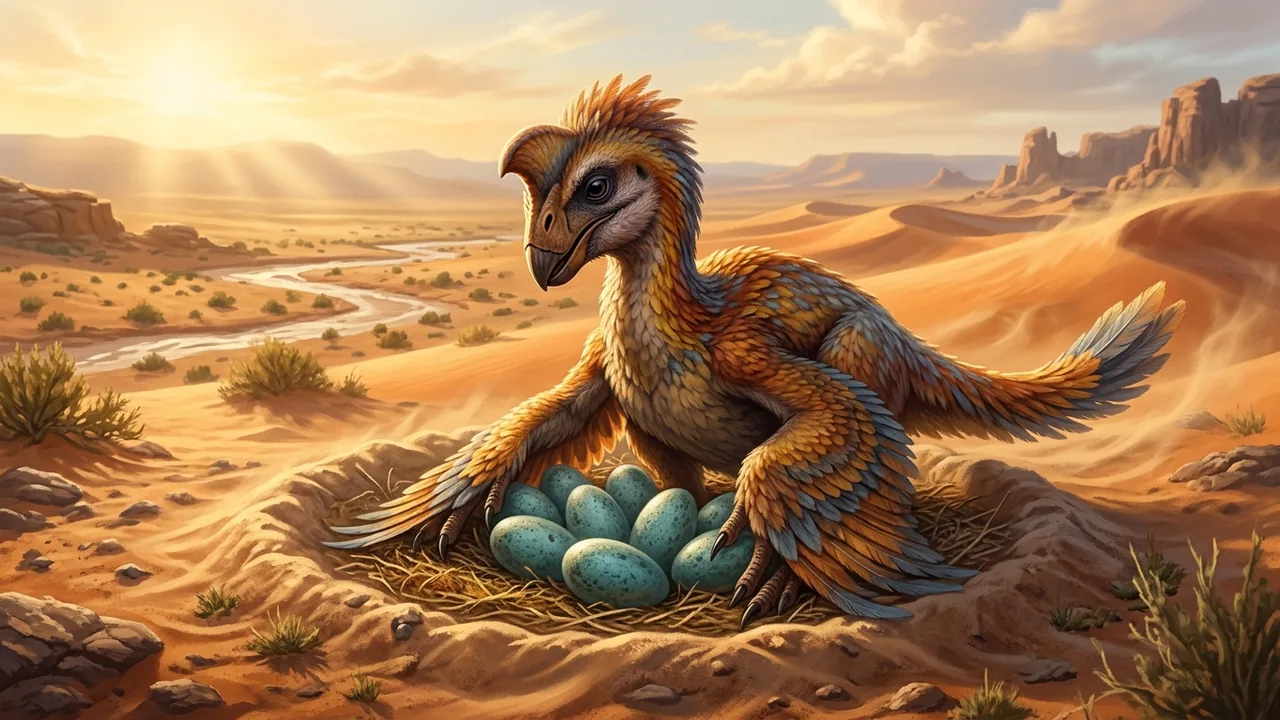
An adult stretched over six feet long—about the length of a grown-up's bicycle—and weighed around eighty pounds, like a big golden retriever dog. Warm, colorful covered its arms and tail fan, while a tall bony crowned its short snout like a bright helmet.
Lost World Habitat: Shifting Gobi Sands
Seventy-five million years ago, Oviraptor lived in what is now the Gobi Desert of Mongolia in central Asia. Towering orange sand dunes rolled for miles under blazing afternoon skies. At night, dry desert air turned brisk and chilly. Tough scrub bushes, low conifers, and shallow ponds dotted valleys between the dunes.
Oviraptor shared these sandy badlands with sheep-sized Protoceratops and swift Velociraptor. Soft body helped Oviraptor handle chilly nights, while parents shielded eggs when sudden desert windstorms whipped huge walls of blowing grit across the valleys.
What's on the Prehistoric Menu?
In a dry desert, picky eaters go hungry fast. Luckily, Oviraptor was a clever that ate almost anything crunchy or nutritious! Even though it had zero teeth inside its mouth, its short, deep jaw held tremendous squeezing power—just like a pair of heavy-duty kitchen nutcrackers.
Below its tall head , a sharp beak trimmed tough desert leaves, roots, and woody seedpods as hard as walnuts. Near oasis streams, Oviraptor cracked thick freshwater clam shells or darted forward on quick legs to snatch scampering lizards and desert beetles.
Superpowers & Anatomy: Built to Care
Every part of Oviraptor's body helped it survive desert extremes and raise healthy chicks. Its rounded skull held hollow air pockets that kept its head light while letting neighbors spot colorful displays across the dunes. Long, springy hind legs carried it swiftly over loose, shifting sand.
Best of all were its three-fingered, feathered arms! When a sandy nest as wide as a hula hoop, Oviraptor crouched carefully in the open center and draped thick wing over two neat rings of blue-green eggs like a living blanket.
Flight vs. Fight Arena: Brave Nest Guardian
Out on open sand flats, fast legs let Oviraptor sprint away from giant predators. Yet once twenty precious eggs were laid in the sand, running away was never an option! parents stood firmly on Team Fight whenever sneaky hunters like turkey-sized Velociraptor crept toward their nests.
Weighing nearly twice as much as Velociraptor, an adult Oviraptor spread its winged to look huge, hissed loudly, and bobbed its tall . With powerful kicking legs, curved hand claws, and a bone-pinching beak, this fearless parent drove nest raiders away!
Fossil Detective Secrets: Case Closed!
Back in 1923, fossil hunters in Mongolia dug up a crushed Oviraptor skeleton lying right over a nest of stone eggs. Guessing the eggs belonged to horned Protoceratops, scientists named the newcomer Oviraptor—and poor Oviraptor got stuck with an unfair 'egg thief' nickname for seventy long years!
Then in the 1990s, a team opened an identical Gobi egg and discovered a tiny unhatched Oviraptor cousin curled inside! Nearby, they unearthed adult Citipati skeletons buried while circular nests in sandstorms. Case closed: Oviraptor was a super-parent!