Meet the Legend: The Parrot-Beaked Theropod
Among all theropod dinosaurs—the mostly meat-eating group that includes giant tyrannosaurs and swift raptors—Oviraptor philoceratops stands out as an evolutionary marvel. Stretching roughly 6.5 feet (2 meters) from snout to tail tip and weighing 70 to 90 pounds, this nimble Late Cretaceous dinosaur traded serrated teeth for a curved, sharp-edged beak.
Named in 1924 from a crushed skeleton unearthed directly above a fossilized of eggs in Mongolia, Oviraptor was unfairly branded an egg thief for seventy years. Early museum murals painted it sneaking into neighbors' nests under desert skies, hiding its true identity from generations of curious readers and scientists alike.
Modern paleobiology, however, revealed a richly feathered, warm-blooded parent whose body plan bridged ground-dwelling theropods and living birds. Flexible half-moon wrist joints let it fold long feathered arms neatly against its sides just like hawks, eagles, and ostriches do today.
A tall, air-light skull crest rose proudly above large, keen eyes, while its muscular tail ended in a broad, colorful feather fan used for balance and signaling. Far from a sneaky raider, Oviraptor combined speed, clever problem-solving, and tireless family devotion across ancient Asia's desert dunes.
Lost World Habitat: Energy in an Arid Basin
Seventy-five million years ago, southern Mongolia's Gobi Basin was a dramatic landscape of towering red sand dunes broken by seasonal streams, shallow oasis ponds, and groves of drought-hardy conifers and horsetails. Daily temperatures swung wildly between baking afternoon sunshine above 105 degrees Fahrenheit and chilly desert nights, making smart essential for survival.
In this arid ecosystem, every drop of moisture and solar energy counted. Sunlight powered tough desert shrubs, deep-rooted tubers, cycads, and seed-bearing plants at the base of the food web, storing vital chemical energy inside woody stems and hard protective seed coats.
Those primary producers supported primary consumers across several active pathways: burrowing mammals, darkling beetles, freshwater clams, desert lizards, and abundant sheep-sized herbivores like Protoceratops. Whenever summer rainstorms filled low interdune valleys, oasis banks buzzed with dragonflies, snails, and hatching amphibians.
Agile predators such as feathered Velociraptor and small terrestrial crocodyliforms hunted along wind-carved dune ridges, while heavily armored Pinacosaurus herds plowed through low scrublands. Within this tightly connected desert web, clean water, shady vegetation, and stable sandy slopes above flood lines were fiercely prized nesting territories.
What's on the Prehistoric Menu? Vise-Jaw Physics
Occupying a flexible middle position, Oviraptor thrived as an opportunistic omnivore across changing desert seasons. When brief rainy spells sparked fresh green growth, it cropped fibrous stems, roots, and hard-coated seeds; during harsh dry months, it hunted fast lizards, hatchling reptiles, beetles, and thick-shelled freshwater mollusks along shrinking creek beds.
Computerized skull explain how a completely toothless dinosaur processed foods far too tough for ordinary raptors. Long-snouted predators like Velociraptor closed their jaws rapidly for quick slashes, sacrificing raw force for speed. Oviraptor took the opposite mechanical path, evolving a short, tall, arched skull with wide openings behind the eyes that anchored thick jaw-closing adductor muscles.
Because Oviraptor's jaw joint sat well below the biting edge, pulling the lower jaw upward created a powerful shearing slide similar to heavy garden loppers. Food items were wedged tightly between the sharp lower rim and two pointed bony spikes on the roof of the mouth, concentrating high pressure per square inch to crack shells effortlessly.
Three long, curved claws on each feathered hand worked alongside that nutcracker beak, hooking tough branches downward or pinning wriggling desert lizards before Oviraptor swallowed its meal.
Superpowers & Anatomy: Nest Architecture
Oviraptor's greatest superpowers centered on nest engineering and precision . In the Gobi Desert, burying eggs deep underground risked suffocating embryos during flash floods, whereas leaving eggs exposed on open sand risked lethal overheating above 110 degrees Fahrenheit at noon or freezing overnight under cloudless skies.
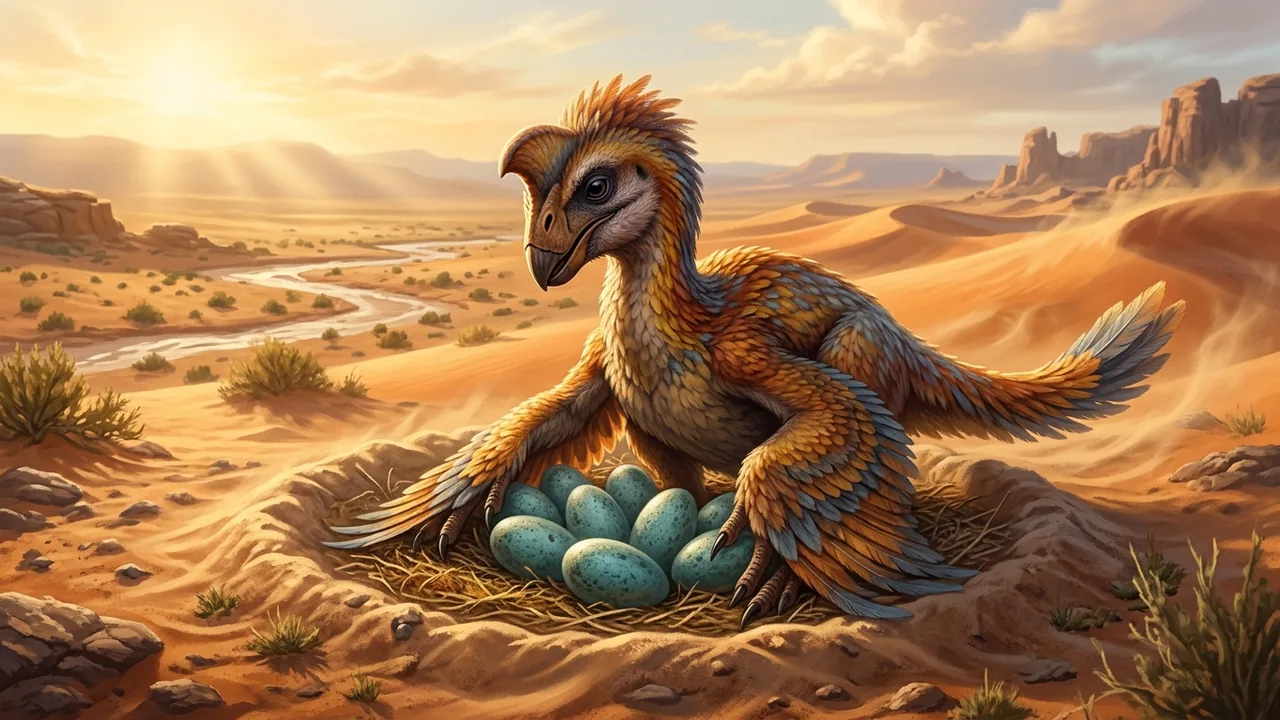
Oviraptorids solved this physics puzzle with brilliant geometry. Parents sculpted a low sandy rim and laid pairs of elongated, blue-green speckled eggs in two or three stacked circular rings, building a of twenty or more eggs around a clear central space. Each seven-inch shell sloped gently inward toward the middle of the sandy mound.
That open bull's-eye allowed an eighty-pound adult to fold its long hind legs neatly beneath its hips and rest its full weight on firm sand without cracking fragile shells. Chemical analyses of oxygen isotopes in fossilized egg minerals indicate incubation temperatures stayed near 98 degrees Fahrenheit, matching warm-blooded living birds.
Once settled into position, the parent draped its long, feathered forearms across the surrounding egg ring. Stiff wing feathers acted as reflective sunshades during scorching afternoons and trapped warm metabolic body heat against chilly night winds until chicks chipped free.
Flight vs. Fight Arena: Defending the Clutch!
Out on open interdune flats, Oviraptor's hollow bones and long lower leg segments allowed brisk sprinting speeds near 28 to 30 miles per hour—swift enough to dodge giant predators when foraging solo. Once anchored to a sand nest holding weeks of parental investment, however, fleeing meant losing the entire . Against fellow Gobi resident Velociraptor mongoliensis, Oviraptor stood boldly on Team Fight!
gave a defending Oviraptor serious close-quarters advantages over its famous raptor neighbor. While Velociraptor stretched a similar six feet in length, over half of that was a stiff balancing tail; an adult Velociraptor weighed roughly 35 to 45 pounds, whereas muscular Oviraptor weighed 70 to 90 pounds—nearly double its rival's mass!
Standing higher at the hip with sturdy footing in loose sand, a guarding parent puffed out broad wing feathers, bobbed its colorful crest, and flared its wide tail fan to look twice as large. If an intruder pressed closer, Oviraptor lashed out with powerful ostrich-strength kicks and three curved hand claws.
Most dangerous of all was its vise-like beak, whose high-leverage jaw muscles could pinch and fracture delicate raptor limb bones—convincing smart desert hunters to search elsewhere for dinner.
Fossil Detective Secrets: The 70-Year Mystery
Few fossil detective stories illustrate scientific self-correction better than Oviraptor. During the 1923 American Museum expedition to Mongolia's Flaming Cliffs, fossil preparator George Olsen uncovered a toothless theropod skeleton lying just four inches above a ring of oblong stone eggs. Because Protoceratops bones were common nearby, paleontologist Henry Fairfield Osborn assumed the predator had died while plundering a Protoceratops .
For seventy years that assumption went unchallenged in textbooks around the globe—until 1993, when paleontologists working at nearby Ukhaa Tolgod discovered an unhatched dinosaur embryo preserved inside an identical oblong egg. Careful preparation with fine needles under microscopes revealed a tiny toothless skull and wishbone: the egg belonged to an oviraptorid all along!
Even more telling, two tiny skulls from juvenile Velociraptor turned up tucked beside that very same oviraptorid nest, hinting that small dromaeosaurs—not Oviraptor—were the real neighborhood nest lurkers.
Shortly afterward, expeditions excavated extraordinary adult skeletons of close cousin Citipati entombed mid-brood when rain-soaked sand dunes collapsed suddenly. With legs tucked neatly and feathered arms still wrapped around their eggs for , these fossils proved beyond doubt that Oviraptor and its kin were devoted super-parents.