Meet the Legend: The Wrongly Accused Parent
For nearly seventy years, museum signs and science books called Oviraptor a sneaky villain! Its scientific name translates to egg seizer, chosen in 1924 after explorers found its skeleton resting directly atop a clutch of fossilized eggs in Mongolia. Because those eggs lay near horned Protoceratops bones, everyone assumed this six-foot dinosaur died while raiding a neighbor's nest.
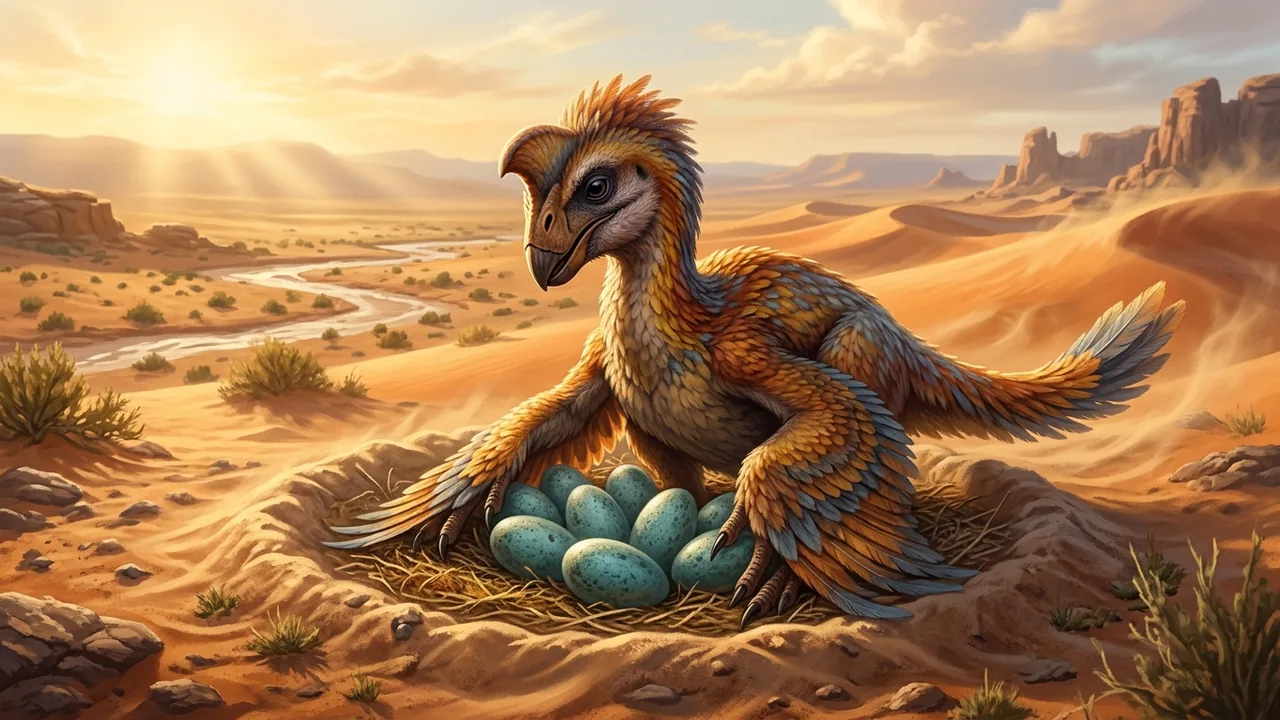
Modern fossil discoveries flipped that story upside down! Far from being a nest bandit, Oviraptor was a feathered, warm-blooded super-parent that worked tirelessly to its own young. Weighing about eighty pounds, it sported a tall hollow head crest, long three-fingered hands, and a curved toothless beak.
Every feature of Oviraptor shows a remarkable physical and behavioral to desert family life, proving that caring bird-like parenting began among dinosaurs long before modern birds filled the skies.
Lost World Habitat: Ancient Desert Oases
During the Late Cretaceous Period about 75 million years ago, Oviraptor roamed an arid desert in southern Mongolia. Towering red sand dunes surrounded seasonal creeks, marshy ponds, scrubby horsetails, and drought-hardy conifers. Summer afternoons blazed with intense heat, clear desert nights turned sharply cold, and fierce spring windstorms swept clouds of sand across the valleys.
Armored ankylosaurs, horned Protoceratops herds, tiny mammals, and agile Velociraptor all shared these rugged badlands, gathering near shady streambeds whenever fresh rain fell. Over millions of years, thick blankets of windblown sand hardened into red rock that locked entire dinosaur neighborhoods and nests in place.
Geologists study similar red Mesozoic sedimentary sandstones right here in Virginia's Culpeper Basin, where ancient stream mudflats hardened into stone and preserved real three-toed theropod dinosaur footprints from millions of years ago!
What's on the Prehistoric Menu?
Food and fresh water could grow scarce in a dry desert , so flexible eating habits gave Oviraptor a huge survival edge. In the Gobi food chain, hardy desert shrubs, roots, and seed plants captured solar energy as producers. Beetles, freshwater clams, snails, and small lizards fed on those plants—and Oviraptor happily ate both!
Being an meant Oviraptor could adjust its diet whenever dry seasons arrived. Although its jaws held zero teeth, its short, deep skull acted like a pair of vise grips, driving a sharp, curved beak through woody seedpods, tough stems, and thick mollusk shells.
Two pointed bony ridges on the roof of its mouth helped wedge and crack hard foods, while long, athletic hind legs let Oviraptor sprint across oasis banks to snatch quick desert skinks.
Superpowers & Anatomy: Feathers, Crests & Nests
Oviraptor's skeleton reveals how physical and behavioral adaptations work together like puzzle pieces. Rising above its short snout and wide, sharp-sighted eyes sat a tall bony crest filled with honeycomb air pockets. This lightweight crest likely flashed bright colors so mates could recognize each other and signal across sunlit dunes.
Along its long forearms grew rows of stiff, bird-like wing feathers, matched by a broad fan of feathers on its muscular tail. Those wings could not lift an eighty-pound adult into the air, yet they solved a tough desert challenge: how to fragile eggs safely.
Parents scooped a low sand mound and arranged up to twenty blue-green eggs in neat rings around an open center. Crouching in the middle, Oviraptor spread its feathered arms like parasols against midday sun and cozy blankets at night.
Flight vs. Fight Arena: Standing Guard!
When foraging alone across open desert flats, Oviraptor had long, slender shin bones built for brisk running to escape giant predators. Back at the nesting colony, however, running away meant losing an entire generation of chicks. Whenever hungry dromaeosaurs like Velociraptor prowled through the dunes, Oviraptor parents switched straight to Team Fight!
In a head-to-head nest confrontation, Oviraptor held impressive physical advantages within its sandy . Weighing roughly eighty pounds, a full-grown Oviraptor outweighed a forty-pound Velociraptor by nearly two to one, giving the defending parent sturdy balance on loose desert sand.
Rising tall over its circular nest, the parent puffed out its wing and tail feathers to look enormous—a classic behavioral used by modern birds. Backed by powerful kicking legs, three curved hand claws, and a bone-pinching beak, Oviraptor fiercely protected its eggs from raiders.
Fossil Detective Secrets: Clearing Oviraptor's Name
Science works like detective work: new clues always test old ideas! Back in 1923, explorers at Mongolia's Flaming Cliffs chipped the very first Oviraptor skeleton out of red sandstone right above a cluster of oblong eggs. Because Protoceratops fossils were abundant nearby, scientists guessed Oviraptor had been caught stealing Protoceratops eggs.
Seventy years later in 1993, paleontologists exploring nearby Ukhaa Tolgod carefully examined a broken fossil egg of the exact same oblong shape. Curled inside the stone shell lay the tiny, toothless skeleton of an unhatched oviraptorid baby waiting to hatch!
Days later, the team unearthed spectacular adult Citipati fossils—close cousins of Oviraptor—buried suddenly by collapsing wet dunes while faithfully crouched to circular nests with spread feathered arms. Thanks to careful fieldwork, fossil detectives cleared Oviraptor's name forever as a devoted parent!