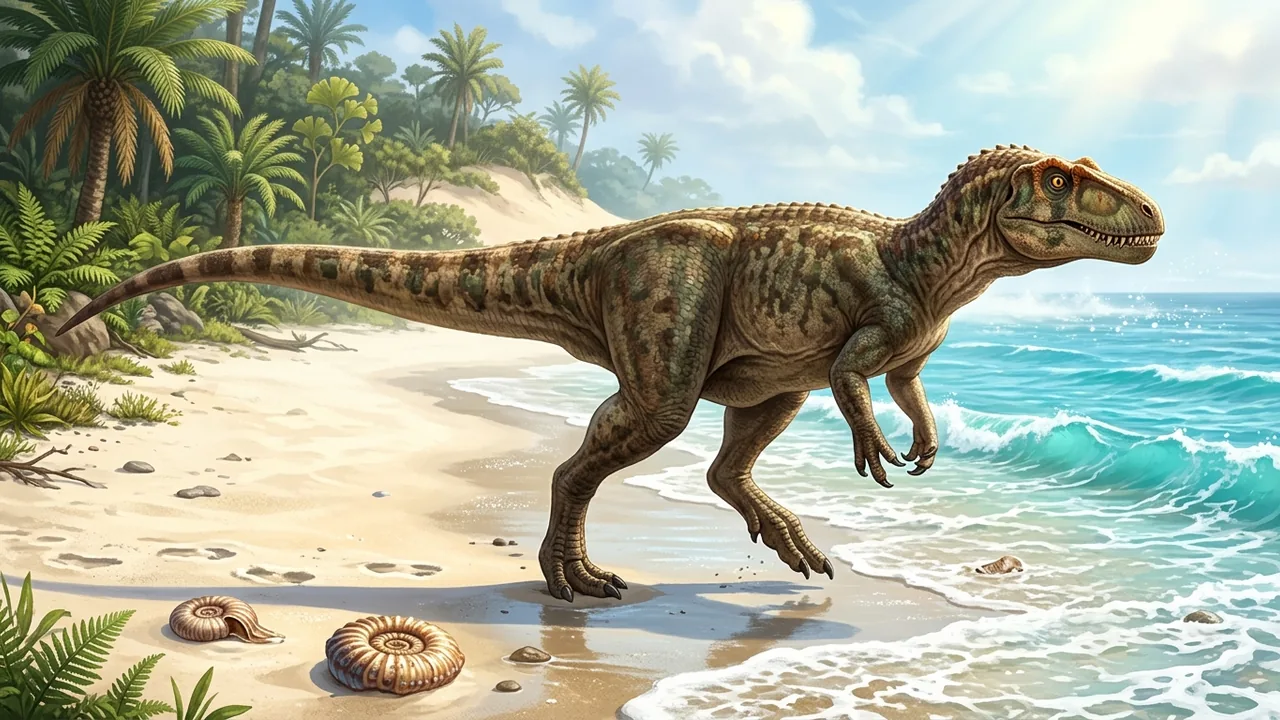
Meet the Legend: Founding Icon of Dinosauria
On February 20, 1824, Oxford geologist William Buckland stood before the Geological Society of London to describe an extraordinary toothed mandible from Oxfordshire—unveiling Megalosaurus and inaugurating vertebrate dinosaur paleontology eighteen years before Sir Richard Owen coined Dinosauria in 1842.
Measuring 8 to 9 meters (26 to 30 feet) in length and weighing 1,000 to 1,400 kilograms, Megalosaurus bucklandii occupied the apex terrestrial predator role across Middle Jurassic Britain.
Modern phylogenetic systematics places Megalosaurus as the type genus of Megalosauridae within —a major basal branch of stiff-tailed Tetanurae sister to fish-eating Spinosauridae.
That evolutionary kinship explains why Megalosaurus shared robust pectoral girdles, stout forearms, and muscular inward-facing three-fingered hands with spinosaurids like Baryonyx, while retaining a deep, laterally compressed terrestrial skull.
Diagnostic autapomorphies set Megalosaurus bucklandii cleanly apart from cousins such as North American Torvosaurus: a pronounced longitudinal vascular groove along the outer dentary surface, swollen third dentary tooth alveoli, and distinctive muscular ridges across its dorsal hip blade.
Lined with recurved ziphodont crowns sheathed in protective extra-oral labial scales, its skull combined slicing precision with high dorsoventral resistance.
Counterbalanced horizontally over sturdy tridactyl hind limbs by interlocking distal caudal vertebrae, this pioneer carnivore bore zero resemblance to sprawling Victorian lizard models.
Two centuries after Buckland's lecture, rigorous cladistics confirms Megalosaurus was an athletic, finely engineered island hunter whose stout forelimbs, pneumatic axial column, and serrated jaws established the classic megalosauroid body plan across Middle Jurassic Europe long before giant allosauroids or tyrannosaurids rose to dominance.
Lost World Habitat: Bathonian Taynton Limestone
Understanding why England's most famous terrestrial predator occurs inside marine rock requires examining the Middle Jurassic stratigraphy of the Cotswold Shelf—specifically the middle Bathonian Taynton Limestone Formation, dated biostratigraphically by ammonite zones (Procerites progracilis) to roughly 166 million years ago.
Within the Taynton Limestone near Stonesfield, Oxfordshire, subsurface miners historically worked thin, quartz-rich, calcareous sandstone and lenses nicknamed the 'Stonesfield Slate.'
During Bathonian greenhouse highs, eustatic sea levels submerged central Europe into warm, agitated carbonate shoals surrounding emergent islands of the London-Brabant Massif.
While crustal spreading simultaneously widened the young central Atlantic basin separating western Europe from eastern North America's Mesozoic coastal plain, wave-swept carbonate banks around Oxfordshire precipitated millions of concentric calcium-carbonate spheres called ooids.
Just onshore across low barrier islands flourished drought-tolerant coastal forests of araucariacean and cheirolepidiacean conifers, cycads, bennettitaleans, ginkgophytes, and ferns.
Tropical storms and tidal creeks regularly swept terrestrial flora and fauna—beetles, lacewings, early mammaliaforms (Phascolotherium, Amphitherium), rhamphorhynchid pterosaurs, and disarticulated Megalosaurus bones—into quiet lagoon troughs alongside ammonites, nautiloids, and teleosaurid marine crocodylomorphs.
Rapid burial beneath fine carbonate mud shielded delicate jawbones and teeth from wave abrasion.
Consequently, Oxfordshire's oolitic limestones preserved one of the richest Middle Jurassic land-and-sea fossil assemblages anywhere on Earth—allowing geologists to correlate warm marine ammonite zones directly with island forest ecosystems where giant bipedal theropods patrolled sunlit carbonate beaches. Few formations anywhere link shallow marine geochemistry so clearly with dinosaurian island life across warm Bathonian lagoons and shell-rich tidal shoals.
What's on the Prehistoric Menu?
Insular coastal habitats reward predators capable of exploiting both upland forest herbivores and marine-subsidized shoreline carrion, and craniodental mechanics shows Megalosaurus bucklandii excelled at both.
Its lectotype right dentary (OUMNH J.13505) exhibits a dorsoventrally deep, robust mandibular ramus devoid of the pronounced upward chin curvature seen in slender-jawed relatives, resisting vertical bending moments when biting into resistant bone and cartilage.
Thirteen to fourteen alveoli per dentary—complemented by four premaxillary and roughly thirteen maxillary crowns above—housed laterally compressed ziphodont blades bearing coarse mesial and distal denticles.
Separate, unfused pentagonal interdental plates reinforced the lingual alveolar margin, while CT and cross-sectional views confirm continuous polyphyodont tooth replacement erupting upward from medial resorption crypts.
Across Bathonian island interiors, Megalosaurus hunted basal stegosaurians, small agile neornithischians, and juvenile eusauropods browsing among cycad and conifer thickets.
Along storm-wracked carbonate beaches, meanwhile, stranded carcasses of teleosaurid marine crocodylomorphs, ichthyosaurs, plesiosaurs, and giant suspension-feeding pachycormid fishes provided high-calorie coastal windfalls.
Stout manual claws on Digits I–III—driven by prominent humeral deltopectoral crests and enlarged ulnar olecranon processes—anchored slippery prey firmly while powerful cervical muscles drew serrated maxillary blades backward.
By coupling terrestrial ambush power with opportunistic shoreline scavenging, Megalosaurus sustained multi-ton predator populations across island archipelagos where strictly specialized hunters might have starved during seasonal dry spells or shifting coastal tides. Shed megalosaurid teeth scattered beside herbivore bones across Cotswold quarries confirm its undisputed status at the apex of Bathonian coastal food webs throughout southern Britain during the Middle Jurassic.
Superpowers, Senses & Anatomy
Although no single complete articulated skeleton of Megalosaurus bucklandii has ever been recovered, composite osteology from over one hundred diagnostic Oxfordshire elements—paired with Bathonian trackway —reconstructs its locomotor and respiratory physiology in vivid detail.
Cervical and anterior dorsal centra contain deep lateral pleurocoels leading into internal camerate air spaces, demonstrating an avian-style flow-through pulmonary air-sac system that reduced axial mass while supporting sustained aerobic output.
Across the pelvis, a long, low ilium with a characteristic median vertical ridge anchored broad iliofemoralis muscles, while the pubis and ischium projected downward to frame deep hind-limb retractors.
Robust femora measuring over eighty centimeters long articulated with sturdy tibiae and three weight-bearing metatarsals configured for energetic cursorial strides.
Direct behavioral confirmation arrived in 1997 when paleontologists led by Julia Day mapped extensive Bathonian limestone surfaces at Ardley Quarry, just twenty kilometers northeast of Stonesfield.
Among dozens of trackways, Trackway 30 preserved a continuous line of large tridactyl theropod prints (~55–62 cm long) exhibiting zero tail-drag furrows and narrow, parasagittal foot placement.
Mid-trail, stride length surged from 1.6 meters to 3.45 meters! Applying R. McNeill Alexander's dimensionless Froude-number equations, ichnologists calculated an abrupt acceleration from a relaxed 7 km/h walk into an athletic 29 km/h (18 mph) sprint across glistening lagoon mud—proving Middle Jurassic megalosaurids combined robust grappling forelimbs with remarkably agile, upright hind-limb mechanics across firm intertidal flats. Deeply impressed claw tips along those longest strides record powerful digital push-off at top running speed across wet carbonate sandbars.
Flight vs. Fight Arena!
Ardley Quarry's Bathonian bedding planes preserve more than isolated sprints—they capture an entire coastal ecosystem where tridactyl megalosaurid tracks intersect broad, meter-wide trackways (ichnogenus Parabrontopodus) left by herds of Cetiosaurus oxoniensis!
Reaching sixteen meters (52 feet) in length and weighing roughly eleven metric tons, Cetiosaurus was Britain's best-known Middle Jurassic eusauropod and a formidable exemplar of Team Fight.
Unlike later diplodocids with extensively hollowed vertebrae, Cetiosaurus retained heavy, spongy presacral bone architecture alongside solid, pillar-like appendicular limbs and a muscular whip-capable tail.
Biomechanical scaling underscores why solo 1.3-ton Megalosaurus avoided frontal assaults against healthy adult Cetiosaurus: an eight-fold mass disadvantage meant a single defensive forelimb stomp or lateral caudal sweep carried bone-shattering kinetic energy.
Evolutionary trade-offs, however, granted Megalosaurus decisive superiority in burst acceleration, turning agility, and sensory responsiveness.
Whereas heavy sauropod herds trudged across exposed carbonate tidal flats at steady 4 to 5 km/h speeds, Megalosaurus could lurk inside coastal conifer fringes and sprint nearly six times faster across firm sand!
Targeting unaccompanied juveniles, exhausted individuals mired in sticky lagoon muds, or smaller thyreophorans, Megalosaurus maximized caloric return while minimizing fatal injury risk.
Those ancient Oxfordshire trackways freeze-frame the enduring evolutionary arms race between sauropod gigantism and tetanuran predatory speed—demonstrating how behavioral caution and selective targeting allowed coastal megalosaurids to coexist beside multi-ton herbivores across European archipelagos throughout the Middle Jurassic without exhausting vulnerable island prey populations or risking crippling defensive blows along sunlit tidal flats and shallow carbonate lagoons.
Fossil Detective Secrets
Tracking the three-century investigation of Megalosaurus reveals how science refines early breakthroughs through stricter evidence. In 1676, Oxford professor Robert Plot published the earliest known illustration of a dinosaur bone—the distal condyle of a giant femur from Cornwell, Oxfordshire—though its true identity remained mysterious until William Buckland's 1824 Stonesfield study, illustrated with lithographic mastery by Mary Morland Buckland.
When Sir Richard Owen established Dinosauria in 1842, sparse skeletal material led him and sculptor Benjamin Waterhouse Hawkins (1854) to model Megalosaurus as a heavy, mammal-like quadruped.
Discovery of complete North American theropods like Allosaurus and Ceratosaurus soon overturned that quadrupedal posture, yet created a brand-new taxonomic headache: for over a century, paleontologists treated Megalosaurus as a convenient , dumping more than fifty unrelated Triassic, Jurassic, and Cretaceous theropod species from around the globe into the genus!
Between 2008 and 2010, Oxford vertebrate paleontologist Roger B. J. Benson conducted an exhaustive anatomical audit of every Middle Jurassic specimen from Oxfordshire and Gloucestershire.
Identifying rigorous autapomorphies on the lectotype dentary, maxilla, ilium, and axial bones, Benson stripped away dubious foreign teeth and stabilized Megalosaurus bucklandii as a distinct, well-diagnosed Bathonian megalosaurid.
From seventeenth-century curiosity to modern cladistics and trackway , the very first named dinosaur continues teaching scientists how to read Earth's deep past accurately while celebrating the collaborative fieldwork, museum curation, and artistic precision that launched paleontology two hundred years ago in central England's historic limestone quarries and university collections for eager readers worldwide.