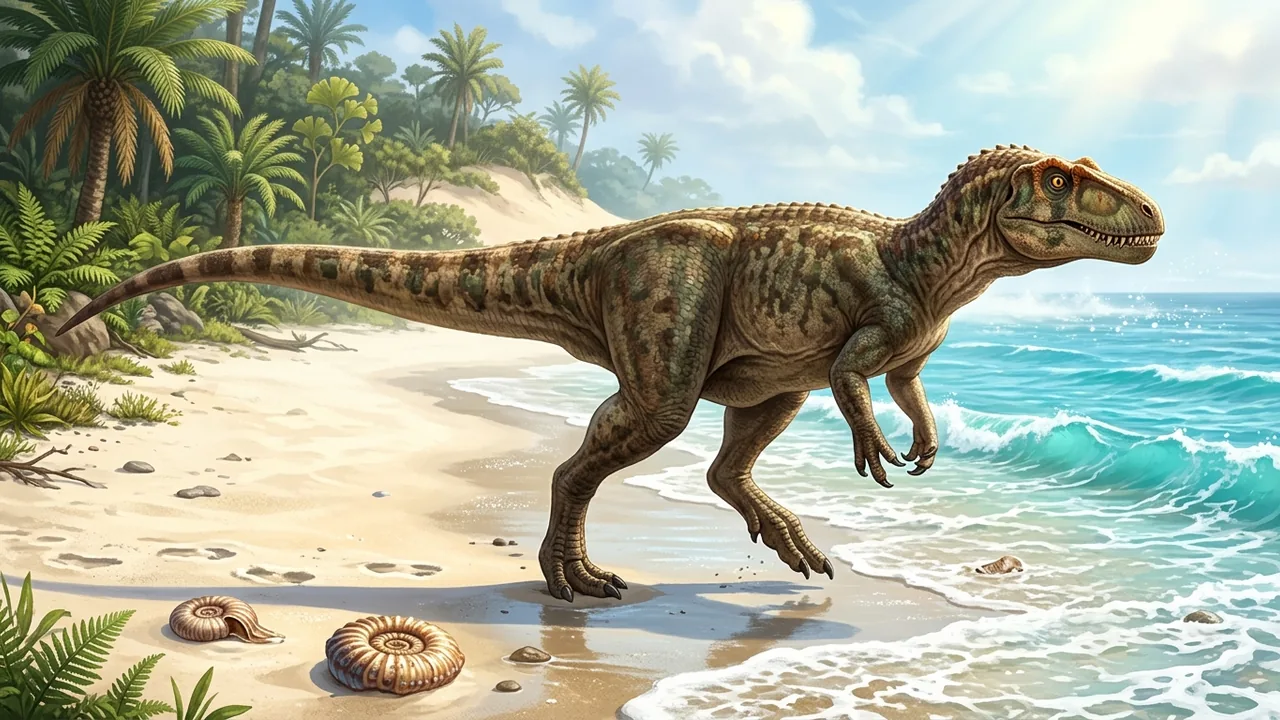
Meet the Legend: Anchor of the Megalosaurids
Every branch of science remembers its founding discovery, and for dinosaur research that honor belongs to Megalosaurus bucklandii. Formally named in February 1824 from a robust lower jawbone unearthed in Oxfordshire, England, this twenty-eight-foot, 1.3-ton carnivore stood at the dawn of paleontology—and near the base of a mighty evolutionary radiation.
Within the theropod family tree, Megalosaurus anchors Megalosauridae inside , the great 'stiff-tailed' clade whose interlocking rear tail vertebrae provided dynamic balance during fast bipedal strides.
Interestingly, megalosaurids were close evolutionary cousins to spinosaurids like Baryonyx; both groups belonged to Megalosauroidea and shared notably muscular shoulders and stout, three-fingered inward-facing hands.
Unlike narrow-snouted piscivores, however, Megalosaurus wielded a tall, heavily built skull armed with curved slicing teeth tucked neatly behind protective lip scales.
Supported by pillar-strong hind limbs and neck vertebrae, it patrolled Middle Jurassic island shores as Europe's premier coastal predator.
Far from a primitive experiment, this athletic pioneer set the anatomical blueprint for giant land hunters across the globe—combining grappling arm strength, shearing jaws, and swift two-legged balance over twenty million years before Allosaurus ruled western plains.
Lost World Habitat: Bathonian Carbonate Lagoons
One hundred sixty-six million years ago during the Bathonian stage of the Middle Jurassic, tectonic plate movements and high sea levels submerged much of western Europe beneath a warm epicontinental sea.
Elevated blocks of older rock rose above turquoise waters as the Anglo-Brabant island chain, ringed by white sandbars, tidal mudflats, and calm barrier lagoons.
Gentle wave action rolled microscopic shell fragments into smooth, spherical limestone grains called ooids, building the Taynton Limestone Formation quarried around Stonesfield in Oxfordshire today.
Just inches above high tide, humid coastal forests of cycadophytes, bennettitaleans, ginkgoes, ferns, and tall araucarian conifers sustained insects, lizards, early tritylodonts, tiny crown-group mammals, and diverse dinosaurian herbivores.
Offshore swam ammonites, marine crocodylomorphs (Teleosaurus), ichthyosaurs, and Rhamphorhynchus-like pterosaurs skimming lagoon surfaces for fish.
Because seasonal storms washed terrestrial carcasses and plants straight off narrow island beaches into oxygen-poor carbonate muds, Oxfordshire's limestones preserved a rare snapshot where land predators and marine life mingled! Warm ocean currents kept these subtropical island archipelagos frost-free all year long, nurturing lush shoreline greenery beside sparkling shell-sand coves where giant hunters left clear three-toed tracks across tidal lime mud.
What's on the Prehistoric Menu?
Analyzing the famous 1824 Stonesfield dentary reveals a feeding apparatus built for high-force, flesh-shearing bites. Unlike slender-jawed theropods whose lower dentaries curved gently, the front of the Megalosaurus lower jaw stood remarkably tall and thick, reinforced along its outer surface by a distinct longitudinal groove and nutrient openings.
Thirteen to fourteen sockets lined each dentary, holding recurved crowns edged front and back with fine serrations that sliced muscle fibers cleanly under downward neck pull.
Inside the inner wall of the jawbone, separate interdental plates walled off each tooth socket while pointed replacement crowns developed continuously below active fangs—guaranteeing sharp cutlery even if a tooth snapped against bone!
Across Oxfordshire's island food web, those jaws targeted early stegosaurs (such as Loricatosaurus relatives), medium-sized ornithopods, and juvenile Cetiosaurus foraging along coastal scrublands.
Living along island shorelines offered a bonus trophic stream too: carcasses of marine crocodylomorphs, plesiosaurs, and giant pachycormid fishes stranded after tropical cyclones supplemented terrestrial hunts.
Versatile foraging ensured top island carnivores thrived despite limited land area, turning both shady conifer woods and shell-strewn beaches into productive hunting territories.
Superpowers, Senses & Anatomy
Skeletal biomechanics and trace-fossil work hand in hand to reveal how Megalosaurus moved in life. Along its axial column, openings called pleurocoels invaded the cervical and anterior dorsal vertebrae, connected in life to bird-like air sacs that trimmed skeletal weight and ventilated high-energy lungs.
Robust deltopectoral crests along its stout humerus anchored thick chest and shoulder muscles, allowing its inward-facing three-clawed hands to grapple struggling island herbivores securely.
Meanwhile, curved femora with prominent fourth trochanter ridges channeled massive caudofemoralis tail-retractor power straight into each backward leg stroke.
In 1997, quarry workers at Ardley Quarry, just miles from Stonesfield, uncovered spectacular ichnology evidence across a vast Bathonian mudflat: over forty consecutive tridactyl footprints left by a single large theropod matching Megalosaurus in foot size!
Midway along Trackway 30, stride length nearly doubled from four feet to over ten feet while footprint rotation narrowed toward the midline.
Applying biomechanical speed equations, researchers calculated the hunter accelerated smoothly from a 4-mph walk into an 18-mph sprint—proving beyond doubt that Middle Jurassic megalosaurids moved with crisp, horizontal athleticism across coastal flats!
Flight vs. Fight Arena!
Nothing brings prehistoric ecology to life faster than footprints left by predator and prey on the very same afternoon—and Oxfordshire's limestone beds preserve exactly that encounter between 1.3-ton Megalosaurus and fifty-foot, eleven-ton Cetiosaurus oxoniensis!
As one of the earliest giant sauropods to evolve heavy, solid limb bones and barrel-vaulted ribs, adult Cetiosaurus stood nearly twice as tall at the hip as Megalosaurus and weighed as much as eight coastal hunters combined.
Charging headlong into a healthy cluster of mature Cetiosaurus invited crushing forelimb stomps or sweeping tail blows.
Yet trackway reveals how nimble bipedal carnivores navigated sauropod country: while wide, dish-shaped sauropod prints plodded steadily at three miles per hour across firm lagoon mud, agile theropods could burst to eighteen miles per hour in seconds!
Using coastal araucaria groves for concealment, Megalosaurus shadowed herd flanks to isolate inexperienced juveniles or infirm stragglers without engaging multi-ton defenders directly.
That dynamic balance between formidable sauropod mass defense and rapid tetanuran sprint ambushes shaped terrestrial ecosystems across every continent for the next hundred million years of Mesozoic history along ancient beaches and floodplains.
Fossil Detective Secrets
The scientific biography of Megalosaurus mirrors the entire history of paleontology. After Oxford chemist Robert Plot sketched a mysterious Stonesfield thighbone end in 1676, quarry miners working forty feet underground chipped out a toothed dentary acquired by Oxford geologist William Buckland.
Assisted by fossil illustrator Mary Morland Buckland—whose meticulous stone-plate drawings captured both erupted crowns and hidden replacement teeth—Buckland presented Megalosaurus to the Geological Society of London on February 20, 1824.
Eighteen years later, Sir Richard Owen united Megalosaurus with Iguanodon and Hylaeosaurus to coin Dinosauria, initially modeling them as elephant-legged quadrupeds immortalized by Benjamin Waterhouse Hawkins in 1854.
Over the next 150 years, however, scientists carelessly assigned hundreds of fragmentary serrated teeth from five continents to Megalosaurus, turning the pioneer genus into a confusing 'wastebasket' label!
Between 2008 and 2010, Oxford paleontologist Roger Benson re-examined every genuine Bathonian bone, identifying unique jaw, hip, and arm traits that strictly defined Megalosaurus bucklandii.
Rescued by modern anatomy and Oxfordshire , the first named dinosaur stands sharper and clearer in 2026 than ever before—reminding students everywhere that careful evidence always improves scientific understanding!