Meet the Legend: Pioneer of Dinosaur Science
Every dinosaur book in the library owes a big thank-you to Megalosaurus (MEG-uh-loh-SOR-us)! Named in 1824, this 'great lizard' was the very first dinosaur ever given an official scientific name—eighteen whole years before scientists coined the word dinosaur!
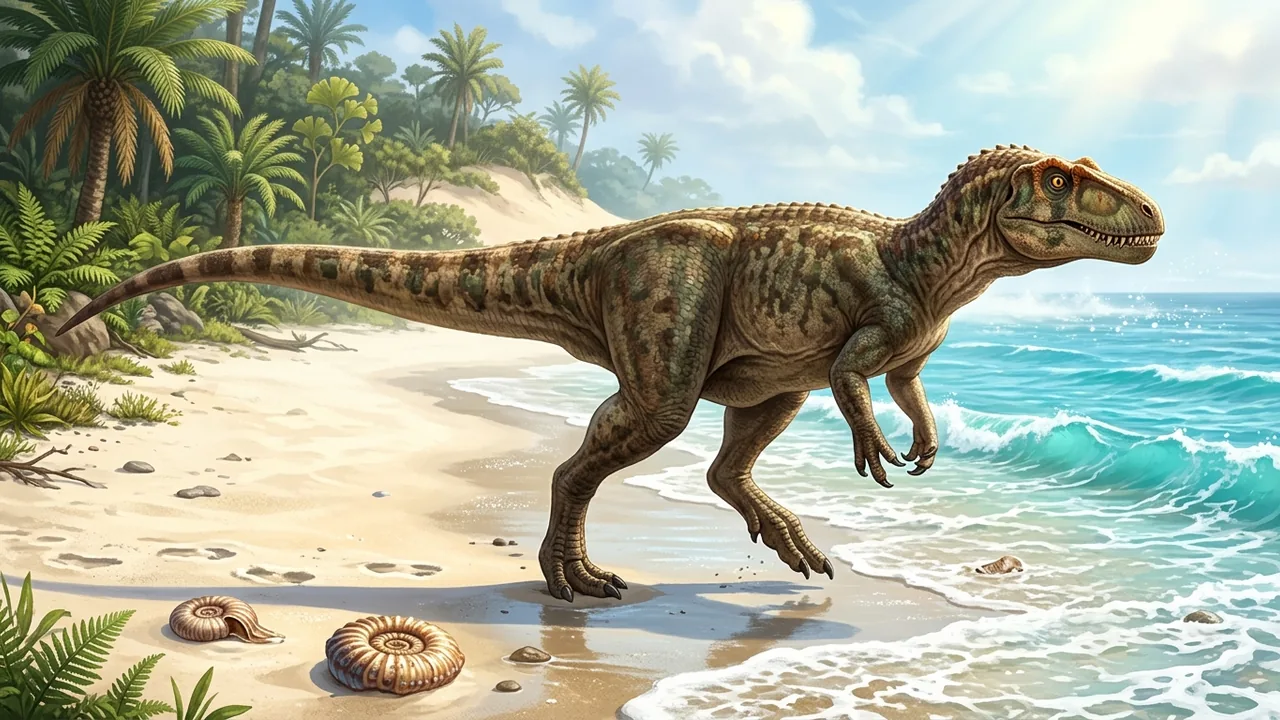
Measuring twenty-six to thirty feet long and weighing as much as a small pickup truck, Megalosaurus was no sluggish lizard. Balanced by a muscular horizontal tail, this athletic predator strode across Middle Jurassic shorelines on two powerful legs with three-clawed hands held ready.
Lost World Habitat: Limestone Island Chains
Travel back 166 million years to the Middle Jurassic Period, and England looked like the sunny Bahamas! High seas flooded low valleys, turning Britain and western Europe into a warm island surrounded by clear, turquoise lagoons.
Tiny shell grains piled up on the shallow seafloor to form pale rock. Cycad palms, ferns, and monkey-puzzle conifers grew right down to sandy beaches where coiled ammonite shells, sea turtles, and small flying pterosaurs shared the warm island breeze with patrolling Megalosaurus.
What's on the Prehistoric Menu?
As the largest land hunter on its island , Megalosaurus sat squarely at the top of the coastal food chain. Its deep, sturdy lower jaw carried curved, teeth that worked like sharp steak knives to slice tough meals cleanly.
Even better, Megalosaurus never worried about losing a tooth during supper! Inside special bony pockets along its jaw, brand-new replacement teeth grew continuously like a steady conveyor belt. Stalking quietly along ferny trails and sunny lagoon beaches, Megalosaurus ambushed early plated stegosaurs, small swift plant-eaters, and young long-necked sauropods wandering near the palms.
Superpowers, Senses & Anatomy
Unlike tiny-armed Carnotaurus, Megalosaurus kept thick, muscular arms tipped with three curved claws that faced inward like giant grappling hooks. Strong chest and shoulder bones helped it hold slippery prey steady while its deep skull delivered powerful bites.
How fast could a one-ton island hunter move? A famous fossil in Oxfordshire answered that question! Across dozens of yards, one set of three-toed footprints suddenly stretched farther apart—capturing the exact moment a Megalosaurus-sized dinosaur shifted from a calm four-mile-per-hour walk into an eighteen-mile-per-hour sprint!
Flight vs. Fight Arena!
Along wide tidal mudflats, thirty-foot Megalosaurus shared island beaches with fifty-foot Cetiosaurus—a hefty, long-necked sauropod whose name means 'whale lizard.' Weighing up to eleven tons, a full-grown Cetiosaurus outweighed Megalosaurus nearly eight to one!
At Oxfordshire's Ardley Quarry, parallel trackways preserved in show herds of Cetiosaurus marching across the mud right alongside Megalosaurus tracks. Rather than charging headfirst into pillar-like legs and whipping tails of healthy adults, smart Megalosaurus shadowed the herd edges, watching patiently for tired stragglers or unguarded youngsters.
Fossil Detective Secrets
Roof-slate miners near Stonesfield, England, chipped a mysterious toothed jawbone out of underground long before museums knew what dinosaurs were. In 1824, Oxford geologist William Buckland studied the fossil while his wife, Mary Morland Buckland, drew detailed scientific plates of its erupting teeth.
In 1854, artist Benjamin Waterhouse Hawkins built a famous concrete of Megalosaurus in London—posing it on four legs like a hump-backed bear! Over the next century, extra hip, arm, and leg bones proved Megalosaurus actually ran swiftly upright on two legs.