Meet the Legend: The Dinosaur That Started It All
Long before museum halls displayed towering skeletons of Tyrannosaurus or Triceratops, a single toothed jawbone from Oxfordshire, England, launched modern dinosaur ! Named Megalosaurus—pronounced MEG-uh-loh-SOR-us, meaning 'great lizard'—in 1824, this remarkable carnivore became the very first non-bird dinosaur ever given an official scientific name.
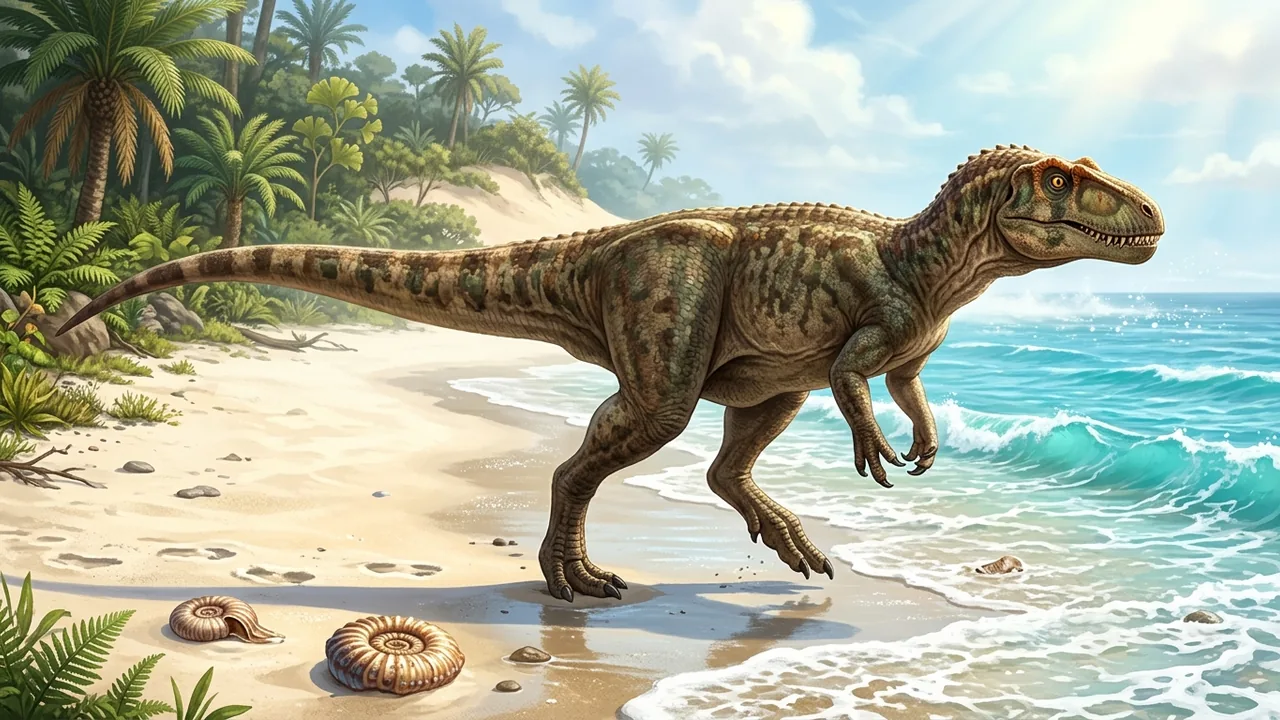
Measuring twenty-six to thirty feet from snout to tail and weighing over a ton, Megalosaurus was an athletic Middle Jurassic apex predator built for coastal islands.
Balanced horizontally over two muscular hind legs by a counterweighting tail, it carried a deep, sturdy skull and powerful three-fingered arms with curved claws facing inward.
More than just a historical pioneer, Megalosaurus gave its name to an entire family of stout-armed hunters—the megalosaurids—that thrived along ancient coastlines, forested islands, and riverbanks millions of years before giant tyrannosaurs ever walked the Earth.
Lost World Habitat: Subtropical Limestone Seas
Around 166 million years ago during the Middle Jurassic Period, rising seas turned central England into a sunlit island surrounded by warm, shallow lagoons. Tiny calcium-rich shells and round mineral grains settled onto the clear lagoon floor, hardening over time into pale Taynton .
Virginia students studying Earth's rock cycle see how similar ancient limestones—like the shell-rich carbonate rocks underlying Virginia's Shenandoah Valley—prove that dry land today once lay beneath warm, shallow seas! Meanwhile, during Megalosaurus's Middle Jurassic era, the young Atlantic Ocean off eastern North America was widening steadily between Virginia and Europe.
Onshore across Oxfordshire's low islands grew cycad palms, ginkgoes, ferns, and conifers.
Storm tides periodically swept driftwood, pinecones, beetles, early tiny mammals, and Megalosaurus bones off sandy beaches into calm lagoons alongside coiled ammonite shells.
What's on the Prehistoric Menu?
Island ecosystems pack diverse food chains into compact spaces, and Megalosaurus ruled where coastal conifer woods met sandy tidal flats. Lush cycads, horsetails, and ferns fed early armored stegosaurs, agile bipedal herbivores, and herds of long-necked Cetiosaurus sauropods.
To harvest tough prey, Megalosaurus relied on a classic carnivorous : thick, curved teeth lined front and back with fine saw-like serrations. When William Buckland peered inside the fossilized lower jawbone, he noticed small triangular tooth tips peeping out from tiny bony windows along the gumline!
Unlike mammals—which grow only one adult set of teeth—Megalosaurus replaced worn or chipped fangs throughout its entire life.
Patrolling shaded island trails as well as white-sand beaches, this versatile hunter ambushed forest herbivores and scavenged marine crocodiles or giant fishes stranded by shifting tides along breezy lagoon shores throughout every season.
Superpowers, Senses & Anatomy
Modern examination of over a hundred Oxfordshire bones reveals how well Megalosaurus was built for active coastal hunting. Its skull was deeper and sturdier than those of narrow-snouted cousins, anchoring thick jaw muscles capable of delivering forceful, flesh-shearing bites without twisting out of shape.
Below its neck, wide shoulder blades and stout upper arm bones supported muscular three-fingered hands armed with curved grappling claws.
Air-filled pockets inside its neck and back vertebrae lightened its skeleton, while strong thigh muscles powered swift strides across firm sand.
Spectacular proof of that athleticism emerged in 1997 at Ardley Quarry near Oxford, where paleontologists uncovered a of huge three-toed footprints stretching nearly two hundred yards—recording a Megalosaurus-sized hunter accelerating smoothly from a four-mile-per-hour walk into an eighteen-mile-per-hour run across glistening tidal mud without ever dragging its balanced tail!
Flight vs. Fight Arena!
Along Oxfordshire's wide tidal lagoons, one-ton Megalosaurus shared beaches with a true Middle Jurassic giant: fifty-foot, eleven-ton Cetiosaurus oxoniensis! Preserved side by side on the exact same surface at Ardley Quarry, round tub-sized sauropod tracks cross paths with sharp three-toed theropod trackways.
In the Flight versus Fight arena, adult Cetiosaurus belonged firmly to Team Fight! Supported by solid, pillar-thick leg bones and armed with a heavy, muscular tail, a healthy herd of eleven-ton adults formed a living wall that no solo one-ton predator dared charge head-on.
Instead, Megalosaurus used speed, patience, and coastal cover to tilt the odds.
Waiting along narrow forest bottlenecks or muddy lagoon inlets where juvenile sauropods lagged behind the main herd, Megalosaurus darted in with a sudden burst of speed while steering wisely clear of defensive adults.
Fossil Detective Secrets
No dinosaur illustrates how science self-corrects better than Megalosaurus! Back in 1676, Oxford professor Robert Plot illustrated the lower end of a giant fossil thighbone from Oxfordshire, wondering if it belonged to a Roman war elephant. More than a century later, quarrymen at Stonesfield unearthed the toothed lower jawbone studied by William Buckland and illustrated by Mary Morland Buckland in 1824.
In 1842, anatomist Sir Richard Owen grouped Megalosaurus with Iguanodon and armored Hylaeosaurus to establish Dinosauria—meaning 'fearfully great reptiles.'
At first, Victorian sculptures unveiled in London in 1854 posed Megalosaurus on four legs with a humped back.
Later discoveries of complete theropod skeletons—culminating in paleontologist Roger Benson's landmark twenty-first-century restudy of every Oxfordshire bone—restored Megalosaurus as a sleek, bipedal island hunter that opened the door to all and inspired museums around the world!