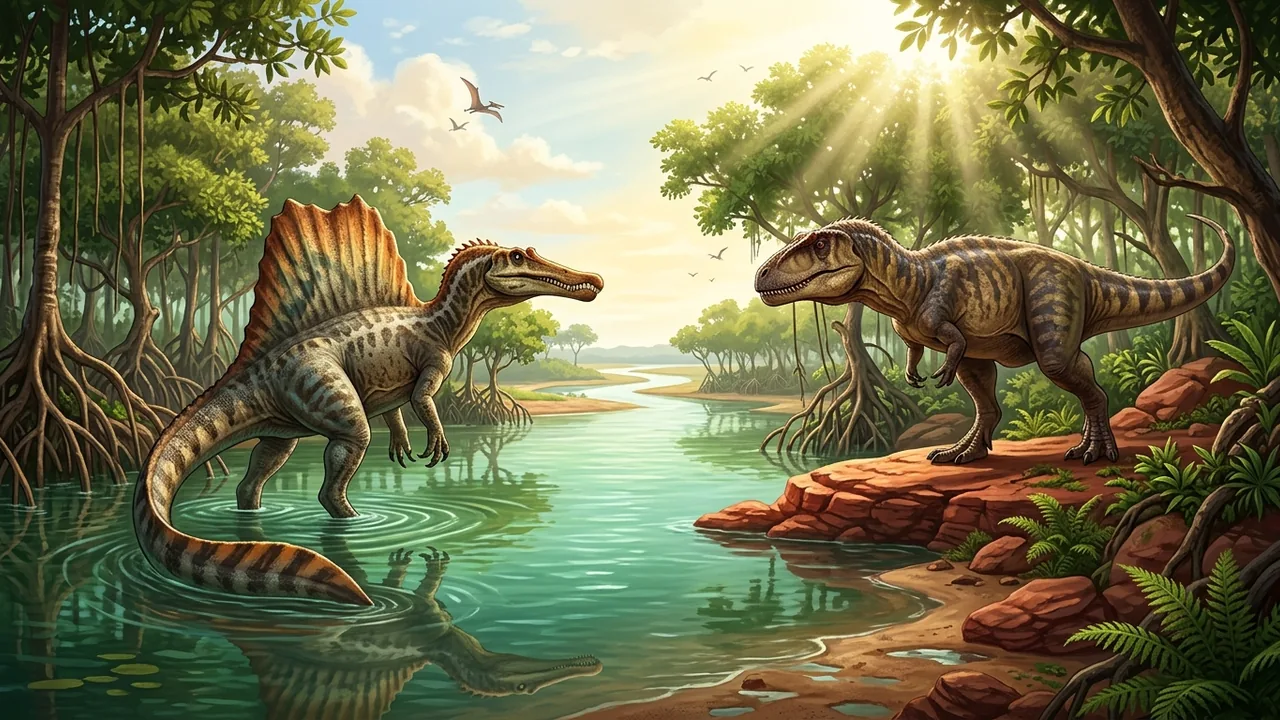
Meet the Legend: Sympatric Cenomanian Giants
Across modern terrestrial biomes, the ecological principle of competitive exclusion prevents multiple multi-ton hypercarnivores from dominating identical habitats for long, because available food energy drops by roughly ninety percent at every upward step of a trophic pyramid. Yet Cenomanian strata of North Africa (~99–94 MYA)—exposed across Egypt's Bahariya Formation and Morocco's —preserve two of the largest theropod dinosaurs ever evolved: fourteen-meter Spinosaurus aegyptiacus and thirteen-meter Carcharodontosaurus saharicus!
First puzzled over by Bavarian paleontologist Ernst Stromer more than a century ago, this apparent predator-heavy guild became famous throughout vertebrate paleontology as 'Stromer's Riddle.' How could a single Gondwanan coastal basin sustain multiple six-to-eight-ton apex theropods alongside fast abelisaurids like Rugops and giant crocodylomorphs without collapsing under relentless interspecific competition?
Cladistic, isotopic, and biomechanical syntheses demonstrate that evolution prevented head-on overlap through strict ecological , sculpting wildly divergent archosaurian bauplans from distant branches of the theropod tree! Descending from megalosauroid stock, Spinosaurus elongated its crocodile-like premaxillary rostrum, shortened its hind limbs, thickened its cortical bone walls for underwater stability, and elevated two-meter dorsal neural spines into a dramatic skin-covered sail.
Conversely, allosauroid Carcharodontosaurus refined classic terrestrial cursoriality: an air-light pneumatic skeleton balanced horizontally over tall, muscular hind limbs and crowned by a 1.6-meter skull lined with thin, serrated shark-like blades built to harvest dry-floodplain sauropods. Together, by splitting deep megafish waterways from sunlit terrestrial corridors rather than battling over identical quarry, these twin Cenomanian giants proved that sharp habitat boundaries allowed ancient North Africa to crown two record-breaking dinosaur kings at the exact same time!
Lost World Habitat: Gondwanan Tethys Deltas
During the Cenomanian greenhouse peak of the Mid-Cretaceous, global eustatic sea levels stood roughly two hundred meters higher than today, flooding low continental margins of northern Gondwana beneath warm Tethyan epicontinental waters. Across what is now hyper-arid Saharan Morocco and western Algeria, cliff-forming red beds of the —subdivided stratigraphically into lower cross-bedded fluvial channel sandstones of the Ifezouane Formation and upper muddy lagoonal-deltaic deposits of the Aoufous Formation—record a colossal north-flowing river system.
Wide meandering distributary channels, tidally flushed mangrove estuaries, and deep freshwater oxbow lakes braided across vast alluvial plains clothed in araucarian conifers, tree ferns, horsetails, cycadophytes, and early Cenomanian flowering plants.
Crucially, aquatic secondary productivity dwarfed adjacent terrestrial plant biomass! Enormous schools of eight-meter sclerorhynchid sawfish (Onchopristis numidus), five-meter Mawsonia lavocati coelacanths, three-meter Bawitius polypterid bichirs, armored lungfish, pelomedusoid river turtles, and bus-sized stomatosuchid crocodylomorphs packed deep channels with renewable protein.
Meanwhile, firmer sandstone levees and inland savannas supported whip-tailed rebbachisaurid sauropods, colossal titanosaurs such as Paralititan stromeri, and sail-backed iguanodontians. Although river currents concentrated shed teeth from multiple microhabitats into single time-averaged channel lag beds over thousands of years, Kem Kem paleogeography genuinely placed deep megafish channels right beside firm sauropod corridors—creating an ideal physical template for ecological between river and floodplain apex hunters! Driven by warm equatorial monsoons, seasonal floods continually connected inland freshwater channels to coastal estuaries from Morocco eastward to Egypt's Bahariya basin, ensuring rich aquatic and terrestrial food chains flourished side by side for five million years before rising Late Cenomanian seas submerged the delta beneath marine limestone.
What's on the Prehistoric Menu?
Quantitative geochemical analyses have transformed ecological between Spinosaurus and Carcharodontosaurus from plausible inference into measured paleobiological fact! Stable oxygen (delta-18O) and calcium (delta-44/42Ca) isotope ratios locked inside crystalline tooth-enamel bioapatite record both daily water residence time and exact trophic position within ancient food webs.
Enamel sampled across dozens of Moroccan spinosaurid crowns consistently exhibits low delta-18O values matching sympatric freshwater turtles and crocodylomorphs, paired with strongly depleted calcium isotope ratios diagnostic of heavy piscivory—high-trophic fish consumption! While rare fossil gut contents and embedded spinosaur teeth show these predators occasionally seized low-flying pterosaurs or unwary shore dinosaurs during dry seasons, giant river fish supplied the overwhelming bulk of Spinosaurus's seven-ton metabolic budget.
Mechanically, Spinosaurus's narrow, sigmoidal premaxillary rosette carried straight, finely fluted conical teeth lacking serrated cutting edges, working alongside curved thirty-centimeter manual-I thumb unguals to impale and pin slippery ganoid-scaled coelacanths and barbed Onchopristis sawfish without slicing them loose in swift currents.
By contrast, Carcharodontosaurus tooth enamel yields enriched terrestrial oxygen and calcium signatures overlapping land-dwelling herbivorous dinosaurs! Shielded against desiccation by subtle extra-oral lip scales, its laterally compressed, six-inch maxillary blades carried chisel-shaped denticles engineered to deliver rapid, deep slicing bites against unarmored titanosaurian sauropods such as Paralititan and Rebbachisaurus across firm floodplains. Because narrow spinosaurid jaws minimized drag underwater while tall carcharodontosaurid skulls maximized vertical slicing leverage on land, every bite reinforced strict resource division—allowing two seven-ton hypercarnivores to harvest completely separate halves of North Africa's rich Cenomanian food web without exhausting shared prey populations.
Superpowers, Senses & Anatomy
High-resolution X-ray micro-CT scanning illuminates how deeply natural selection remodeled Spinosaurus for aquatic foraging while honing Carcharodontosaurus for rapid overland pursuit. Internal digital reconstructions of Spinosaurus premaxillae revealed dozens of external sensory foramina wired into a branching trigeminal canal—forming a crocodile-grade mechanoreceptive array capable of pinpointing faint hydrodynamic pressure waves from hidden sawfish in silt-clouded currents while retracted external nares remained safely above the waterline!
Postcranially, Matteo Fabbri and colleagues' landmark 2022 phylogenetic bone-compactness survey demonstrated that Spinosaurus femora and dorsal ribs exhibited extreme pachyostotic , infilling medullary marrow cavities with dense compact bone to provide natural subaqueous ballast! Combined with wide, flat-bottomed pedal unguals that prevented sinking in soft delta silt and sixty-centimeter caudal neural spines forming an undulating tail paddle, Spinosaurus possessed unmistakable semi-aquatic specializations.
Vigorous peer-reviewed debate continues in 2026 between paleontologists modeling Spinosaurus as a diving tail-propelled pursuit swimmer (Nizar Ibrahim et al.) versus three-dimensional buoyancy and drag biomechanical models reconstructing it as a stable shoreline and channel wader (Paul Sereno et al.)—illustrating how living science tests competing physical hypotheses!
Ashore, Carcharodontosaurus retained extensive camerate vertebral pneumaticity that lightened its frame, elongated cursorial tibiae for swift strides across open plains, and semicircular ear-canal geometry orienting its five-foot skull slightly downward for rapid stereoscopic targeting of terrestrial quarry. Backed by broad temporal jaw muscles, deep dorsal vertebrae braced by stout ligaments, and three-toed weight-bearing feet built for firm sandstone traction, Carcharodontosaurus embodied high-speed dry-land predation just as completely as dense-boned, sensory-snouted Spinosaurus embodied life along ancient African waterways.
Flight vs. Fight Arena!
Seasonal Cenomanian dry spells inevitably shrank Kem Kem channels into isolated oxbow refugia, drawing Spinosaurus and Carcharodontosaurus onto shared sandbars beside stranded Onchopristis sawfish or mired sauropods. Although minimized year-round conflict and cursorial Flight made little sense for seven-ton apex predators, evolutionary game theory strongly favored ritualized bluffing over dangerous combat! Because a fractured jaw could starve even the mightiest hunter, Spinosaurus pivoted broadside first to display its vascularized, keratin-sheathed two-meter dorsal sail—projecting an intimidating silhouette across open water.
Whenever neither giant yielded and a turf clash escalated, substrate biomechanics dictated a decisive, terrain-dependent verdict regardless of whether Spinosaurus swam deeply or waded! Out on firm, dry floodplain sandstone, Spinosaurus's elongated presacral trunk and muscular forelimbs shifted its center of mass anteriorly ahead of unusually short hind limbs, slowing bipedal rotational turns and exposing tall dorsal neural spines to dangerous flanking bites.
Across firm dry ground, hip-balanced, long-striding Carcharodontosaurus controlled engagement geometry, circled rapidly on pneumatic legs, and wielded wide-gaped ziphodont jaws with unmistakable terrestrial superiority!
Once a standoff entered waist-to-chest-deep river currents and unconsolidated delta mud, however, physics reversed immediately: narrow-footed, high-centered Carcharodontosaurus lost traction in slick silt while ballast, broad mud-spreading toes, hooked manual-I thumb claws, and undulating caudal tail stability gave Spinosaurus commanding home-water victory. Rather than crowning a single universal champion, Cenomanian physics enforced a sharp ecological border right at the water's edge—rewarding bluff displays first, awarding firm savannas to agile Carcharodontosaurus, and granting every deep emerald channel to North Africa's sail-backed river king.
Fossil Detective Secrets
Few sagas in vertebrate paleontology rival the century-spanning detective hunt required to reconstruct North Africa's twin Cenomanian kings! Between 1911 and 1914, Bavarian paleontologist Ernst Stromer and collector Richard Markgraf excavated the original holotypes of Spinosaurus aegyptiacus (described in 1915) and Carcharodontosaurus saharicus (described in 1931) in Egypt's Bahariya Oasis—only for an April 1944 Allied air raid on Munich's Paläontologisches Museum to destroy both irreplaceable skeletons.
For half a century, only Stromer's meticulous lithographs, field measurements, and archival photographs rediscovered in a Bavarian family castle survived! Then in 1995, Paul Sereno's Sahara expedition into Morocco's cliffs unearthed a magnificent 1.6-meter neotype skull, followed between 2008 and 2020 by Nizar Ibrahim's international team tracing distinctive purple-streaked bones from a Moroccan quarryman's box back to a Zrigat cliff horizon preserving associated Spinosaurus hind limbs, hips, and thirty articulated paddle-tail vertebrae (specimen FSAC-KK 11888)!
Rare pathological fossils from Kem Kem sandstones even preserve spinosaurid dorsal neural spines bearing healed fractures and large theropod tooth scores, documenting real-life delta standoffs when drought-shrunk territories collided.
Synthesizing stratigraphic Kem Kem Group fieldwork, stable tooth-enamel isotopes, snout CT scans, and global bone-density profiles, twenty-first-century paleontology proves ancient North Africa crowned two specialized rulers—one commanding emerald megafish rivers, the other ruling sunlit sauropod floodplains! By combining Stromer's surviving twentieth-century illustrations with high-resolution laser scans, 3D-printed Moroccan vertebrae, and geochemical enamel tests, researchers turned a tragic wartime museum loss into one of modern science's clearest triumphs of paleobiological reconstruction and ecological discovery.