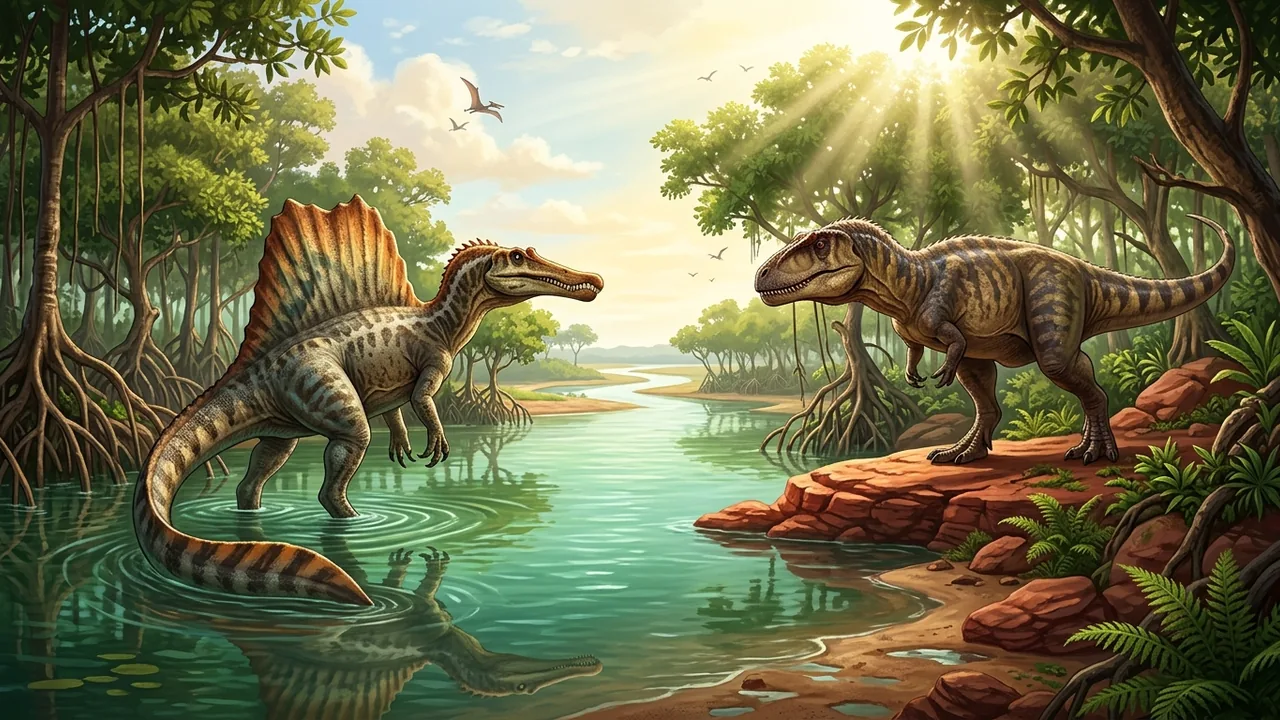
Meet the Legend: Solving Stromer's Riddle
In modern terrestrial ecosystems, gigantic apex carnivores rarely crowd into the exact same territory because available food energy shrinks steeply near the top of a trophic pyramid. Yet ninety-nine to ninety-four million years ago across North Africa, Mid-Cretaceous rock beds preserve multiple seven-ton theropods—headlined by forty-six-foot Spinosaurus aegyptiacus and forty-two-foot Carcharodontosaurus saharicus!
Paleontologists call this ecological puzzle 'Stromer's Riddle,' honoring pioneer researcher Ernst Stromer, who wondered why Saharan sandstones yielded abundant mega-predator bones alongside seemingly fewer medium-sized land herbivores. How could one ancient river basin feed two predators heavier than bull elephants without constant, exhausting turf wars?
Modern biomechanics and geochemistry finally cracked Stromer's code through ecological ! Rather than competing head-to-head for identical quarry across the exact same ground, these two titans evolved radically divergent body blueprints.
Spinosaurus shifted its forward toward muscular forelimbs, shortened its hind legs, and engineered a crocodile-snouted, paddle-tailed river specialist crowned by a towering six-foot dorsal sail. Meanwhile, Carcharodontosaurus perfected a hip-balanced, tall-striding terrestrial powerhouse armed with thin shark-like blades—proving evolution can pack two giant kings into one kingdom wherever deep emerald rivers meet broad sunlit floodplains!
Lost World Habitat: Kem Kem River Trophic Web
Ninety-five million years ago during the Cenomanian stage of the Mid-Cretaceous, northern Africa sat near the equator bordered by the warm Tethys Ocean. Instead of today's arid Sahara sand seas, an immense network of wide braided rivers, calm oxbow lakes, brackish mangrove estuaries, and lush seasonal floodplains stretched across Morocco, Algeria, Tunisia, and Egypt.
Unlike typical dinosaur ecosystems powered mainly by terrestrial ferns and conifers, the Kem Kem trophic web drew massive energy from aquatic food chains! Sunlit, nutrient-rich channels teemed with twenty-five-foot Onchopristis sawfish armed with barbed snout teeth, car-sized Mawsonia coelacanths, giant armored bichirs, lungfish, freshwater turtles, and bus-sized crocodylomorphs.
Along firmer red sandstone levees and inland plains grew towering araucarian conifers, tree ferns, horsetails, and early flowering shrubs browsed by long-necked sauropods such as Rebbachisaurus and massive thirty-ton titanosaur Paralititan.
Chemical clues preserved inside ancient sediments and fossil teeth show how closely water and land habitats worked side by side. That dual aquatic-and-terrestrial productivity solved Stromer's Riddle cleanly through : deep waterways supplied endless megafish biomass for semi-aquatic Spinosaurus, while adjacent savannas nourished giant sauropod herds for overland hunter Carcharodontosaurus!
What's on the Prehistoric Menu?
Chemical clues locked inside fossil tooth enamel confirm Kem Kem with laboratory precision! Geochemists analyze oxygen and calcium ratios in enamel because animals that drink, wade, and catch fish in river channels preserve markedly different atomic signatures than strictly terrestrial hunters feeding under hot open skies.
Across dozens of Moroccan specimens, Spinosaurus tooth enamel consistently matched semi-aquatic crocodiles and freshwater turtles, confirming giant river fish dominated its daily calorie budget—even though rare fossil gut and bone clues show spinosaurids also opportunistically snatched low-flying pterosaurs or unwary shore prey!
Its narrow crocodile-like jaws worked like giant needle-nose fish traps: an expanded terminal rosette of smooth, straight, conical teeth interlocked cleanly to pierce slippery Onchopristis sawfish and armored Mawsonia coelacanths while curved twelve-inch thumb claws pinned heavy catches steady.
By contrast, Carcharodontosaurus tooth enamel matched land-dwelling sauropods! Armed with thin, six-inch laterally flattened blades lined with razor-fine serrations inside a five-foot skull, Carcharodontosaurus skipped bone-crushing to deliver rapid, deep slicing bites engineered to harvest muscle from multi-ton floodplain herbivores like giant titanosaur Paralititan, whip-tailed Rebbachisaurus, and sail-backed iguanodont Ouranosaurus across open savannas without ever needing to wade after river fish.
Superpowers, Senses & Anatomy
Every bone in Spinosaurus and Carcharodontosaurus reflects contrasting laws of physics! High-resolution CT scans of Spinosaurus's narrow snout revealed branching internal nerve canals wired to dozens of tiny surface —pressure-sensing pores nearly identical to modern crocodile jaws that pinpoint faint underwater vibrations from unseen sawfish swimming through murky currents.
Even more telling, microscope cross-sections of Spinosaurus ribs and thigh bones revealed extreme : instead of hollow air-filled marrow cavities typical of land theropods, dense solid bone walls added natural ballast to counteract lung buoyancy during deep wading and shallow submergence!
Combined with retracted nostrils set partway up the skull, wide flat foot unguals that spread weight across soft delta mud, and two-foot-tall tail spines forming an undulating paddle, Spinosaurus mastered river margins—whether swimming across deep channels or stalking shallows like a colossal seven-ton heron.
Ashore, Carcharodontosaurus kept lightweight pneumatic hollow bones, protective lip scales, and a hip-centered balanced squarely over muscular femora and shins! Built to sprint past twenty miles per hour across dry floodplains, its wide five-foot skull packed powerful temporal jaw muscles that drove swift, shark-toothed slicing strikes with pinpoint balance.
Flight vs. Fight Arena!
What happened when fierce seasonal droughts shrank Kem Kem channels into narrow emerald pools packed with trapped Onchopristis sawfish and drew both seven-ton kings onto the same sandbar? Because severe jaw injuries could starve any apex hunter, towering visual intimidation came first: Spinosaurus angled its body broadside to flash its colorful six-foot dorsal sail like a fourteen-foot warning billboard!
If bold bluff displays failed to settle territory, biomechanics made terrain the ultimate referee! Out on firm, dry floodplain sandstone, Spinosaurus faced a clear mechanical handicap: its elongated ribcage and heavy forelimbs shifted its forward ahead of unusually short hind legs, slowing overland pivots and leaving its tall dorsal neural spines vulnerable to flanking bites.
Across firm dry ground, taller, faster-turning Carcharodontosaurus circled smoothly on long legs, controlled striking distance, and held unmistakable command with wide, serrated jaws!
Yet if the standoff spilled into chest-deep river currents and slippery delta mud, physics reversed within seconds: high-centered Carcharodontosaurus bogged down on narrow toes while ballast, broad mud-gripping feet, flexible paddle-tail balance, and curved twelve-inch thumb claws handed Spinosaurus unbeatable home-water victory right inside its river stronghold!
Fossil Detective Secrets
Reconstructing North Africa's twin kings required overcoming one of paleontology's greatest historical losses! Between 1911 and 1914, Ernst Stromer's Egyptian expeditions in the Bahariya Oasis unearthed the original skeletons of both Spinosaurus and Carcharodontosaurus—only for an Allied bombing raid on Munich in April 1944 to destroy the museum hall housing those irreplaceable fossils.
For half a century, only Stromer's meticulous measurements, ink drawings, and family archive photographs survived! Then in 1995, paleontologist Paul Sereno excavated an intact five-foot Carcharodontosaurus skull high in Morocco's red Kem Kem cliffs, followed between 2014 and 2020 by Nizar Ibrahim's recovery of associated Spinosaurus hind limbs, pelvic bones, and eighty percent of its flexible paddle-shaped tail.
In 2022, global bone-density comparisons led by Matteo Fabbri confirmed Spinosaurus possessed penguin-level while Carcharodontosaurus retained lightweight hollow bones, matching tooth-enamel proof of strict between river channels and dry floodplains!
Fossil pathology seals the detective case: isolated Kem Kem spinosaur vertebrae preserve healed fractures and deep tooth gouges matching large theropod jaws, proving Africa's river monster and shark-toothed titan occasionally clashed face to face along prehistoric delta shores.