Meet the Legend: Twin Rulers of Africa
In most habitats today, one top predator rules the food chain—lions command African savannas while Nile crocodiles rule the muddy rivers. Ninety-nine to ninety-four million years ago across North Africa, both roles belonged to gigantic theropod dinosaurs longer than forty-foot yellow school buses!
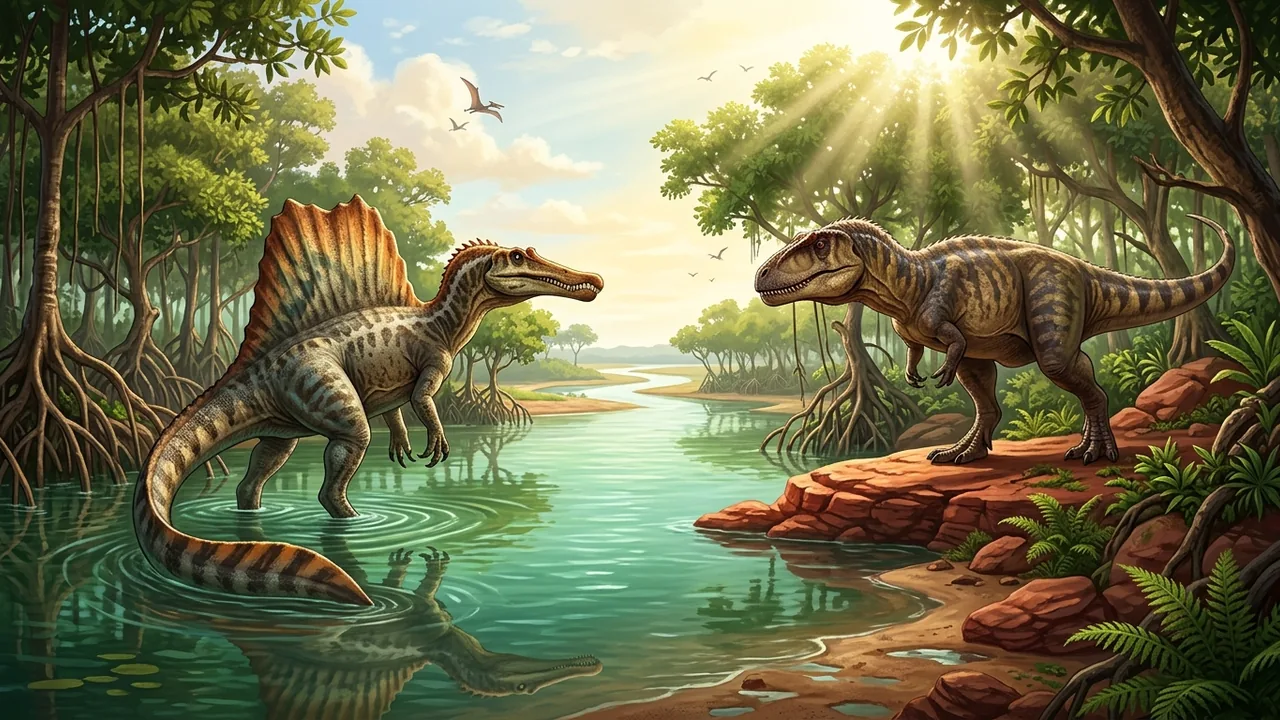
Wading through emerald waterways was forty-six-foot Spinosaurus aegyptiacus, whose name means Egyptian spine lizard. Along its back rose a dramatic six-foot skin sail supported by tall bony rods called projections. Striding across nearby red sandstone ridges stood forty-two-foot Carcharodontosaurus saharicus, the Saharan jagged-toothed lizard, armed with six-inch serrated blades shaped like great white shark teeth!
Weighing roughly seven tons apiece, these real Mid-Cretaceous neighbors did not battle over every single meal. Instead, each giant relied on specialized body traits—every inherited of jaws, claws, bones, and tails—to divide water from dry land and rule one extraordinary prehistoric kingdom together.
Lost World Habitat: The Kem Kem Waterways
During the Mid-Cretaceous Period, Earth experienced a warm greenhouse climate with high ocean levels and zero polar ice caps. Across northern Africa, immense braided rivers flowed northward into warm coastal seas, forming lush mangrove swamps, tidal marshes, and broad deltas preserved today in Morocco's famous Kem Kem sandstone cliffs.
Rising Cretaceous seas reshaped coastlines around the globe! Along Virginia's own Coastal Plain and Potomac riverbanks, Early-to-Mid Cretaceous streams and shallow estuaries left behind fossil conifer logs, fern spores, early flowering leaves, and ancient crocodile teeth from that same warm greenhouse world.
In North Africa's Kem Kem delta, deep emerald channels teemed with twenty-five-foot Onchopristis sawfish, car-sized coelacanths, armored lungfish, and giant river turtles. Just beyond the muddy mangrove roots stretched sunlit floodplains dotted with towering conifers and tree ferns, creating a dual water-and-land habitat where long-necked sauropods and sail-backed herbivores grazed in herds.
What's on the Prehistoric Menu?
Ecologists wondered for decades how ancient Morocco supported two school-bus-sized meat-eaters inside the exact same rock layers. Nature's answer was —dividing an ecosystem's food chain and hunting zones so giant neighbors rarely competed over the same dinner!
Spinosaurus thrived in deep channels as a specialized , or fish-eating hunter. Dipping its long, narrow rosette-tipped snout into murky river currents, it used smooth, interlocking conical teeth and curved foot-long thumb claws to pierce and grip slippery car-sized Onchopristis sawfish, giant Mawsonia coelacanths, and armored lungfish that flat slicing teeth would easily drop.
Meanwhile, Carcharodontosaurus commanded the terrestrial food web ashore! Prowling firm floodplains and conifer forest borders on muscular hind legs, it used thin, shark-like serrated teeth to ambush giant titanosaur sauropods like Paralititan and large iguanodont plant eaters such as Ouranosaurus—keeping river and savanna menus cleanly separated.
Superpowers, Senses & Anatomy
Comparing their skeletons side by side reveals how water and land pressures built two completely different body plans! Spinosaurus evolved nostrils positioned partway back on its narrow skull so it could breathe easily while scanning underwater, plus dozens of tiny nerve pits on its snout tip that felt faint water ripples from hidden fish.
Unlike land theropods with air-filled hollow bones, Spinosaurus grew thick-walled, solid limb bones that worked like a scuba diver's weight belt against river currents! Short hind legs, wide flat foot claws for soft mud, and two-foot caudal fins transformed its tail into a flexible swimming paddle.
Ashore, Carcharodontosaurus perfected high-speed land engineering: lightweight hollow bones, tall running legs balanced directly beneath its hips, protective lip scales, sharp forward-tilted eyesight, and five-foot jaws lined with serrated teeth built for swift overland strikes!
Flight vs. Fight Arena!
Although kept peace during rainy seasons, scorching dry months shrank Kem Kem waterways and pushed both seven-ton apex hunters toward the same shrinking pools and stranded sawfish! Far too massive to rely on timid Flight, both giants used bold visual warnings first—with Spinosaurus turning broadside to flash its towering six-foot sail like a giant warning flag.
When neither rival backed down, the ground beneath their feet decided the winner! Out on firm, dry floodplain sandstone, Spinosaurus's short hind legs and long front-heavy body slowed its turns, giving taller, faster-pivoting Carcharodontosaurus a decisive land advantage.
Step into waist-deep or chest-deep channels and slippery river mud, however, and the advantage flipped completely! Supported by river water, anchored on broad mud-walking feet, and balanced by its tall paddle tail and heavy hooked thumb claws, Spinosaurus ruled the deep channels!
Fossil Detective Secrets
Solving the mystery of North Africa's twin kings took more than a hundred years of fossil detective work! German paleontologist Ernst Stromer named Spinosaurus in 1915 and Carcharodontosaurus in 1931 from Egyptian desert bones, but both original skeletons were tragically destroyed during World War II, leaving behind only careful notebooks, ink sketches, and archival black-and-white photographs.
Decades later, expedition teams led by Paul Sereno and Nizar Ibrahim searched Morocco's rugged Sahara cliffs, uncovering a five-foot Carcharodontosaurus skull in 1995 and a remarkable new Spinosaurus skeleton—including thirty connected paddle-tail bones—between 2014 and 2020!
Fossil detectives also discovered a Spinosaurus back that cracked and healed during life, alongside shed Carcharodontosaurus teeth washed into ancient river sandbars. Using 3D computer models and stone clues together, modern science proved Earth's largest and Africa's shark-toothed land hunter truly shared—and occasionally contested—the Cretaceous delta!