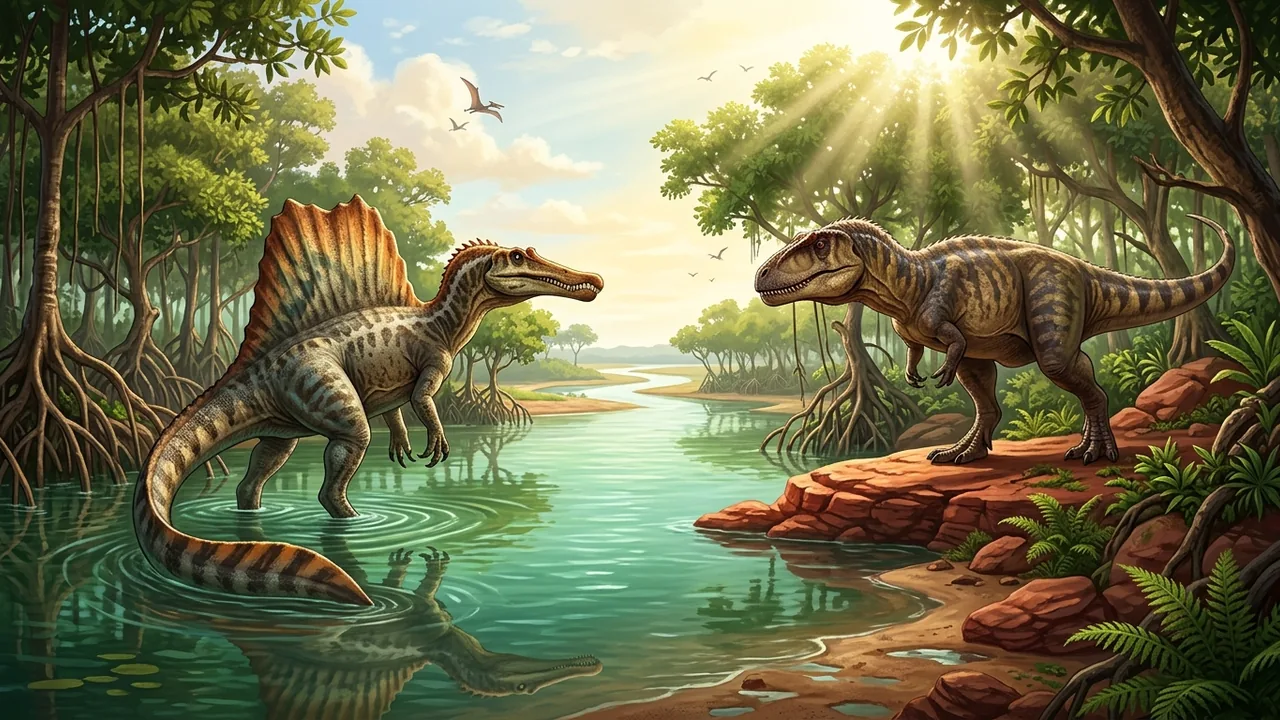
Meet the Legend: Rulers of Water & Land
Imagine two meat-eating dinosaurs even longer than a forty-foot yellow school bus living in the exact same neighborhood! Ninety-five million years ago in North Africa, forty-six-foot Spinosaurus and forty-two-foot Carcharodontosaurus ruled side by side. Each giant weighed around seven tons!
Spinosaurus means spine lizard because bony rods taller than an adult human held up a colorful along its back. Carcharodontosaurus means jagged-toothed lizard, named after great white sharks! How did two hungry giants share one land? Let's find out!
Lost World Habitat: Emerald Sahara Rivers
If you visit Morocco or Egypt today, you see dry red cliffs and sweeping desert sand. Ninety-five million years ago during the Mid-Cretaceous Period, that exact spot was a giant tropical river maze! Warm waterways wider than the Mississippi River wound past mangrove swamps and lush ferns.
Beneath the green water swam twenty-five-foot Onchopristis , armored coelacanths as big as cars, and giant river crocodiles. Just beyond the muddy banks stretched broad, sunny savannas where long-necked dinosaurs browsed tall trees!
What's on the Prehistoric Menu?
In nature, two giant hunters can live as peaceful neighbors when each picks its own ecological ! Spinosaurus claimed the deep waterways as the ultimate dinosaur fisherman. Wading or swimming through warm channels, it snapped up car-sized , armored coelacanths, and giant lungfish using a narrow crocodile-like snout lined with straight, cone-shaped teeth.
Meanwhile, Carcharodontosaurus claimed the dry niche! Sprinting across firm ground on tall, muscular hind legs, it hunted giant long-necked sauropods and sail-backed plant eaters—leaving slippery river meals completely to Spinosaurus so neither giant stole the other's lunch!
Superpowers, Senses & Anatomy
Both kings carried specialized superpowers from nose to tail! Spinosaurus had tiny pressure-sensing dimples on its snout like a crocodile so it could feel fish move in murky water. Unlike land hunters with light hollow bones, Spinosaurus had dense, solid leg bones for underwater balance and a tall, flat tail that pushed through currents!
Carcharodontosaurus carried land-hunting gear instead. Its massive five-foot skull held rows of flat, six-inch teeth that sliced like giant steak knives, balanced by long legs built for fast overland strides!
Flight vs. Fight Arena!
During hot dry seasons, shrinking rivers forced both giants onto the same narrow sandbars! Neither seven-ton predator belonged on Team Flight, yet smart hunters hated unnecessary injuries. Usually, Spinosaurus turned sideways to flash its towering six-foot as a bold warning sign!
If a turf clash broke out, the ground beneath their feet decided everything! In chest-deep river water, balanced Spinosaurus held the clear advantage. Up on firm, dry banks where short-legged Spinosaurus walked awkwardly, taller and faster Carcharodontosaurus ruled supreme!
Fossil Detective Secrets
Spinosaurus holds one of paleontology's wildest detective stories! German scientist Ernst Stromer found the first skeleton in Egypt in 1912, but those bones were tragically lost in 1944. Over seventy years later, paleontologist Nizar Ibrahim matched new bones from Moroccan red cliffs to Stromer's old notes!
In 2020, digs in Morocco finally uncovered Spinosaurus's tall, fin-shaped tail—proving it truly propelled itself through ancient rivers! Researchers also found a damaged Spinosaurus sail spine showing even river monsters occasionally tangled with giant rivals.