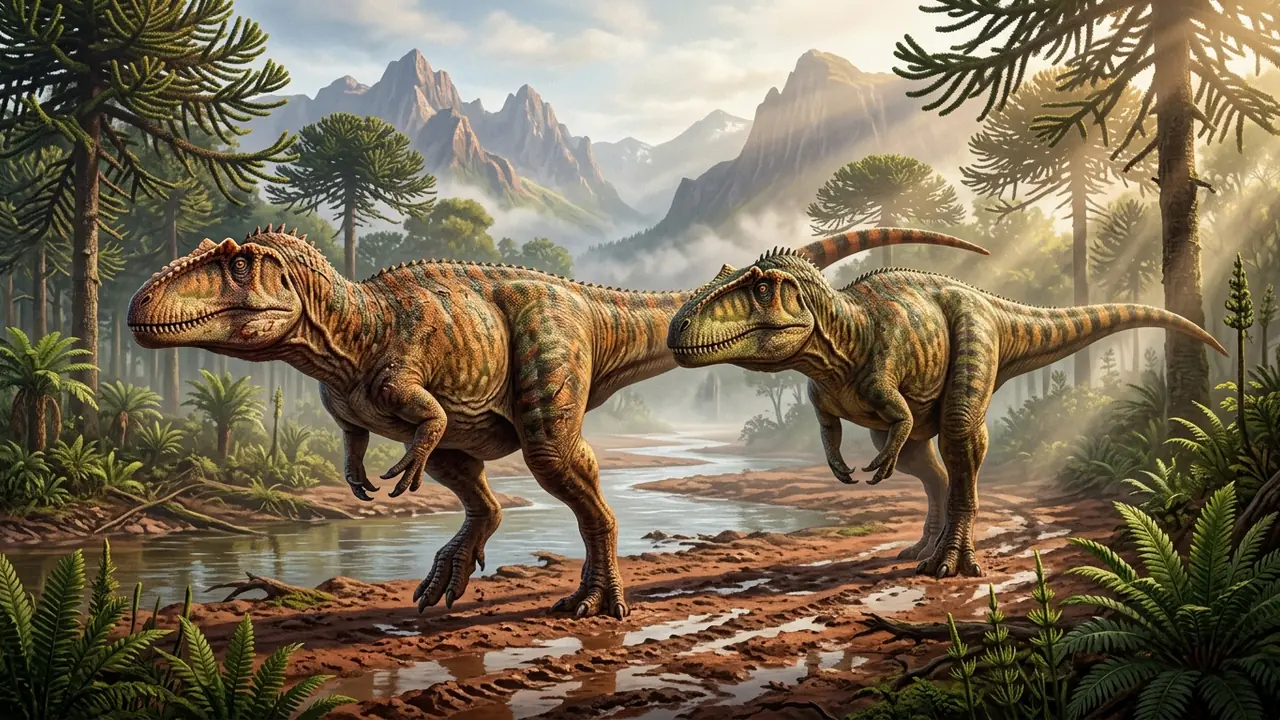
Meet the Legend: Apex of the Giganotosaurini
When Argentine paleontologists Rodolfo Coria and Leonardo Salgado formally described Giganotosaurus carolinii in 1995, their discovery overturned decades of northern-hemisphere bias assuming Tyrannosaurus rex stood unrivaled as Earth's sole forty-foot terrestrial carnivore. Dating to the early stage of the Late Cretaceous (~99 to 97 million years ago), holotype specimen MUCPv-Ch1 stretched roughly 12.2 meters and weighed approximately seven metric tons, while an isolated left dentary fragment (MUCPv-95) scales six-and-a-half percent larger—indicating mature individuals nearing thirteen meters and eight metric tons.
Phylogenetically, Giganotosaurus anchors the southern Gondwanan tribe Giganotosaurini within Carcharodontosauridae alongside Patagonian sister taxa Mapusaurus roseae and Meraxes gigas.
Descended from Jurassic allosauroid ancestors rather than coelurosaurian tyrannosaurs, this balanced its deep, laterally compressed trunk horizontally across massive pelvic girdles and a heavily muscled caudal counterbalance.
Its cranium—reconstructed between 1.56 and 1.80 meters in length depending on premaxillary-quadrate scaling—featured heavily rugose nasals, a prominent cornual boss above each orbit, and extra-oral labial tissues shielding twenty-centimeter serrated maxillary blades.
Comparative anatomy from complete-armed Meraxes confirms Giganotosaurus carried shortened, muscular three-fingered forelimbs rotated palms-inward, illustrating striking convergent evolution with later tyrannosaurids and abelisaurids as cranial dimensions expanded.
Across Cenomanian South America, this colossal predator stood as the evolutionary pinnacle of flesh-shearing theropod design.
Elongated dorsal neural spines strengthened by interspinous ligaments braced its thoracic column like suspension cables, allowing the multi-ton hunter to pivot smoothly across soft alluvial sandbars while tracking migrating sauropod herds through towering Patagonian conifer valleys. Broad three-toed feet carried reinforced pedal phalanges built to cushion immense stride forces across red floodplain clays.
Lost World Habitat: Stratigraphy of the Candeleros Beds
Reconstructing the paleoecology of Giganotosaurus begins with the of Argentina's Neuquén Basin, a retro-arc foreland depression bordering the rising proto-Andean volcanic arc. Giganotosaurus occurs within the Candeleros Formation, the basal unit of the Neuquén Group, constrained by radiometric zircon dates from interbedded volcanic tuffs to roughly 99.6 through 97 million years ago during the early stage.
Sedimentological facies document an expansive interplay of braided meandering rivers, eolian Kokorkom sand-dune fields, and oxidized paleosols supporting gallery forests of Araucariaceae conifers, podocarps, cycads, and diversifying early angiosperms.
Primary productivity across these alluvial corridors sustained extraordinary sauropod guild diversity: diplodocoid rebbachisaurids such as Limaysaurus tessonei cropped low equisetalean horsetails, while basal lithostrotian titanosaurs like Andesaurus delgadoi browsed upper conifer tiers.
Sharing the understory were unenlagiine paravian Buitreraptor gonzalezorum, basal coelurosaur Bicentenaria, armored uruguaysuchid crocodyliform Araripesuchus, madtsoiid snakes, and abundant herbivorous sphenodontian Priosphenodon.
Secondary carnivorous niches belonged to robust furileusaurian abelisaurid Ekrixinatosaurus novasi, leaving megaherbivore regulation squarely to apex Giganotosaurus.
Immediately overlying the Candeleros beds sits the Huincul Formation (~96–93 MYA), recording seamless faunal succession into Mapusaurus, Meraxes, and colossal Argentinosaurus huinculensis across the exact same Patagonian river plain.
Caliche nodules and iron-oxide coatings inside those red beds confirm warm, strongly seasonal rainfall cycles that alternated lush wet-season floodplains with dusty dry-season oases where dinosaur trackways baked hard in equatorial sunshine. Chelonian turtle carapaces and dipnoan lungfish tooth plates verify permanent freshwater channels persisted through summer droughts, sheltering diverse aquatic life across Neuquén's ancient meandering river bends.
What's on the Prehistoric Menu? Sauropod Specialization
Predation inside a titanosaur-dominated ecosystem selected for anatomical tools radically distinct from Laurasian ceratopsian-and-hadrosaur hunters. Whereas Tyrannosaurus rex evolved broad, rigid palates and sub-circular crowns to pulverize cortical bone, Giganotosaurus perfected high-clearance, low-drag soft-tissue excision tailored to multi-ton sauropods.
Finite-element structural analyses by François Therrien and colleagues demonstrate that the narrow mandibular ramus of Giganotosaurus generated roughly 6,000 to 13,000 Newtons of vertical bite force—ample for deep penetration, yet avoiding the tooth-shattering risk of biting solid titanosaur femora.
Crucially, the anterior dentaries united at a ventrally deepened mandibular forming a pronounced bony 'chin' that resisted dorsoventral shear and mediolateral torsion as twenty-centimeter ziphodont blades raked backward through thick dermal hide.
Kinematic stability modeling by Blanco and Mazzetta calculated that massive caudofemoralis retractors could theoretically propel Giganotosaurus toward fourteen meters per second, though cautious ambush sprints minimised catastrophic rotational inertia.
Taphonomic evidence from the neighboring Huincul monodominant bonebed of sister genus Mapusaurus—preserving at least seven individuals spanning 5.5 to 12.2 meters—raises compelling hypotheses of facultative mobbing behavior.
By harassing subadult titanosaurs or juvenile sauropods iteratively along forest-floodplain ecotones, Patagonian carcharodontosaurids unlocked Earth's largest terrestrial biomass reservoir without confronting healthy seventy-ton adults head-on.
Rapid replacement waves inside deep maxillary alveoli guaranteed that freshly erupted, finely denticulated crowns continuously replenished worn blades across decades of demanding megaherbivore predation and seasonal floodplain scavenging. Shed teeth recovered beside sauropod limb elements confirm both active hunting and opportunistic carcass utilization across Neuquén's fertile red-earth river corridors.
Superpowers & Senses: Braincase Endocasts & Pneumatics
Detailed computed tomography of the well-preserved holotype braincase (MUCPv-Ch1) by Rodolfo Coria, Philip Currie, and Ariana Paulina Carabajal illuminated the neurosensory world of Giganotosaurus in remarkable three-dimensional detail. Measuring roughly 275 millimeters long and displacing approximately 250 to 275 milliliters, the digital exhibits a classic non-maniraptoran allosauroid elongate contour—colloquially likened in shape and volume to a large banana—contrasting with the laterally expanded telencephalon of tyrannosaurids.
Anteriorly, colossal olfactory bulbs and thick peduncles dominate the forebrain, proving acute chemoreception guided long-distance tracking of sauropod herds and drought carrion across wooded floodplains.
Vestibular reconstruction of the lateral semicircular ear canal indicates that in alert habitual posture, Giganotosaurus held its 1.6-meter skull tilted slightly nose-downward by roughly five to ten degrees, optimizing forward binocular field overlap beneath its rugose lacrimal-postorbital bosses.
Surrounding the braincase, extensive paranasal and tympanic pneumatic recesses excavated the maxillae, nasals, basicranium, and cervical vertebrae.
Linked directly to avian-style pulmonary air sacs, this skeletal pneumatization drastically reduced cranial rotational inertia so cervical muscles could accelerate rapid slashing strikes.
Simultaneously, heavily vascularized sculpturing across the dorsal nasals anchored tough keratinous sheaths capable of absorbing head-to-head agonistic shoving between rival territory holders.
Well-developed optic nerve exits and floccular recesses coordinated rapid gaze stabilization whenever the eight-ton predator pivoted sharply out of shaded conifer groves to intercept moving quarry. Low-frequency cochlear sensitivity further tuned its inner ears to deep ground-borne footfalls of distant titanosaur herds marching across open Patagonian floodplains, giving this apex tracker an unmistakable sensory edge.
Flight vs. Fight Arena: Evolutionary Arms Race
Across Patagonia, intense predator-prey coevolution drove herbivore lineages toward starkly divergent survival optima. Small basal ornithopods such as Gasparinisaura cincosaltensis invested wholly in Team Flight cursoriality, exploiting elongated tibiae and rapid directional changes through dense araucaria understory.
Conversely, lithostrotian titanosaurs culminating in Argentinosaurus huinculensis—reaching thirty to thirty-five meters and sixty-five to seventy-five metric tons—executed history's grandest Team Fight strategy: sheer biomechanical invulnerability through rapid ontogenetic gigantism!
Histological bone-growth studies confirm young titanosaurs gained thousands of kilograms annually, racing upward toward a size refuge where pillar-like limbs, sweeping caudal whips, and embedded dermal osteoderms rendered healthy adults virtually immune to solitary predation.
Confronting such asymmetric mass odds, Giganotosaurus could never rely on brute jaw clamping alone.
Success demanded cautious risk management: leveraging lateral agility, wide-gape cervical retraction, reinforced stability, and selective targeting of subadults or isolated herd stragglers before protective adult rings closed.
Meanwhile, agonistic head-shoving displays along keratin-armored nasal ridges settled territorial boundary disputes between rival eight-ton carcharodontosaurids without risking lethal ziphodont lacerations.
Shortly after the Cenomanian-Turonian greenhouse thermal peak (~94 MYA), changing sea levels and floral turnover extinguished the giant carcharodontosaurids, handing Gondwana's late Cretaceous apex crown to short-snouted abelisaurids. Until that global climatic boundary, however, Patagonia's red floodplains hosted the ultimate terrestrial clash between flesh-shearing speed and titanosaurian mass across millions of thriving generations, illustrating how biomechanical trade-offs shaped every giant South American dinosaur lineage from nimble hatchling to full-grown sovereign across ancient Neuquén's sunlit araucaria valleys and seasonal river corridors.
Fossil Detective Secrets: Gondwanan Drift & Discovery
When mechanic Rubén Dario Carolini spotted an articulated theropod tibia eroding from Candeleros red beds eighteen kilometers southwest of Villa El Chocón in July 1993, he ignited a golden era of South American vertebrate paleontology. Excavating nearly seventy percent of the skeleton—preserving braincase, maxillae, dentary , scapulocoracoid, pelvis, hindlimbs, and most of the presacral column—Coria and Salgado established the Ernesto Bachmann Paleontological Museum right in Villa El Chocón.
Why do strata in Argentina yield giant carcharodontosaurids closely allied to African Carcharodontosaurus and Saharan sauropods rather than North American tyrannosaurids? Plate-tectonic provides the exact paleogeographic key!
Throughout the Early Cretaceous, South America and Africa remained joined inside western Gondwana until seafloor spreading progressively unzipped the South Atlantic Ocean, isolating sister lineages on opposite shores.
Students in Virginia see the northern mirror of that Atlantic tectonic story preserved in Early-to-Mid Cretaceous fluvial sands of Virginia's Potomac Group—where conifer trunks, early angiosperm pollen, and sauropodomorph tracks washed down coastal rivers along the widening North Atlantic margin.
Combining radiometric tuff dating, digital tomography, and comparative Neuquén discoveries like Mapusaurus and Meraxes, modern paleontology reveals how drifting continents sculpted two hemisphere-spanning empires of giant predatory dinosaurs.
Ongoing badlands expeditions across Neuquén and Río Negro provinces continue unearthing articulated skeletons, tracksites, and nesting horizons that deepen humanity's window into ancient Gondwana every single field season as Argentine researchers train the next generation of fossil detectives across Patagonia's colorful desert canyonlands and community museums.