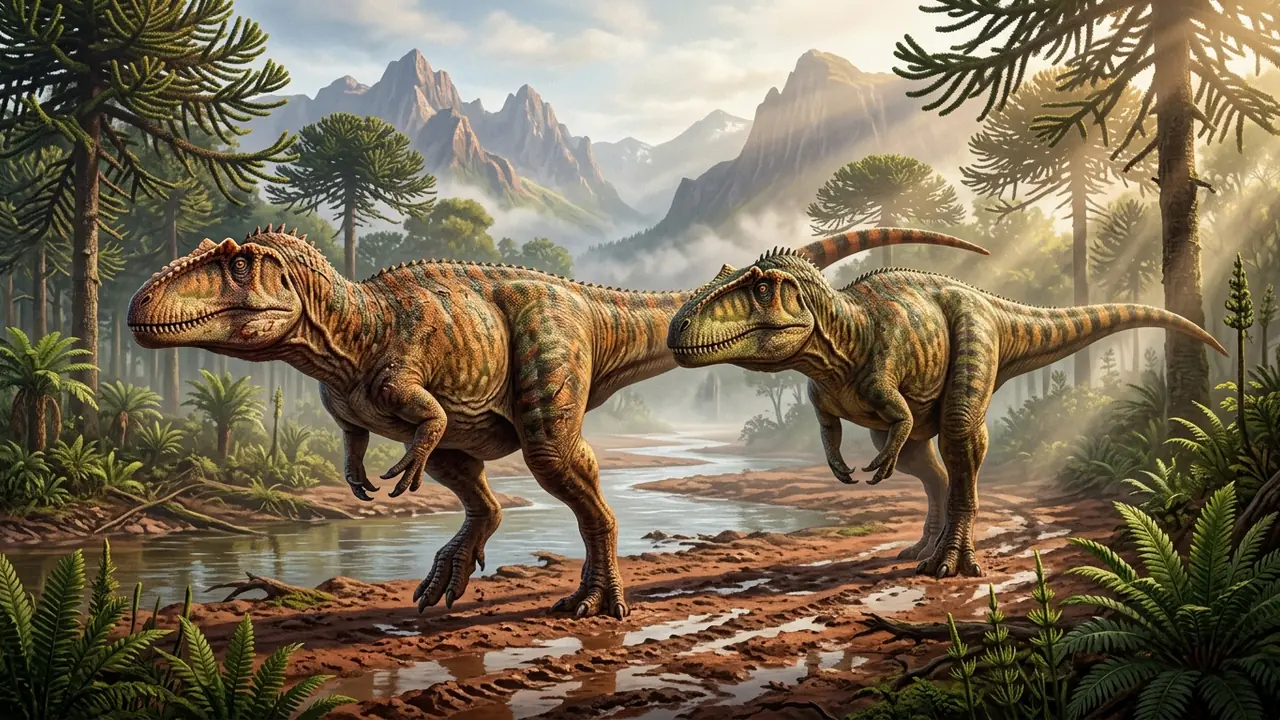
Meet the Legend: Crown Prince of Southern Gondwana
Ninety-eight million years ago, while tyrannosaurs were still relatively modest hunters in the north, a colossal forty-two-foot carnivore commanded southern South America! Named Giganotosaurus carolinii, this seven-to-eight-ton apex predator belonged to the shark-toothed carcharodontosaurid family rather than the tyrannosaur branch.
Every feature of its skeleton displayed specialized predatory . Its horizontal backbone pivoted smoothly over muscular hips, counterbalanced by a thick, stiffened tail during swift turns.
A deep, narrow skull measuring over five feet long carried sculpted nasal ridges and smooth extra-oral lip scales that shielded flat, serrated slicing teeth from drying out.
Below powerful shoulders, three-fingered forelimbs rotated palms-inward toward its chest, completing one of prehistory's grandest land hunters.
Deep footprints pressed into ancient Argentine riverbanks show how effortlessly those sturdy three-toed hind feet supported tons of athletic muscle across damp floodplain sand.
Lost World Habitat: Patagonia's Conifer Floodplains
During the early Late Cretaceous Period, Neuquén Province in Argentina looked completely different from today's dry windswept steppe. Winding braided rivers spilled across red-mud floodplains bordered by towering forests of araucaria monkey-puzzle conifers, tree ferns, and leafy early flowering shrubs.
Inside this thriving Patagonian , sunlight fueled green producers that sustained staggering diversity! Sail-necked Limaysaurus stripped low riverside ferns, mid-sized ornithopods browsed forest clearings, and colossal titanosaurs pruned high conifer crowns.
Smaller neighbors filled every remaining niche, including long-legged land crocodylomorphs, coiled river snakes, sphenodontian reptiles, and heron-like feathered dromaeosaurs called Buitreraptor.
Standing at the top of the food chain, Giganotosaurus kept giant plant-eating populations balanced and moving across the river valleys.
Seasonal rainstorms refreshed shallow oxbow lagoons where freshwater turtles and lungfish thrived beneath shifting golden sand dunes.
What's on the Prehistoric Menu?
Sharing a floodplain with gigantic sauropods required smart behavioral and physical . Full-grown titanosaur adults weighed fifty to seventy tons—far too dangerous for a lone predator to tackle head-on—yet sprawling nests produced hundreds of fast-growing juveniles and herd members every decade.
Using dappled conifer shadows for cover, Giganotosaurus launched rapid ambush rushes powered by massive tail-pulling leg muscles. Rather than clamping down and holding on like a bulldog, it delivered swift, slicing bites with curved, knife-flat teeth and stepped nimble paces clear of counterstrikes.
Just miles away in slightly younger Argentine rock layers, paleontologists uncovered seven skeletons of its close cousin Mapusaurus buried together.
That remarkable clue suggests giant southern hunters sometimes gathered in temporary groups to wear down oversized quarry!
Dry-season carcasses along shrinking river bends also supplied welcome meals that sustained hungry predators without risky chases.
Superpowers, Senses & Anatomy
How did Giganotosaurus swing a skull longer than a kitchen table without losing balance? Hollow air-filled sinuses carved through its snout and cheek bones, lightening the cranium while sturdy ridges along the nasal bones channeled biting stress safely upward.
At the front tip of the lower jaw, where the left and right bones joined, projected a thick downward knob—a reinforced chin that prevented the jaw from twisting when eight-inch serrated blades sliced tough sauropod hide.
Digital X-ray scans of its fossilized braincase revealed enormous olfactory bulbs up front for scent-tracking distant herds across humid floodplains.
Inner-ear balance loops also showed Giganotosaurus carried its snout angled slightly downward, giving it a clear view of ground obstacles and smaller prey during fast pursuits.
Bird-like air sacs connected to its lungs flowed right inside hollow backbones, supplying steady oxygen whenever this giant sprinted across open mudflats.
Flight vs. Fight Arena!
Across Patagonia's red-earth floodplains, every encounter pitted apex speed against survival instincts! Fleet two-legged plant-eaters like Gasparinisaura trusted pure Team Flight, zigzagging into dense fern thickets where eight-ton hunters could not turn sharply.
Colossal sauropods like Argentinosaurus and Andesaurus embodied ultimate Team Fight defense! Weighing up to seventy tons, mature adults stood shoulder-to-shoulder around vulnerable youngsters, turning pillar legs and sweeping muscular tails into an almost unbreakable perimeter.
To succeed without suffering broken ribs, Giganotosaurus relied on quick footwork, wide-angle slicing strikes, and patience—waiting until a careless wandered too far into lakeside trees.
Predator and herbivore pushed each other to extraordinary evolutionary size across millions of years!
Even rival Giganotosaurus neighbors respected bumpy nasal crests, using visual displays and careful posturing before risking injuries over territory across the sunlit Patagonian river valley.
Fossil Detective Secrets: Drifting Southern Continents
After Giganotosaurus died beside a winding Patagonian river, flood sands buried its skeleton until pressure turned mud into rusty-red rock called the Candeleros Formation. Millions of years later, wind erosion exposed a shinbone for Rubén Carolini to spot from his dune buggy in 1993!
Why did South America host giant shark-toothed hunters while North America later evolved bone-crushing tyrannosaurs? Plate tectonics explains the split—and connects to Virginia's own fossil record! During the Cretaceous Period, South America and Africa drifted apart to open the South Atlantic Ocean, isolating southern Gondwana.
Meanwhile, along Virginia's Early Cretaceous Potomac Group rivers, conifer logs and dinosaur tracks were burying in sedimentary clays along North America's own Atlantic coast.
Reading rock layers across both Americas lets geologists reconstruct an entire planet in motion!
Every new fossil bone brushed clean in Neuquén adds another vivid puzzle piece to South America's prehistoric story.