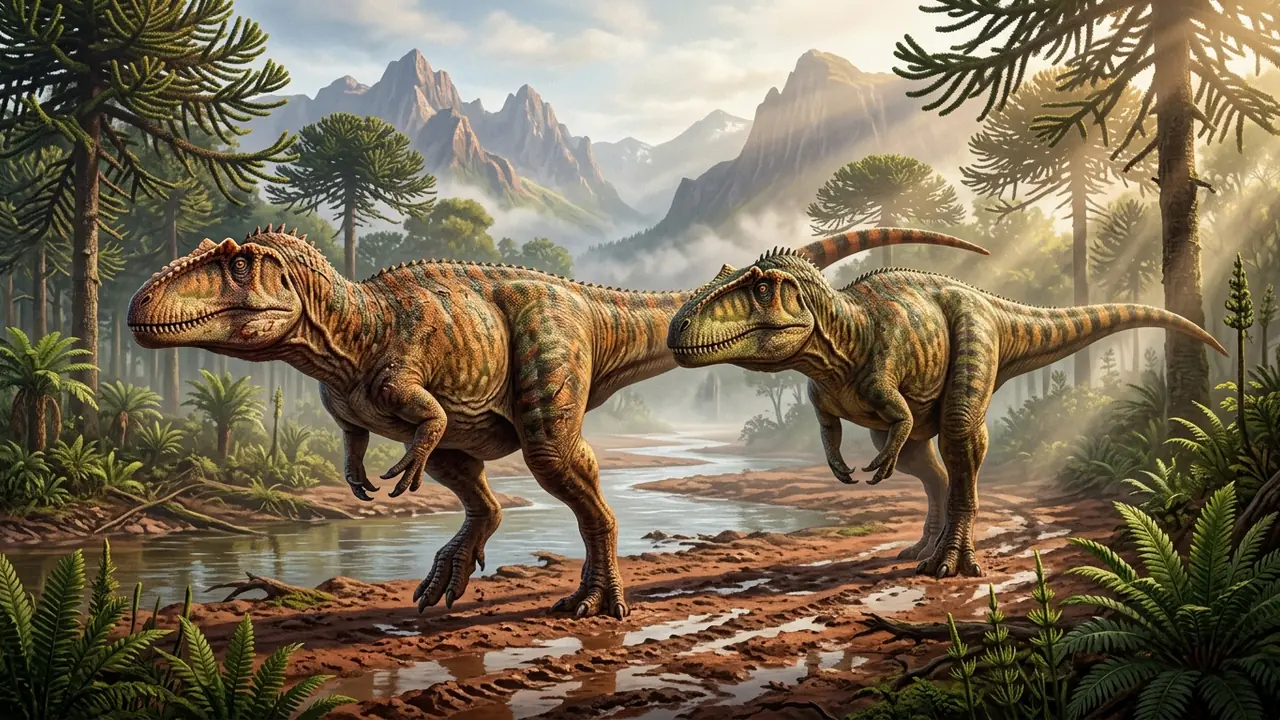
Meet the Legend: South America's Super-Predator
Long before Tyrannosaurus rex walked North America, another giant ruled the southern hemisphere! Giganotosaurus prowled ancient Argentina about ninety-eight million years ago. Stretching up to forty-three feet long, it measured slightly longer than a full-sized yellow school bus and weighed as much as five family SUVs.
Its rugged skull stretched more than five feet from nose to neck—taller than most elementary school kids! Bumpy bone ridges decorated its snout, while scaly lips kept its eight-inch teeth moist and sharp. Balanced horizontally by a muscular tail, its three-clawed hands faced inward toward each other.
Lost World Habitat: Red Rivers & Tall Conifers
Today, Patagonia in southern Argentina has cool winds and dry rocky . Ninety-eight million years ago, that same ground was a warm floodplain crisscrossed by wide, sandy rivers! Towering monkey-puzzle conifers formed a high green over carpets of ferns and horsetails.
Warm rains filled shallow lagoons where freshwater turtles, lungfish, and small crocodiles splashed in the mud. Swift feathered runners darted after lizards beneath fallen logs. Out on the red-earth clearings, giant long-necked herds munched pine needles high in the treetops while Giganotosaurus watched quietly from shaded forest borders.
What's on the Prehistoric Menu?
Feeding an eight-ton took plenty of calories! Giganotosaurus shared its floodplain home with medium-sized plant-eaters, mid-sized long-necks like Limaysaurus, and Earth's heaviest , Argentinosaurus. Because full-grown titans were giant living fortresses, smart hunters searched for smaller juveniles straying from the main group.
Waiting behind dense conifer trunks, Giganotosaurus exploded forward on powerful back legs! Its three-fingered hands hooked inward while jaw blades delivered swift, clean bites. Fossil quarries of its cousin Mapusaurus nearby hold multiple predator skeletons together, hinting these southern giants sometimes gathered to hunt big quarry.
Superpowers, Senses & Anatomy
Inside Giganotosaurus's huge skull, airy pockets kept the bone surprisingly light so its strong neck could swing fast! Instead of thick banana-shaped pegs for smashing bone, its jaws held dozens of flat, blades shaped like steak knives. A downward-pointing bony chin strengthened the front of its lower jaw against twisting forces.
Hospital CT scanners peered inside its stone braincase and found a narrow, banana-curved brain! Oversized scent bulbs at the front picked up faint odors blowing under the forest , while steady inner-ear loops kept its eyes locked on moving targets.
Flight vs. Fight Arena!
Imagine an eight-ton Giganotosaurus stepping out of the trees toward a herd of Argentinosaurus! Smaller two-legged plant-eaters trusted Team Flight, sprinting away down dry creek beds. Giant families relied on pure Team Fight size and herd teamwork.
A healthy adult Argentinosaurus stretched over one hundred feet long and weighed seventy tons—nearly ten times heavier than the predator! Adults formed protective rings around youngsters and swung sweeping tails that struck like wrecking balls. Giganotosaurus needed nimble footwork, patience, and smart timing rather than reckless head-on charges.
Fossil Detective Secrets: The Dune Buggy Discovery
One sunny day in 1993, auto mechanic and fossil fan Rubén Carolini drove his homemade dune buggy across barren near Villa El Chocón, Argentina. Half-buried in red sandstone, a huge fossilized leg bone caught his eye! Paleontologists Rodolfo Coria and Leonardo Salgado rushed out to excavate the site.
Piece by piece, their team uncovered skulls, hips, legs, and backbones—nearly seventy percent of the whole animal! Five years later, another fossil jaw tip turned up nearby that measured even larger, proving some Patagonian giants grew bigger still!