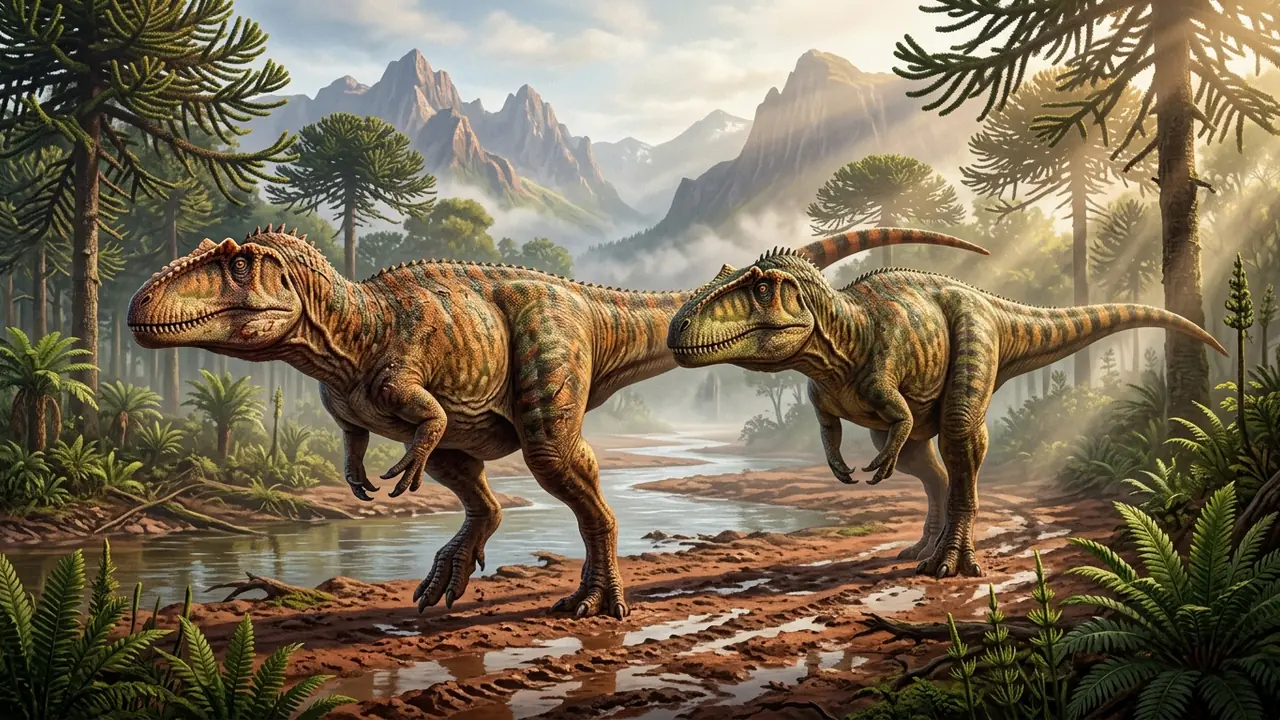
Meet the Legend: Engineering a Southern Titan
Ninety-eight million years ago across Late Cretaceous Patagonia, Giganotosaurus carolinii stood among the largest terrestrial carnivores ever to walk the planet. Holotype skeleton MUCPv-Ch1 measured roughly forty to forty-one feet long and weighed around seven tons, while a second larger lower-jaw specimen (MUCPv-95) indicates exceptional individuals stretched nearly forty-three feet and exceeded eight tons!
Despite rivaling or slightly surpassing Tyrannosaurus rex in total length, Giganotosaurus belonged to a completely separate evolutionary branch called Carcharodontosauridae.
Its torso balanced horizontally over pillar-strong hindlimbs, counterweighted by deep caudofemoralis tail muscles that powered athletic strides across firm floodplain sands.
Up front, its remarkably tall, narrow skull exceeded five feet in length, crowned by rough, keratin-covered nasal bosses and lined with eight-inch teeth tucked behind protective extra-oral lip scales.
Sturdy shoulders carried reduced three-fingered forelimbs with palms rotated inward toward the midline.
Every skeletal lever reflected specialized built to harvest giant sauropods across ancient South America.
Tall neural spines rising along its hips and back anchored heavy ligaments that supported its massive front end without straining spinal joints during swift floodplain turns. Broad three-toed feet distributed multi-ton loads evenly across damp riverside silt.
Lost World Habitat: Patagonia's Candeleros Food Web
During the Cenomanian dawn of the Late Cretaceous roughly ninety-nine to ninety-seven million years ago, northwestern Patagonia formed a warm, seasonally humid basin drained by wide meandering rivers and wind-blown sand dunes. Towering Araucaria monkey-puzzle conifers, podocarps, cycads, and early broad-leaved angiosperms anchored fertile red floodplains.
Energy surged through a multi-layered web! Giant rebbachisaurid sauropods like Limaysaurus grazed low horsetail marshes with broad, squared-off snouts, while basal titanosaurs such as Andesaurus and early relatives of Argentinosaurus browsed high conifer crowns.
Beneath their feet darted armored terrestrial crocodylomorphs like Araripesuchus, beaked sphenodontian reptiles called Priosphenodon, and long-snouted feathered dromaeosaur Buitreraptor.
Mid-sized abelisaurid carnivores such as Ekrixinatosaurus hunted smaller floodplain prey across drier scrubland.
Perched atop the entire trophic pyramid, Giganotosaurus regulated megaherbivore herds whose trampling and browsing continuously reshaped forest clearings.
Seasonal flood pulses deposited iron-rich silts over fallen leaves, footprints, and shed teeth across hundreds of square miles.
Shallow floodplain ponds also sheltered side-necked chelid turtles, gar-like fishes, and pipid frogs that completed a thriving semitropical river corridor between arid dune fields. Warm breezes off the rising early Andes brought seasonal downpours that kept those braided river channels flowing.
What's on the Prehistoric Menu? Hunting Titanosaurs
How does an eight-ton hunter secure meals when neighboring herbivores grow past fifty tons? and tooth morphology reveal a calculated specialist strategy! Rather than wrestling indestructible adult titanosaurs, Giganotosaurus targeted ten-to-twenty-ton subadults, sick stragglers, and medium-sized Limaysaurus along river bends.
Physicists Rodolfo Blanco and Ernesto Mazzetta modeled leg proportions and center-of-mass stability, calculating that Giganotosaurus maintained kinematic balance up to theoretical sprint speeds near twenty-five to thirty-one miles per hour—though practical ambush bursts around twenty miles per hour minimized dangerous tripping risks.
Closing rapidly from araucaria shade, Giganotosaurus struck broad sauropod flanks with wide-opening jaws, driving serrated blades through thick hide before stepping clear.
Intriguingly, an adjacent Patagonian quarry preserved at least seven individuals of its close sister genus Mapusaurus across multiple age classes.
Paleobiologists study whether temporary carcharodontosaurid mobs harassed oversized titanosaurs cooperatively—much like modern Komodo dragons or lions converging on Cape buffalo!
Either solo or in loose groups, slicing efficiency turned giant herds into dependable floodplain energy.
Continuous tooth replacement ensured fresh, razor-serrated crowns always stood ready whenever feeding against tough sauropod dermal skin wore older blades down. Scavenging drought-stricken sauropods along dry channels supplied vital bonus calories without high-speed chase risks.
Superpowers, Senses & Anatomy: Slicing Jaws & Endocasts
Comparing skull engineering between Giganotosaurus and Tyrannosaurus rex highlights two completely different predatory masterpieces! Finite-element stress tests estimate Giganotosaurus generated roughly 6,000 to 13,000 Newtons (1,350 to 3,000 pounds) of vertical bite force—powerful, yet roughly one-third of T. rex's bone-shattering clamp.
Instead of crushing femurs, Giganotosaurus optimized its five-foot cranium as a high-speed flesh-shearing instrument! Laterally flattened crowns carried razor-sharp enamel serrations fore and aft, slicing cleanly with minimal drag.
To prevent its narrow lower jaws from buckling or twisting when tugging against moving prey, the front mandibular expanded downward into a reinforced bony 'chin' buttress.
Meanwhile, high-resolution CT scans mapped its 275-millimeter brain cavity and inner-ear labyrinth.
Huge olfactory bulbs channeled rich scent data directly to the forebrain, while horizontal semicircular ear canals revealed an alert, slightly nose-down head carriage.
Pneumatic air sacs hollowed its vertebrae and facial bones, trimming hundreds of pounds of dead weight without sacrificing structural strength.
Thick occipital neck attachments behind the braincase further drove rapid downward head sweeps, amplifying slicing momentum across broad herbivore flanks. Wide visual fields ahead of its brow crests helped judge exact striking range.
Flight vs. Fight Arena: Slicers vs. Living Fortresses
Every hunt across Neuquén floodplains pitted Giganotosaurus's slicing agility against formidable herbivore countermeasures. Nimble ornithopods like Gasparinisaura relied on Team Flight acceleration, darting beneath low araucaria branches where multi-ton predators could not follow.
Titanosaur herds led by colossal Argentinosaurus huinculensis—preserved in Patagonia's immediately overlying rock beds—perfected Team Fight mass defense! Measuring over one hundred feet long and weighing sixty to seventy-five metric tons, a healthy adult outweighed Giganotosaurus nearly ten to one.
Columnar legs stomped with earth-shaking force, muscular tails swept wide defensive arcs, and rows of dermal osteoderm scutes toughened exposed backs.
Attacking a braced adult herd head-on risked fatal rib fractures.
Consequently, Giganotosaurus relied on lateral agility, reinforced stability, and flanking teamwork to isolate inexperienced subadults at watering holes.
Across millions of Cenomanian years, giant sauropod gigantism and carcharodontosaurid slicing weaponry drove one of prehistory's grandest evolutionary arms races.
Textured brow bosses above the eyes also protected sensitive orbits during territorial head-shoving contests when rival hunters disputed prime floodplain hunting grounds. Patience, timing, and nimble footwork kept Patagonia's apex hunter thriving alongside Earth's heaviest land animals across seasonal wet and dry cycles.
Fossil Detective Secrets: Badlands & Sister Giants
When Rubén Dario Carolini spotted an exposed tibia gleaming in red Candeleros sandstone near Villa El Chocón in July 1993, Argentine paleontologists Rodolfo Coria and Leonardo Salgado launched a landmark excavation. Recovering nearly seventy percent of the holotype skeleton—including braincase, maxillae, dentary, pelvis, femora, and vertebral column—they unveiled Giganotosaurus carolinii in the journal Nature in 1995.
Subsequent Patagonian discoveries transformed that single skeleton into a vivid evolutionary dynasty! In 2006, Coria and Philip Currie described sister taxon Mapusaurus from nearby Huincul strata, and in 2022 researchers unveiled remarkably complete Meraxes gigas from the same Neuquén Basin.
Meraxes preserved complete forelimbs and feet that were missing in Giganotosaurus, proving giant carcharodontosaurids independently shrank their arms as their skulls grew massive—just like tyrannosaurs millions of years later!
By combining badlands fieldwork, digital tomography, and comparative anatomy, scientists continue unlocking South America's lost age of titans.
Today, Villa El Chocón's municipal museum proudly houses the original bones just miles from their discovery cliff.
Microscopic growth rings inside cousin Meraxes limb bones even proved giant Patagonian carcharodontosaurids lived past forty years of age—decades older than typical tyrannosaurs! Careful preparation of red sandstone blocks keeps revealing new anatomical details every year.