Meet the Legend: Peak Cursorial Ornithomimosaur
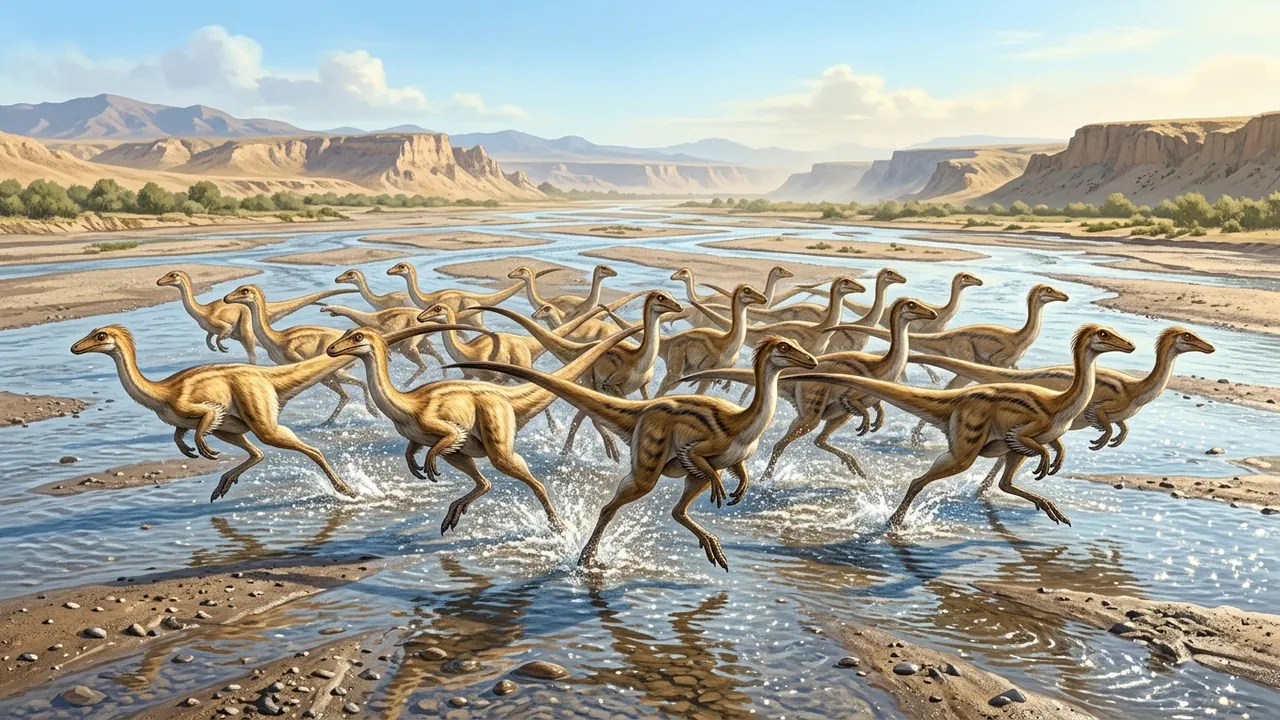
Within Coelurosauria, no lineage pushed bipedal running specialization further than Ornithomimidae, and no confirmed member grew larger than Gallimimus bullatus. Reaching 6 meters (20 feet) in total length, standing nearly 2 meters tall at the hip socket, and weighing approximately 410 to 440 kilograms (900 to 970 pounds), a mature Gallimimus combined the body mass of a thoroughbred racehorse with the slender cursorial profile of a giant ratite bird.
First recovered from southern Mongolia's Gobi Basin during the celebrated 1963 to 1965 Polish-Mongolian Paleontological Expeditions and formally described in 1972, its genus name translates to chicken mimic, referencing striking anatomical parallels between its anterior neck vertebrae and those of galliform birds, while bullatus honors the bulbous, inflated parasphenoid capsule beneath its braincase.
Extensive skeletal lightening defined its entire frame: avian-style respiratory air sacs invaded cervical, dorsal, and anterior tail vertebrae, creating hollow bone walls with exceptional strength-to-mass ratios across the delta.
Although coarse channel sandstones rarely preserve delicate epidermal filaments directly on Gallimimus skeletons, exquisitely preserved Canadian fossils of sister taxon Ornithomimus edmontonicus demonstrate filamentous body plumage across juveniles and adult pennaceous wing fans anchored along the forearm only after sexual maturity.
Toothless, keen-eyed, long-necked, and aerodynamically balanced from its shovel-tipped bill to its stiffened caudal tip, Gallimimus epitomized pure cursorial grace and peaceful omnivorous versatility among Late Cretaceous theropod dinosaurs! Every single joint from ankle to skull reflected millions of years of natural selection favoring swift, watchful herd life.
Lost World Habitat: Nemegt Delta Stratigraphy
To understand why half-ton ostrich dinosaurs flourished in Late Cretaceous Asia, geologists examine the early Maastrichtian of the Formation, deposited approximately 70 million years ago across famous outcrops such as Tsagaan Khushuu, Altan Uul, and Bugiin Tsav. Unlike the older, wind-deposited eolian sand seas of the Djadochta Formation, Nemegt strata consist of cross-stratified fluvial sandstones, point-bar siltstones, and overbank mudstones laid down across vast meandering rivers, braided deltas, and shallow oxbow lakes.
Fossilized Araucaria conifer trunks, towering dawn redwoods, ginkgoes, aquatic charophyte algae, freshwater unionid mussels, and abundant soft-shelled turtles indicate a warm, seasonally humid alluvial oasis framed by drier continental uplands.
Isotopic oxygen records extracted from vertebrate tooth enamel carbonate confirm pronounced wet monsoonal summers alternating with cooler, drier winters across the fertile Nemegt basin.
That dynamic mosaic of forested river levees and broad, firm sandbars sustained one of the richest dinosaur faunas ever discovered on Earth: giant duck-billed hadrosaurids Saurolophus and Barsboldia, club-tailed ankylosaurid Tarchia, towering herbivorous theropod Therizinosaurus, hump-backed omnivore Deinocheirus, dome-skulled Prenocephale, and five-ton apex tyrannosaurid Tarbosaurus bataar.
Wide, unobstructed channel margins gave gregarious Gallimimus flocks long visual sightlines and firm, flat running substrates ideally suited for high-speed predator evasion across shimmering Late Cretaceous floodplains! Whenever summer monsoons swelled shallow waterways, abundant aquatic plants, insects, and tiny crustaceans fueled booming multi-generational herds from edge to edge of the lush Asian valley. Crisp three-toed footprints preserved across hardened channel sandstones confirm flocks trotted together along sunny riverbars right beside wading duckbills!
What's on the Prehistoric Menu? Lamellae & Omnivory
For nearly three decades after 1972, paleobiologists debated whether toothless Gallimimus snapped up swift small vertebrates like an African secretary bird or cropped soft plants like an ostrich. In 2001, paleontologists Mark Norell, Peter Makovicky, and Philip Currie transformed that debate when they announced specimen IGM 100/1133 from the Formation, a three-dimensional skull preserving mineralized sandstone impressions of its delicate keratinous beak sheath!
Lining both upper and lower jaw margins were densely packed, vertical columnar ridges called keratinous , spaced roughly half a millimeter apart and remarkably similar to straining structures inside modern dabbling ducks. Could a 440-kilogram terrestrial runner survive solely by filter-feeding microscopic pond plankton? Subsequent three-dimensional biomechanical finite-element analyses showed thin beak keratin would wear down rapidly if straining coarse gravel all day, yet functioned superbly for versatile wetland omnivory!
Gallimimus used its broad, shovel-tipped bill and fine lamellae both to sieve concentrated seasonal blooms of freshwater ostracods, amphipods, snails, and floating duckweed-like flora and to shear tender terrestrial shoots, seeds, fruits, beetles, frogs, and small lizards ashore.
Replacing heavy dentition and massive jaw-closing muscles with a paper-thin skull kept rotational inertia low out at the tip of its slender two-meter neck.
Meanwhile, muscular gastric mills packed with swallowed smooth quartz gastroliths pulverized fibrous plant cell walls and crunchy arthropod exoskeletons efficiently right near the animal's pelvic center of mass! That dual-purpose feeding toolkit kept large flocks well nourished across both rainy summers and dry winters.
Superpowers: Arctometatarsalian Sprint Engineering
From pelvis to toe tips, Gallimimus embodies textbook cursorial biomechanics engineered for sustained speed and stride efficiency. Its broad ilium anchored massive caudofemoralis and pelvic limb muscles high near the hip joint, minimizing lower-leg mass so each slender limb swung rapidly forward and back with minimal rotational energy cost. Whereas giant sauropods and heavy carnivores possessed thigh bones far longer than their shins, Gallimimus reversed that ratio: its elongated tibia exceeded femur length, and its slender pes stretched stride length dramatically across firm sand.
Crucial to surviving repeated ground-reaction impacts exceeding several times body weight was its specialized foot architecture. Within the three weight-bearing foot bones of Digits II, III, and IV, the upper shaft of central Metatarsal III pinched into a narrow triangular wedge so Metatarsals II and IV pressed tightly together in front of the ankle joint!
During each 30 to 35 mile per hour (48 to 56 km/h) footstrike, downward compression wedged Metatarsal III snugly against tough elastic ligaments, dissipating bone-cracking twisting stresses and returning spring recoil energy like a modern carbon-fiber running blade.
Hollow vertebrae and interlocked bony tail projections turned its horizontal tail into an aerodynamic steering rudder, while short, flattened, hoof-like toe claws gripped damp sandbars like track cleats.
Atop its graceful neck, huge ring-supported eye sockets oriented sideways granted panoramic predator surveillance stabilized during full-tilt sprints by sensitive semicircular inner-ear balance canals! Few terrestrial vertebrates of comparable mass have ever matched its effortless mechanical economy.
Flight vs. Fight Arena: Cursorial Escape vs. Apex Mass
Across open sandbars, ecological encounters between Gallimimus bullatus and Tarbosaurus bataar illustrated the sharpest divergence along the prehistoric Flight versus Fight trade-off continuum. Adult Tarbosaurus represented extreme hypercarnivorous brawn: stretching 10 to 12 meters long, weighing roughly 4,500 to 5,000 kilograms, and wielding a rigid, deep-snouted skull armed with sixty serrated, bone-crushing teeth! Conversely, Gallimimus invested zero metabolic budget in dermal osteoderm armor, brow horns, tail clubs, or defensive jaw strength.
Instead, every gram of Gallimimus anatomy maximized early threat detection and locomotor escape velocity! Biomechanical scaling laws dictate that while muscle cross-sectional force grows with surface area (length squared), total body mass climbs far faster with volume (length cubed).
Even though Tarbosaurus also possessed an foot suited for efficient long-distance walking and pursuit, five-ton body mass and catastrophic tripping hazard capped adult tyrannosaurid top sprint speeds near 17 miles per hour (27 km/h).
Sporting extensive skeletal lightening and elongated lower leg levers, a 440-kilogram Gallimimus easily doubled its predator's maximum velocity across firm delta flats! Living in gregarious multi-age flocks multiplied visual vigilance across 340-degree lateral fields and triggered coordinated, banking escape waves whenever a stalking tyrannosaur broke tree cover.
Only dense riverside ambush foliage, moonless darkness, or deep sticky mud could bridge that decisive two-to-one speed gap, making Team Flight an enduring evolutionary triumph across Late Cretaceous Asia! Modern African ostriches outrunning ambushing lions across open savannas replay this exact survival physics today. Pure speed, wide panoramic eyesight, and instant flock coordination proved just as effective as heavy armor shields!
Fossil Detective Secrets: Kielan-Jaworowska's Legacy
Modern scientific understanding of Gallimimus stands as an enduring tribute to international collaboration and women pioneers in vertebrate paleontology. Between 1963 and 1971, trailblazing Polish paleontologist Zofia Kielan-Jaworowska organized eight demanding Polish-Mongolian Paleontological Expeditions deep into the southern Gobi Basin, hauling multi-ton sandstone blocks out of roadless canyons by expedition truck and hand winch.
In 1972, Kielan-Jaworowska's Warsaw colleagues Halszka Osmolska and Ewa Roniewicz teamed with renowned Mongolian theropod specialist Rinchen Barsbold to publish the landmark monograph naming Gallimimus bullatus. Because Nemegt preserved an extraordinary ontogenetic growth series, spanning diminutive juvenile specimen ZPAL MgD-I/94 with a skull barely twelve centimeters long up to six-meter adults, researchers quantified exact developmental shifts as big-eyed, short-snouted chicks matured into long-snouted, sprinters!
Twenty-first-century imaging pushed those classic discoveries even further: high-resolution casts documented soft-tissue beak on specimen IGM 100/1133, digital CT scans mapped its hollow braincase bullae, and feathered Ornithomimus specimens discovered in Alberta revealed adult forearm wing fans evolving originally for visual courtship signaling and nest brooding rather than flight.
Through six decades of meticulous desert fieldwork and laboratory detective work, Gallimimus transformed our picture of Late Cretaceous wetland ecosystems, proving beyond doubt that keen intelligence, social flock vigilance, and breathtaking athletic speed wrote one of dinosaur evolution's brightest success stories! Visitors standing beneath mounted skeletons in Warsaw and Ulaanbaatar still marvel at the pioneering women explorers who brought this feathered sprinter back to light. Every slender bone reminds us how curiosity and international teamwork unlock Earth's deepest prehistoric secrets!