Meet the Legend: Half-Ton Feathered Speedster
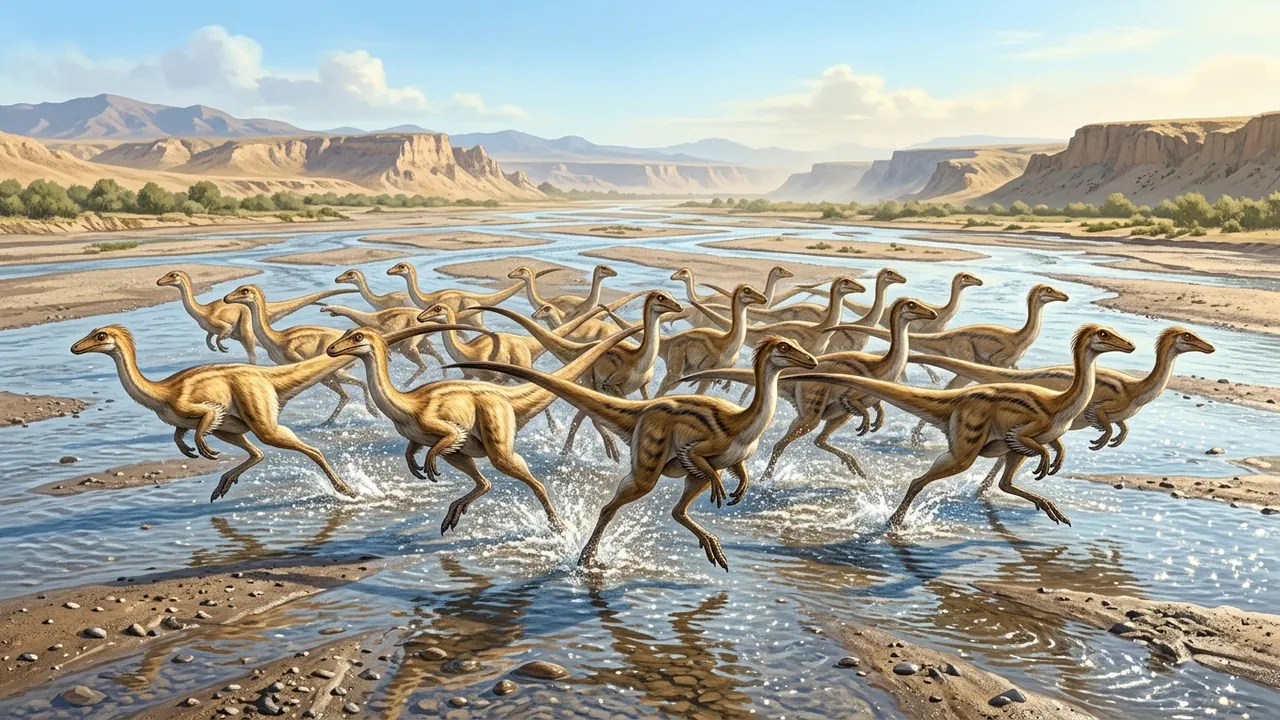
Meet the undisputed heavyweight sprinter of the ostrich-mimic clan: Gallimimus bullatus! As the largest known dinosaur, a mature adult stretched 20 feet (6 meters) from beak tip to tail tip, stood over six feet tall at the hip with its head held nearly ten feet high, and weighed 900 to 970 pounds (410 to 440 kilograms). That makes Gallimimus more than three times heavier than the biggest living African ostrich and roughly equal in mass to a thoroughbred racehorse!
Despite descending from meat-eating theropod ancestors, Gallimimus traded serrated teeth and slashing claws for sleek, bird-like grace. Air-filled chambers hollowed out its vertebrae and limb bones, shaving crucial pounds off its frame without sacrificing skeletal strength.
Fossil evidence from close ornithomimid cousins confirms adults wore dense golden-brown body plumage alongside long, fan-like display feathers anchored along their three-fingered forearms to flash signals to herd mates and shade warm nests.
With an S-curved neck, expressive wide-set eyes, slender lower legs, and a long horizontal tail , Gallimimus looked like a magnificent prehistoric marathon champion striding gracefully across ancient Asian floodplains and shallow sunlit streams!
Lost World Habitat: Rich Trophic Webs of Mongolia
Roughly 70 million years ago during the Late Cretaceous Period, southern Mongolia looked far greener than the dry sand-dune basins of earlier millennia. Braided rivers fed by distant uplands carved wide channels, oxbow ponds, and muddy sandbars across a fertile lowland oasis bordered by dawn redwoods, araucaria conifers, ginkgoes, ferns, and floating carpets of green aquatic plants.
Seasonal monsoons flooded broad deltas each summer before giving way to cooler, drier winters when wildlife gathered around deep permanent channels. Across this dynamic wetland ecosystem, energy flowed upward from lush riverside flora and tiny pond invertebrates to towering herbivores and giant carnivores alike.
Flocks of swift runners shared muddy river crossings with duck-billed Saurolophus, dome-skulled Prenocephale, club-tailed ankylosaur Tarchia, scythe-clawed giant Therizinosaurus, and five-ton apex tyrannosaur Tarbosaurus.
Because open sandbars offered very few hiding spots for a nine-hundred-pound animal, Gallimimus relied on clear sightlines, firm running flats, and flexible trophic foraging along shallow waterways where watchful herds could spot stalking predators from hundreds of yards away and sprint safely across wide sparkling shallows! Cool river mud also preserved crisp three-toed trackways showing flocks traveling side by side along ancient shorelines.
What's on the Prehistoric Menu? Strainers & Stones
For decades after its discovery, scientists puzzled over how a nearly half-ton fueled its high-energy body without a single tooth in its jaws! In 2001, paleontologists inspecting an exceptionally preserved Gallimimus skull solved the mystery when they spotted rows of delicate, comb-like keratinous ridges, spaced barely half a millimeter apart, preserved along the inner margins of its broad, shovel-tipped beak.
Those tiny ridges operated much like the straining plates inside modern dabbling ducks and geese! Sweeping its flat bill side to side through shallow pond mud, Gallimimus filtered ostracods, tiny mollusks, aquatic seeds, and tender water weeds, while also plucking crunchy beetles, frogs, small lizards, and green shoots ashore.
Feeding across both plant and animal levels gave Gallimimus dependable year-round calories through booming summer floods and cool dry winters alike.
Instead of carrying heavy jaw muscles and grinding molars out on the end of a slender three-foot neck, clever evolutionary shifted food processing backward to its belly: swallowed smooth river pebbles, with each polished churning inside a muscular gizzard, crushed tough shells and plant fibers right near its pelvic center of gravity!
Superpowers: 35-MPH Cursorial Biomechanics
Every lever in Gallimimus's hind limbs exemplifies pure cursorial, high-speed running ! Huge driving muscles anchored high near the hip socket swung lightweight lower legs rapidly back and forth like inverted pendulums. Whereas heavy plodding giants had thigh bones much longer than their shins, Gallimimus possessed elongated shin bones roughly 110 percent of thigh length paired with long, compact foot bones that stretched every bounding stride across dramatic distances.
Even its three central foot bones formed a natural shock absorber! The middle foot bone, called Metatarsal III, was pinched into a narrow wedge near the ankle between the two outer bones, dissipating pounding ground-reaction forces safely through tough elastic ligaments at 30 to 35 miles per hour (48 to 56 km/h).
Short, blunt, hoof-shaped toe claws dug into wet river sand like track spikes, while overlapping bony tail projections created a stiff horizontal for sharp high-speed turns.
Crowning this sleek chassis were enormous side-mounted eyes stabilized by keen inner-ear balance canals, scanning nearly 340 degrees around the open river horizon while the agile sprinter raced full tilt! That effortless combination of springy tendons, hollow bones, and wrap-around vision turned every open delta flat into a safe highway.
Flight vs. Fight Arena: Speed Beats Five-Ton Bite!
Step onto a misty Mongolian sandbar where pure Team Flight confronted ultimate Team Apex Hunter! Representing speed stood Gallimimus: zero bony osteoderm armor, weak forelimb grip strength, and a delicate toothless bill, yet rated 10 out of 10 for velocity and 9 out of 10 for agile footwork. Bursting out from the riverside conifers came Tarbosaurus bataar, stretching nearly 40 feet long, weighing five tons, and armed with bone-shattering jaws exceeding 35,000 Newtons of crushing bite force!
From a physics and perspective, immense body mass limits top sprint speed severely. If a five-ton tyrannosaur tripped at 20 miles per hour, crashing forward onto firm sand could snap its own ribs and skull, capping adult Tarbosaurus around 15 to 17 miles per hour!
Gallimimus exploited that wide speed gap with effortless precision. Once wide-angle flock vision detected movement in the ferns, dozens of long-legged runners accelerated past 30 miles per hour within seconds.
Using its feathered tail and spread wing fans to bank sharply in unison across shallow water, the alert herd left Tarbosaurus empty-jawed unless dense ambush cover caught an unwatchful straggler completely by surprise!
Fossil Detective Secrets: Gobi Beaks & Plumage
How did paleontologists piece together such a vivid portrait of a dinosaur that raced across Asia 70 million years ago? During legendary Polish-Mongolian Paleontological Expeditions between 1963 and 1971, led across rugged desert canyons by pioneering woman scientist Zofia Kielan-Jaworowska, field crews excavated extraordinary skeletons from pale yellow river sandstones at Tsagaan Khushuu and Nemegt.
In 1972, researchers Halszka Osmolska, Ewa Roniewicz, and Rinchen Barsbold named Gallimimus bullatus after a distinctive, inflated bony bulb on the underside of its braincase. Because recovered skeletons spanned growth stages from a tiny half-meter juvenile up to six-meter adults, specialists charted how leg proportions and snout length stretched steadily as youngsters matured!
Later fossil breakthroughs added soft-tissue magic: fine sandstone molds preserved delicate keratinous beak strainers on Gallimimus skulls, polished clusters turned up inside ornithomimid ribcages, and Canadian fossils of close cousin Ornithomimus revealed downy juvenile coats developing into showy adult wing fans.
Together, these stone clues celebrate an unforgettable evolutionary lesson: in the prehistoric survival arena, blazing speed, sharp eyesight, and keen flock awareness rivaled the fiercest jaws and claws on Earth!