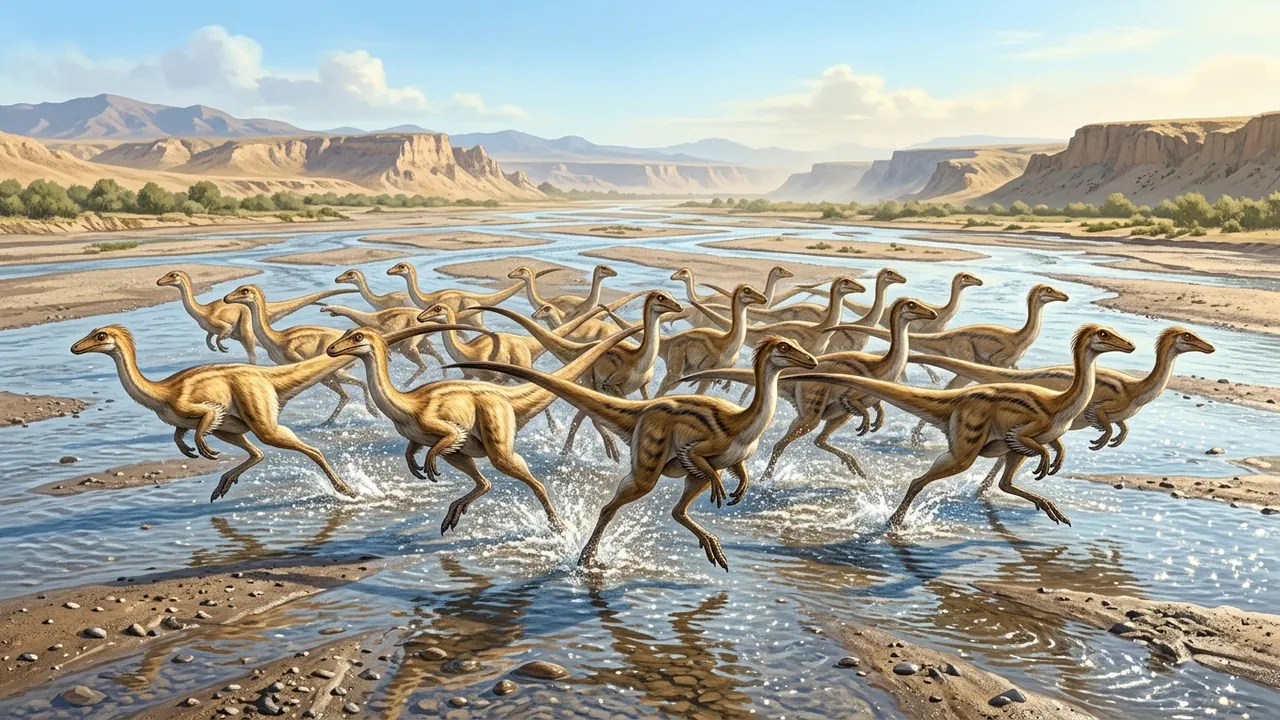
Meet the Legend: Giant Ostrich-Mimic Sprinter
Not every two-legged theropod dinosaur used sharp teeth and curved claws to hunt big game! Meet Gallimimus bullatus, whose Latin name means chicken mimic. Stretching twenty feet from its toothless bill to the tip of its feathered tail and weighing 900 to 970 pounds, Gallimimus was the largest member of the ostrich-dinosaur family ever discovered.
Standing taller at the head than a doorway, its sleek body featured a long, S-curved neck, fluffy golden-brown feathers, and broad ornamental wing plumes draping from its forearms. Hollow bones filled with air pockets served as a lightweight physical that kept this half-ton runner remarkably nimble.
Every who examines Gallimimus admires how evolution reshaped a meat-eating ancestor's two-legged body plan into a gentle, fleet-footed sprinter built for open Asian river valleys! Instead of heavy teeth or slashing talons, pure athletic grace became its winning ticket across prehistoric floodplains.
Lost World Habitat: Nemegt Rivers & Oases
Around 70 million years ago during the Late Cretaceous Period, Gallimimus thrived in a lush river-delta across what is now southern Mongolia. Wide, braided rivers carried cool mountain water across sandy plains, creating wet floodplains, shallow marshes, and shady forests of towering conifers, ginkgoes, water lilies, and horsetails.
Warm wet seasons brought booming insect swarms and fresh green shoots, followed by cooler dry months when animals gathered near deep river bends. Traveling together in watchful flocks was a vital behavioral across flat, open sandbars where giant predators lurked inside forest edges.
Across the globe, wet Mesozoic river flats recorded dinosaur motion in stone. Just as muddy stream banks in Virginia's Culpeper Basin preserved crisp three-toed theropod sprint trackways in hardened sandstone, Mongolia's river sandstones preserved entire skeletons of swift Gallimimus herds!
What's on the Prehistoric Menu?
Where did a twenty-foot, toothless sprinter fit inside its wetland ? Gallimimus thrived as an adaptable , linking green producers and tiny invertebrate consumers together! In 2001, scientists studying a beautifully preserved Gallimimus skull noticed paper-thin, comb-like ridges lining the inside of its fossilized upper and lower beak.
Much like modern ducks and flamingos, Gallimimus dipped its flat bill into shallow river mud to strain tiny crustaceans, water snails, seeds, and soft aquatic plants! On dry riverbanks, its sharp eyesight helped it snap up crunchy beetles, grasshoppers, frogs, and small lizards.
Because it lacked grinding molars, Gallimimus swallowed smooth river pebbles into a muscular stomach pouch as a digestive . Churning together like millstones, those stones mashed tough plant fibers and insect shells into rich fuel for high-speed running!
Superpowers, Senses & High-Speed Anatomy
From snout to toe tip, Gallimimus showcased one extraordinary structural after another for blazing speed! Its shin bones grew noticeably longer than its thigh bones, stretching each running stride wide across firm river sand. Even cooler, the three long bones inside each foot pressed tightly together like shock-absorbing springs so landings at 35 miles per hour would not crack ankles!
Short, blunt, hoof-like claws gripped wet mud like track cleats, while a stiffened horizontal tail swung smoothly to keep its heavy body balanced around sweeping curves.
High on its delicate skull sat huge, round eyes facing sideways rather than straight ahead. That wide-angle vision gave this watchful nearly wrap-around sight across its open , spotting a stalking predator in tall ferns long before an ambush could begin! Even while dipping its head low to sip water, Gallimimus kept scanning every riverbank around the flock.
Flight vs. Fight Arena: Pure Speed Wins!
Not every prehistoric survivor needed horns, tail clubs, or bone-crushing jaws! In the Flight versus Fight arena, Gallimimus stood proudly as an undisputed champion of Team Flight. Sharing its Mongolian river was Tarbosaurus bataar, a forty-foot, five-ton apex tyrannosaur sitting at the very top of the !
Against jaws packed with sixty serrated, bone-snapping teeth, a thin-boned, toothless Gallimimus had zero chance in a standing brawl. Instead, each behavioral and physical worked in harmony: sentinel herd members scanned tree lines with giant side-set eyes and sounded instant warning calls whenever bushes rustled along the muddy shore.
Bursting forward at 30 to 35 miles per hour, the entire feathered flock banked and weaved across wide river shallows! Because five-ton Tarbosaurus risked dangerous falls if it sprinted recklessly over slippery mud, swift evasion saved Gallimimus time after time.
Fossil Detective Secrets: Women Pioneers of the Gobi
Gallimimus owes its scientific fame to one of history's most inspiring expedition teams! Between 1963 and 1971, trailblazing Polish Zofia Kielan-Jaworowska organized joint Polish-Mongolian expeditions across the remote Gobi Basin. Braving blazing heat and rugged canyons, her crew excavated several spectacular Gallimimus skeletons from pale river sandstones!
In 1972, paleontologists Halszka Osmolska, Ewa Roniewicz, and Mongolian colleague Rinchen Barsbold officially named Gallimimus bullatus, honoring a rounded, bulb-shaped capsule on the underside of its braincase.
Decades later, new fossils of close North American cousin Ornithomimus preserved dark carbonized feather traces, showing babies wore fuzzy down before adults grew showy wing fans! Every paleontologist studying these discoveries celebrates how careful detective work revealed a fast, feathered thriving peacefully through sheer athletic grace across ancient Asian river plains for millions of years.