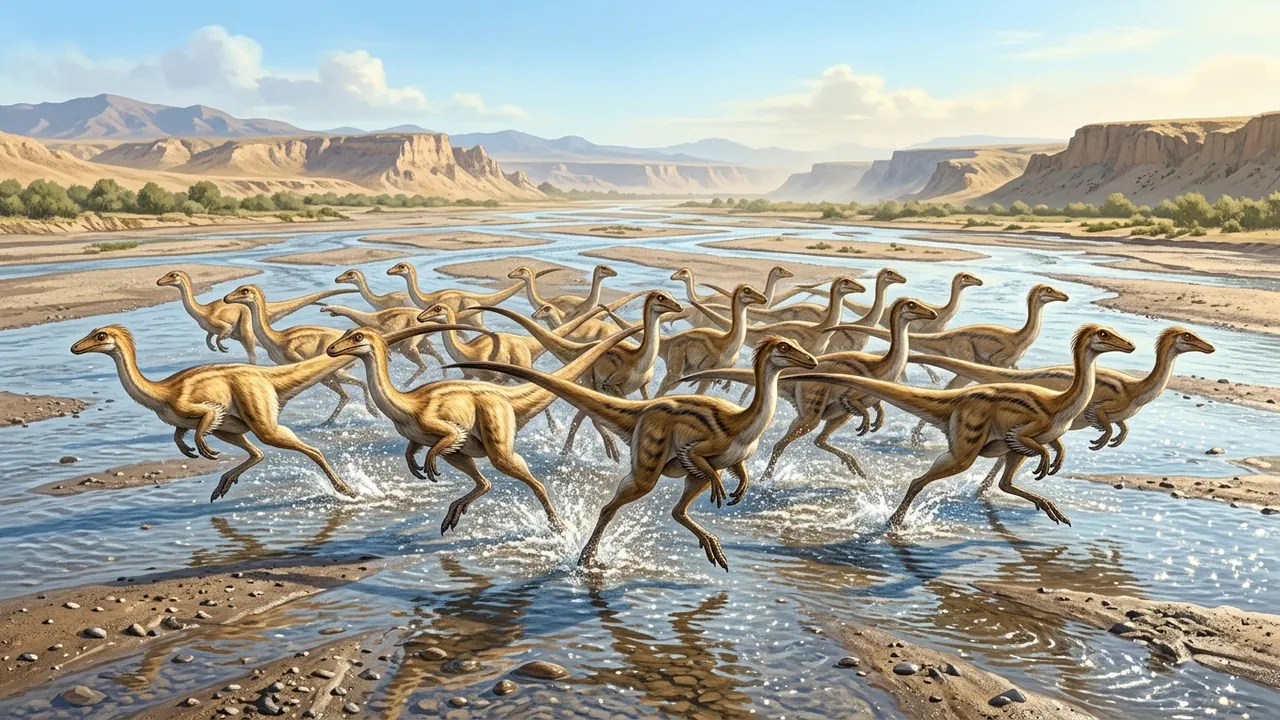
Meet the Legend: Racehorse-Weight Ostrich Dino
Imagine an ostrich puffed up until it stretched twenty feet long—as long as a family pickup truck—and weighed nearly 1,000 pounds like a thoroughbred racehorse! That was Gallimimus, the biggest ostrich-mimic dinosaur ever discovered. Even though its name means chicken mimic, an adult stood taller than a basketball player's raised hand!
Soft, golden-brown fluffed across its neck and body, while longer display feathers draped from its three-fingered arms. Built for pure speed rather than biting, this gentle raced across ancient Asia on two powerhouse legs!
Lost World Habitat: Lush Mongolian River Deltas
Seventy million years ago during the Late Cretaceous Period, Gallimimus lived in a lush river across southern Mongolia. Braided streams wound between sandy islands, lily-pad ponds, and tall forests of dawn redwoods, ginkgoes, and ferns. Unlike dry sand-dune regions nearby, fresh water sparkled everywhere during warm rainy months!
Flocks of Gallimimus preened their water-resistant along open mudflats where everyone had a clear view of the trees. They shared these waterways with giant long-clawed Therizinosaurus, duck-billed Saurolophus, armored ankylosaurs, and hungry tyrannosaur Tarbosaurus.
What's on the Prehistoric Menu?
Because Gallimimus was a flexible , almost every pond and meadow offered tasty snacks! Its long, flat snout ended in a smooth keratin beak with zero teeth. When paleontologists examined fossilized beak impressions under microscopes, they spotted rows of tiny comb ridges lining the edges—just like the strainer inside a mallard duck's bill!
Wading through a muddy , Gallimimus dabbed water to strain tiny shrimp, snails, and tender water weeds, or plucked seeds, beetles, and small lizards ashore. Swallowed pebbles inside its muscular mashed tough food smoothly!
Superpowers: Giant Strides & 360-Degree Sight
Every bone in Gallimimus screamed speed! Unlike heavy plodders with thick thigh bones, Gallimimus had extra-long shin bones and tightly locked foot bones that absorbed shock like pogo-stick springs. Each bounding covered huge ground, pushing top speed up to 35 miles per hour—faster than cars cruising down a neighborhood street!
Hollow air pockets kept its skeleton super light, while a stiff, feathered tail worked like a steering rudder. Huge eyes set flat on the sides of its narrow head spotted sneaking predators almost all the way around!
Flight vs. Fight Arena: Outrunning a Tyrant!
What happened when five-ton Tarbosaurus—Mongolia's giant cousin of Tyrannosaurus rex—charged out of the trees onto the open river ? With a toothless beak, light belly, and thin skin, Gallimimus never tried to wrestle a forty-foot predator! Instead, it proved why Team Flight is one of nature's smartest survival superpowers.
Dozens of watchful eyes spotted danger early. Exploding into a synchronized 35-mph sprint, the agile flock zig-zagged in wide, splashing arcs! Within seconds, each long left lumbering Tarbosaurus huffing far behind in the wet sand.
Fossil Detective Secrets: Desert Expeditions!
During hot summers between 1963 and 1965, pioneering Polish paleontologist Zofia Kielan-Jaworowska led daring joint expeditions with Mongolian scientists deep into the Gobi Basin. Chipping into pale river-channel sandstones from an ancient , her team uncovered multiple Gallimimus skeletons ranging from a tiny two-foot youngster to twenty-foot adults!
Named officially in 1972 by three women and Mongolian researchers, Gallimimus amazed museums worldwide. Later fossils of close ostrich-dinosaur cousins preserved actual feather marks and stones, proving this gentle wore warm as it sprinted across prehistoric Asia!